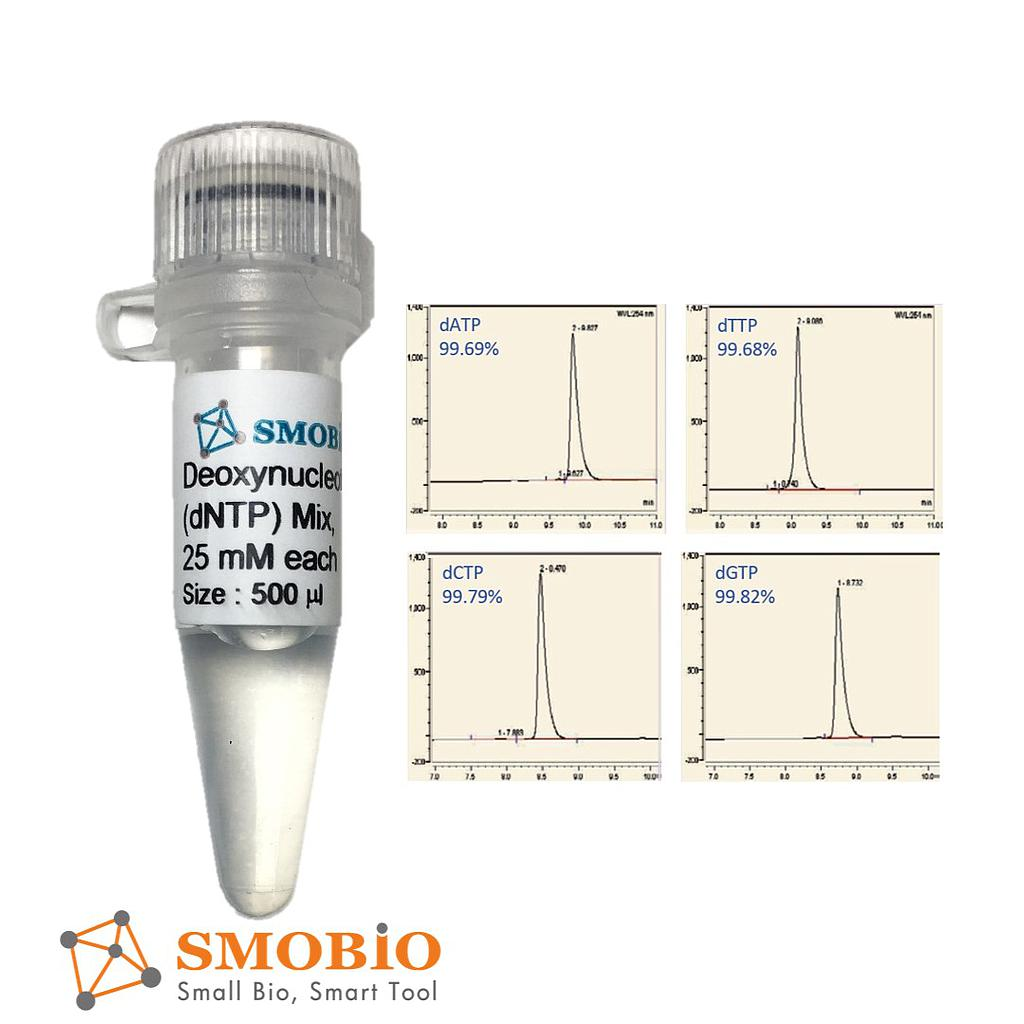
[CD1021] SMOChem™ Deoxynucleotide (dNTP) Mix, 25 mM each (100 mM total), 500 µl x 6
Facebook
X
Pinterest
Email
The SMOChem™ Deoxynucleotide (dNTP) Mix is an aqueous solution that contains an equimolar solution of ultrapure dATP, dCTP, dGTP and dTTP, each at a concentration of 25 mM at pH 8.5. The dNTP Mix is designed for many different molecular biology applications that involved in DNA synthesis or labeling, such as PCR, real-time PCR, DNA sequencing, reverse transcription, primer extension, and etc. The dNTP Mix is free of exo-deoxyribonuclease and endo-deoxyribonuclease as well as ribonuclease activity. The dNTP Mix offers the possibility to reduce the number of pipetting steps and the risk of reaction set up errors.
Detail
Description
The SMOChem™ Deoxynucleotide (dNTP) Mix is an aqueous solution that contains an equimolar solution of ultrapure dATP, dCTP, dGTP and dTTP, each at a concentration of 25 mM at pH 8.5. The dNTP Mix is designed for many different molecular biology applications that involved in DNA synthesis or labeling, such as PCR, real-time PCR, DNA sequencing, reverse transcription, primer extension, and etc. The dNTP Mix is free of exo-deoxyribonuclease and endo-deoxyribonuclease as well as ribonuclease activity. The dNTP Mix offers the possibility to reduce the number of pipetting steps and the risk of reaction set up errors.
Norgen’s Legionella sp. TaqMan PCR Kit is designed for the detection of Legionella sp. specific DNA in a real-time PCR based on the use of TaqMan technology. This kit is designed for research use only and not for use in diagnostic procedures. The detection of Legionella sp. specific DNA is based on TaqMan PCR providing a simple, reliable and rapid result for the detection of Legionella sp. infection. Norgen’s Legionella sp. TaqMan PCR Kit includes a PCR control to monitor for PCR inhibition, and to validate the quality of the sample and the detection result. The Legionella sp. TaqMan PCR Kit comprises Master Mix for the target and PCR control detection, Primer & Probe Mix, as well as a positive control and a negative control (nuclease-free water) to confirm the integrity of the kit reagents.
Legionella sp. TaqMan PCR Kit, 100 reactions
Ready to use format, including Master Mix for the target and PCR control to monitor for PCR inhibition and validate the quality
Specific Primer and Probe mix for the pathogen/virus/viroid of interest
Primer and Probe mix
Positive and negative control to confirm the integrity of the kit reagents
Legionella sp. TaqMan PCR Probe/Primer Set and Controls, 100 reactions
Specific Primer/Probe mix and Positive Control for the pathogen/virus/viroid of interest
Nuclease-free water
Can be used together with Norgen’s PCR Master Mix (#28007) or customer supplied master mix
For research use only and NOT intended for in vitro diagnostics.
Storage Conditions and Product Stability All kit components can be stored for 2 years after the date of production without showing any reduction in performance.
All kit components should be stored at -20°C upon arrival. Repeated thawing and freezing (> 2 x) of the Master Mix and Positive Control should be avoided, as this may affect the performance of the assay. If the reagents are to be used only intermittently, they should be frozen in aliquots.
Nucleic acid testing (NAT) is the method of choice for detection and quantification of a wide range of micro organisms. Primerdesign manufactures and supplies high quality quantitative real-time PCR kits for the detection and simultaneous quantification of numerous significant pathogens. A copy number standard curve is provided for quantification and an the internal extraction template (DNA or RNA), controls for the quality of the nucleic acid extraction and eliminates false negative results.
The kit is designed with the broadest possible detection profile to ensure that all clinically relevant strains and subtypes are detected. Target sequences are selected by working with data from key opinion leaders in the field. Multiple sequence alignments and unprecedented real-time PCR expertise in design and validation ensure the best possible kit.
Details of the target and priming specificity are included in the individual handbooks above.
Packaged, optimised and ready to use. Expect Better Data.
Document
Exceptional value for money Rapid detection of all clinically relevant subtypes Positive copy number standard curve for quantification Highly specific detection profile High priming efficiency Broad dynamic detection range (>6 logs) Sensitive to < 100 copies of target
Accurate controls to confirm findings
150 reactions