
Description
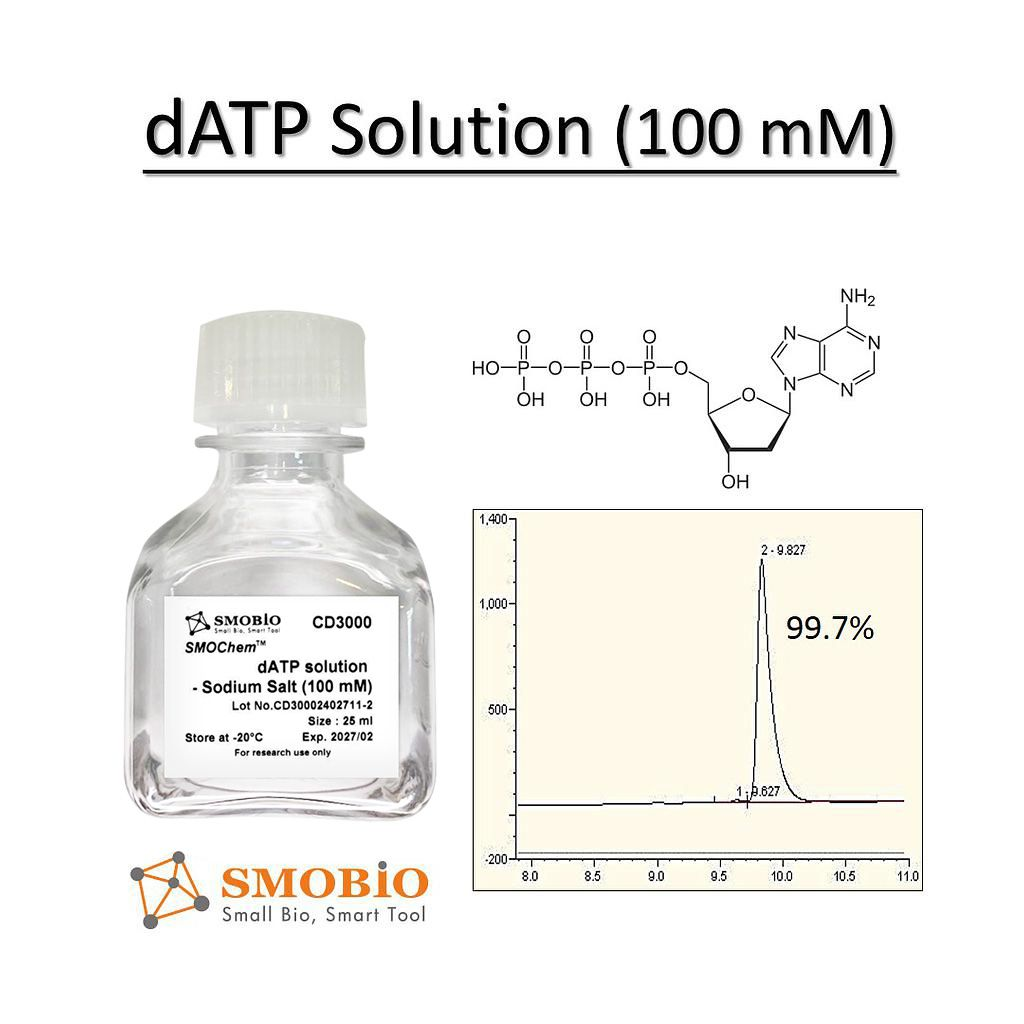
Ultrapure dATP supplied as sodium salt in purified water (pH 8.5).
Features
- Ideal for PCR amplification and cDNA synthesis
- Nuclease and ribonuclease free
Applications
- PCR
- A-Tailing with Taq DNA Polymerase
Storage
-20°C for 36 months

Description
Ultrapure dATP supplied as sodium salt in purified water (pH 8.5).
Features
Applications
Storage
-20°C for 36 months

Bis-propargyl-PEG3 is a crosslinker with alkyne groups at both ends of the molecule. The alkyne groups react with azide-bearing compounds or biomolecules via copper catalyzed Click Chemistry to form a stable triazole linkage. Reagent grade, for research purpose. Please contact us for GMP-grade inquiries.

Bis-propargyl-PEG3 is a crosslinker with alkyne groups at both ends of the molecule. The alkyne groups react with azide-bearing compounds or biomolecules via copper catalyzed Click Chemistry to form a stable triazole linkage. Reagent grade, for research purpose. Please contact us for GMP-grade inquiries.

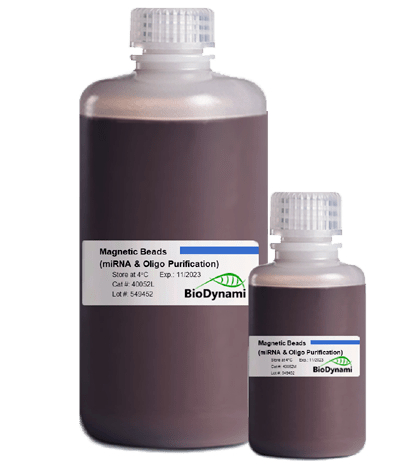
Solid Phase Reversible Immobilization magnetic beads are often used for DNA purification because they are simple, fast, and effective. The beads are paramagnetic particles coated with carboxyl groups that reversibly bind to nucleic acid. However, Standard SPRI beads can only purify DNA/RNA fragments that are 100 base pairs or longer. DNA/RNA fragments shorter than 100 base pairs are not effectively recovered by SPRI beads. We have developed Magnetic Beads (microRNA & Oligo Purification) to solve the problem.
With our proprietary beads technology, the beads overcomes the hurdle of the short DNA/RNA recovery problem. The magnetic beads is ideal for microRNA purification, oligo purification, short DNA/RNA purification, and removing impurities and unwanted components such as dNTPs, detergents, salts, proteins, and other contaminants effectively. The magnetic bead reagents are RNase-free and can be used for both DNA and RNA applications.
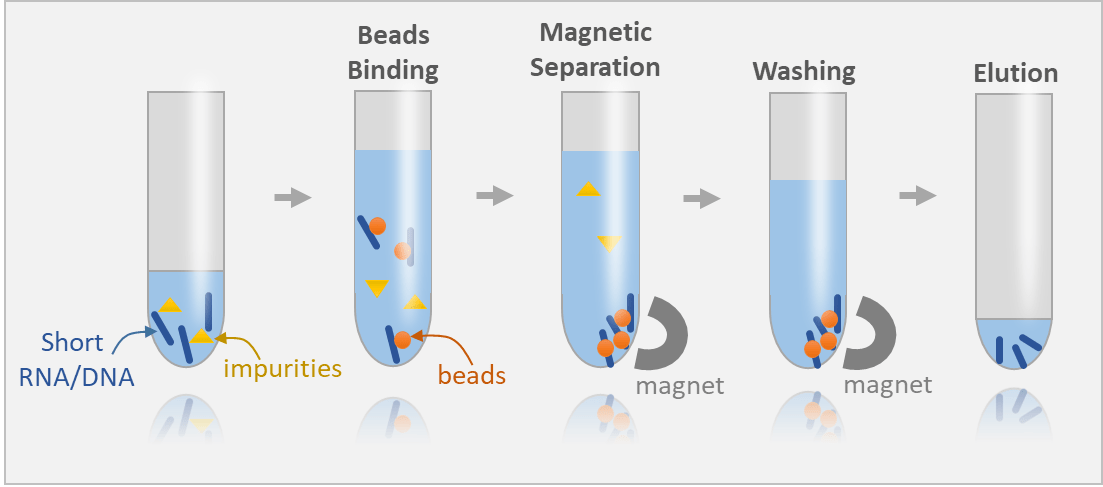
Our magnetic beads are optimized for microRNA purification, oligo purification, and DNA/RNA purification. The fragments can be as short as 20 bases, such as microRNA, tRNA, dsDNA fragments 20 bp or longer, ssDNA fragments 20 nt or longer, RNA fragments 20 nt or longer, DNA/RNA hybrid fragments 20 bp or longer, and oligos and chimeric oligos 20 nt or longer. Purified short DNA and RNA fragments are ideal for applications requiring high-quality fragments, as the fragments are free of impurities and contaminants.
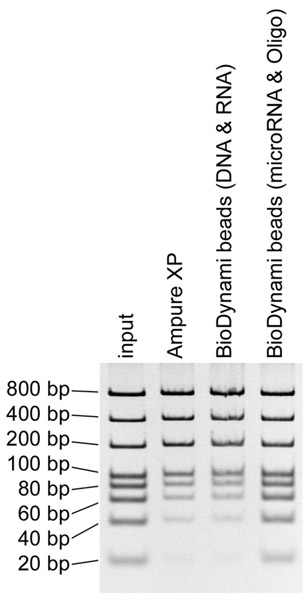
Comparison of short DNA fragments recovery. BioDynami 20 bp DNA ladder (Cat. # 10002) was used as DNA input. Ampure XP beads, BioDynami beads (DNA & RNA purification) and BioDynami beads (microRNA & Oligo purification) were tested. Only BioDynami beads (microRNA & Oligo purification) successfully recovered DNA fragments between 20-100 bp.
Recovery of DNA and RNA oligos with BioDynami magnetic Beads (microRNA & Oligo Purification). 20 nt of DNA oligos and RNA oligos were used as input. Input and recovered oligos were quantified with BioDynami ssDNA Quantification kit (Cat. # 40043) and BioDynami RNA Quantification kit (Cat. # 40044).
Features

Designed for those labs wishing to separate magnetic beads into rings.
The Permagen ring magnet low elution plate with integrated cushion base plate was designed for use in automation applications where volumes as low as 5 µL are required. Most PCR plates are bent, leading to inconsistent lab results. Unlike most products, we have added an angled frame around the top of our plate, this helps with two things, straightening out the PCR plate, and leading it to the proper location on the magnets during automation while the cushion assist compensates for labware inconsistencies.
SBS SLAS Footprint (127.75mm x 85.50mm) to fit into any automated liquid handling robot
Features include solid aluminum alloy construction and hard coat anodized finish for years of trouble-free use, and compatible with any magnetic beads
RLE500R
Maximum – 150 µL
Minimum – 5 µL
Designed for those labs wishing to separate magnetic beads into rings.
The Permagen ring magnet low elution plate with integrated cushion base plate was designed for use in automation applications where volumes as low as 5 µL are required. Most PCR plates are bent, leading to inconsistent lab results. Unlike most products, we have added an angled frame around the top of our plate, this helps with two things, straightening out the PCR plate, and leading it to the proper location on the magnets during automation while the cushion assist compensates for labware inconsistencies.