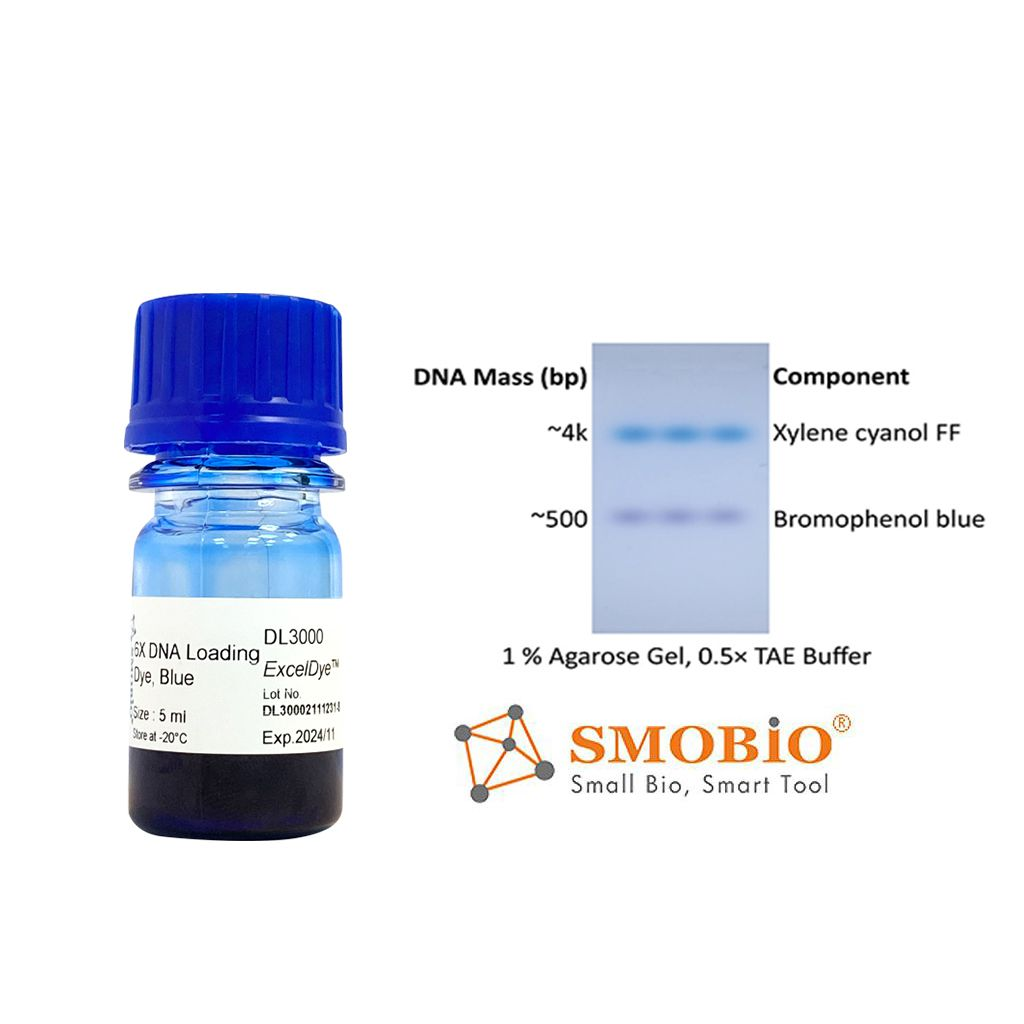
[DL3000] ExcelDye™ 6X DNA Loading Dye, Blue, 5 ml x 2
Facebook
X
Pinterest
Email
The ExcelDye™ 6× DNA Loading Dye (Blue) is pre-mixed buffer for tracking the DNA sample during the electrophoresis on agarose or polyacrylamide gels. It contains two dyes (Xylene cyanol FF and Bromophenol blue) for tracking the DNA migration. The Xylene cyanol FF and Bromophenol blue migrate at approximately 800 bp and 150 bp on a standard 2% TAE agarose gel respectively (4,000 bp and 500 bp on 1% TAE agarose gel respectively). The included glycerol keeps the DNA at the bottom of the well and the presence of EDTA chelates divalent metal ions to prevent the process of metal-dependent nuclease.
Detail
Description
The ExcelDye™ 6× DNA Loading Dye (Blue) is pre-mixed buffer for tracking the DNA sample during the electrophoresis on agarose or polyacrylamide gels. It contains two dyes (Xylene cyanol FF and Bromophenol blue) for tracking the DNA migration. The Xylene cyanol FF and Bromophenol blue migrate at approximately 800 bp and 150 bp on a standard 2% TAE agarose gel respectively (4,000 bp and 500 bp on 1% TAE agarose gel respectively). The included glycerol keeps the DNA at the bottom of the well and the presence of EDTA chelates divalent metal ions to prevent the process of metal-dependent nuclease.
Composition
0.03% Xylene cyanol FF
0.03% Bromophenol blue
10 mM Tris-HCl (pH 8.0)
60% glycerol
60 mM EDTA
Storage
4°C for 12 months -20°C for 36 months
Other Products
DBCO-C3-PEG4-amine
Product Info
Document
Product Info
DBCO-C3-PEG4-amine is a PEG linker which contains DBCO and amine moieties. The DBCO group is commonly used in copper-free Click Chemistry reactions. The amine group is reactive with carboxylic acids, activated NHS esters, carbonyls (ketone, aldehyde) etc. The hydrophilic PEG spacer increases solubility in aqueous media. Reagent grade, for research purpose. Please contact us for GMP-grade inquiries.
Document
DBCO-C3-PEG4-amine is a PEG linker which contains DBCO and amine moieties. The DBCO group is commonly used in copper-free Click Chemistry reactions. The amine group is reactive with carboxylic acids, activated NHS esters, carbonyls (ketone, aldehyde) etc. The hydrophilic PEG spacer increases solubility in aqueous media. Reagent grade, for research purpose. Please contact us for GMP-grade inquiries.
Extraction RNA Nucleic Acid Reagent With 12 Months Shelf Life
Product Info
Document
Product Info
Product Description
Nucleic Acid Extraction Reagent – RNA Extraction Kit with 12 Months Shelf Life
Product Description:
Amp-future Bio’s Nucleic Acid Extraction Reagent is a RNA extraction kit that provides the highest quality nucleic acid extraction. The RNA extraction kit is an automated nucleic acid extractor which allows for quick and easy RNA isolation. The reagent is in liquid form and has a shelf life of 12 months, making it a reliable and durable product. With the Nucleic Acid Extraction Reagent, Amp-future Bio provides the accuracy and reliability of a professionally designed RNA extraction kit.
Features:
Product Name: RNA Nucleic Acid Extraction Reagent
Brand: Amp-future Bio
Form: Liquid
Shelf Life: 12 Months
Application: RNA Extract
Keywords: RNA Extraction Kit
Technical Parameters:
Property
Value
Form
Liquid
Product Name
RNA Nucleic Acid Extraction Reagent
Application
RNA Extraction
Brand
Amp-future Bio
Shelf Life
12 Months
Composition
5ml*4 tubes
Applications:
Amp-future Bio’s Nucleic Acid Reagent is an advanced automated nucleic acid extraction solution designed to efficiently extract RNA from biological samples while maintaining quality and accuracy. It is made in China and has a 12-month shelf life. It comes in a liquid form and is suitable for use in automated nucleic acid extractors, allowing for automatic and highly efficient extraction of nucleic acid from various sample types. The reagent is also designed to be easy to use, making it an ideal solution for laboratories that require fast and reliable results. This reagent is a great choice for any research or clinical laboratory that needs efficient and accurate nucleic acid extraction.
Support and Services:
Technical Support and Services for Nucleic Acid Reagent We provide technical support and services for Nucleic Acid Reagents. Our experts are available to help you identify the right reagents for your application, answer any questions, and provide assistance on the use and optimization of these reagents. Our experts are also available to provide advice on troubleshooting and protocol optimization. We offer a range of services to make ordering and stocking of reagents easy and convenient.
We provide:
Expert advice on the selection of the right reagents for your application
Free samples for evaluation
Bulk and custom orders
Technical support and troubleshooting assistance
Secure and reliable online ordering
Fast and convenient shipping options
Please contact us for more information about our technical support and services for nucleic acid reagents.
Document
Amp-future Bio’s Nucleic Acid Extraction Reagent is a RNA extraction kit that provides the highest quality nucleic acid extraction. The RNA extraction kit is an automated nucleic acid extractor which allows for quick and easy RNA isolation. The reagent is in liquid form and has a shelf life of 12 months, making it a reliable and durable product. With the Nucleic Acid Extraction Reagent, Amp-future Bio provides the accuracy and reliability of a professionally designed RNA extraction kit.