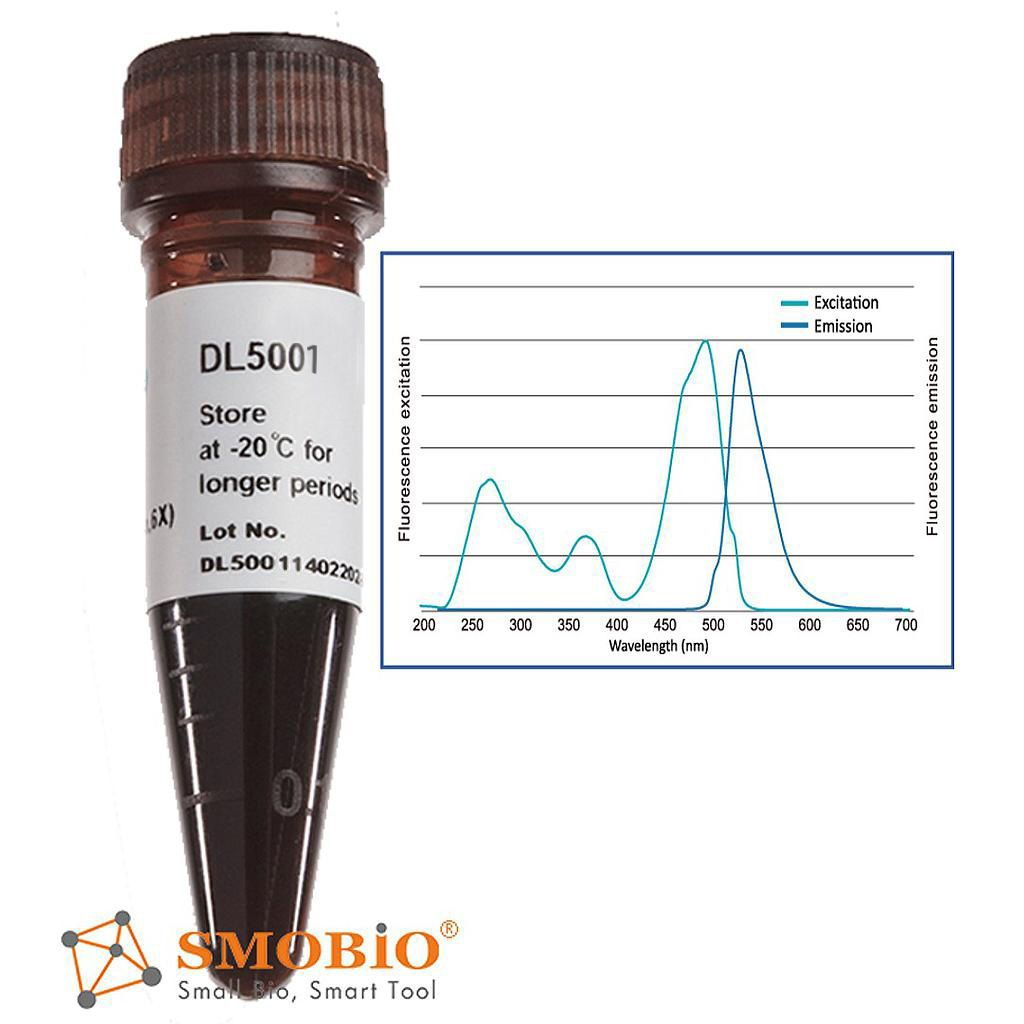
[DL5001] FluoroDye™ DNA Fluorescent Loading Dye (Green, 6X), 1 ml x 5
Facebook
X
Pinterest
Email
FluoroDye™ DNA Fluorescent Loading Dye is a ready-to-use 6X DNA loading dye designed for fast qualitative electrophoresis analysis. Containing sensitive fluorescent dye with high specific affinity towards double stranded DNA (dsDNA), the FluoroDye™ Fluorescent DNA Loading Dye has negligible background and renders destaining process unnecessary. The FluoroDye™ DNA Fluorescent Loading Dye allows the user to immediately visualize electrophoresis result upon completion or to monitor the electrophoresis in real time. FluoroDye™ DNA Fluorescent Loading Dye is compatible with both the conventional UV gel-illuminating system as well as the less harmful long wavelength blue light illumination system. FluoroDye™ emission as bound to dsDNA is 522 nm, while its excitation peaks are at 270, 370 and 497 nm.
Detail
Description
FluoroDye™ DNA Fluorescent Loading Dye is a ready-to-use 6X DNA loading dye designed for fast qualitative electrophoresis analysis. Containing sensitive fluorescent dye with high specific affinity towards double stranded DNA (dsDNA), the FluoroDye™ Fluorescent DNA Loading Dye has negligible background and renders destaining process unnecessary. The FluoroDye™ DNA Fluorescent Loading Dye allows the user to immediately visualize electrophoresis result upon completion or to monitor the electrophoresis in real time. FluoroDye™ DNA Fluorescent Loading Dye is compatible with both the conventional UV gel-illuminating system as well as the less harmful long wavelength blue light illumination system. FluoroDye™ emission as bound to dsDNA is 522 nm, while its excitation peaks are at 270, 370 and 497 nm.
Features:
Excellent for premix with DNA samples
Sensitivity: 0.14 ng (DNA)
A safer alternative to EtBr
Compatibility: suitable to blue or UV light
Increased cloning efficiency (blue light)
Composition
FluoroDye™ DNA Fluorescent Loading Dye is stored in 6X concentration in 60% glycerol and buffered with Tris-HCl and EDTA, containing Bromophenol blue, Xylene cyanol FF and Orange G as tracking dyes.
Storage
Protected from light -20°C for 24 months
Other Products
[PM5200] ExcelBand™ 3-color Pre-Stained Protein Ladder, Broad Range (3.5-245 kDa), 250 μl x 2
Product Info
Document
Product Info
Description
The PM5200 3-color Pre-Stained Protein Ladder Broad Range is a ready-to-use three-color protein standard with 15 pre-stained proteins covering a wide range of molecular weights from 5 to 245 kDa in Tris-Glycine Buffer (3.5 to 235 kDa in Bis-Tris (MOPS) buffer and Bis-Tris (MES) buffer). Proteins are covalently coupled with different chromophores for easy identification of bands, with three reference proteins carrying enhanced intensity corresponding to a blue band at 20 kDa, green at 40 kDa, and red at 75 kDa, respectively, as separated on SDS-PAGE (Tris-Glycine buffer). The PM5200 3-color Pre-Stained Protein Ladder Broad Range is designed for monitoring protein separation during SDS-polyacrylamide gel electrophoresis, verification of Western transfer efficiency on membranes (PVDF, nylon, or nitrocellulose) and for approximating the size of proteins.
Features
Ready-to-use — Premixed with a loading buffer for direct loading, no need to boil.
Three reference bands — 75 kDa (red), 40 kDa (green), and 20 kDa (blue)
Contents
Approximately 0.1~0.4 mg/ml of each protein in the buffer (20 mM Tris-phosphate (pH 7.5 at 25°C), 2% SDS, 0.2 mM DTT, 3.6 M urea, and 15% (v/v) glycerol).
Quality Control
Under suggested conditions, PM5200 ExcelBand™ 3-color Pre-Stained Protein Ladder Broad Range resolves 15 major bands in SDS-PAGE (Tris-Glycine, MOPS, and MES buffer) and after Western blotting to nitrocellulose membrane.
Storage
4°C for 3 months -20°C for long term storage
Document
The PM5200 3-color Pre-Stained Protein Ladder Broad Range is a ready-to-use three-color protein standard with 15 pre-stained proteins covering a wide range of molecular weights from 5 to 245 kDa in Tris-Glycine Buffer (3.5 to 235 kDa in Bis-Tris (MOPS) buffer and Bis-Tris (MES) buffer). Proteins are covalently coupled with different chromophores for easy identification of bands, with three reference proteins carrying enhanced intensity corresponding to a blue band at 20 kDa, green at 40 kDa, and red at 75 kDa, respectively, as separated on SDS-PAGE (Tris-Glycine buffer). The PM5200 3-color Pre-Stained Protein Ladder Broad Range is designed for monitoring protein separation during SDS-polyacrylamide gel electrophoresis, verification of Western transfer efficiency on membranes (PVDF, nylon, or nitrocellulose) and for approximating the size of proteins.
Attogene’s Montmorillonite Bentonite Clay binds toxins with high affinity and high capacity. Montmorillonite has been shown to be the active ingredient in bentonites. The proposed mechanism of action of Attogene’s Montmorillonite Bentonite Clay is through the adsorption of toxins (mainly onto the interlayer spaces of montmorillonite). Attogene’s Montmorillonite Bentonite Clay is a common anti-caking agent in animal feeds to adsorb aflatoxins and diminish their bioavailability. Its composite for application in drug system can be formed through the utilization of anionic, cationic, and nonionic surfactants.
Bentonite is a promising rock of clay which is found in nature. It is a major source of montmorillonite in nature. It is a rock produced of highly colloidal and plastic clays mainly comprised of montmorillonite. In addition to montmorillonite, bentonite may compose of some amount of crystalline quarz, cristobalite, and feldspar. Montmorillonite nanoclay is used as a drug carrier system and as an additive. Its composite for application in drug system can be formed through the utilization of anionic, cationic, and nonionic surfactants. These are used to improve basal spacing resulting in organo clay to be utilised in drug loading and drug release.
Document
Promotes flocculation of cyanobacteria cell debris, binds residual phosphate compounds and promotes gradual settling of the cyanobacterial biomass on the sediment.
Rapid isolation of both small and large species of DNA from urine
Convenient spin column format
Effective removal of PCR inhibitors
Purified DNA is highly suited to sensitive downstream applications
Allows for the purification of viral DNA from urine
Both high molecular weight DNA (greater than 1 kb in size; mostly cell associated) and the smaller DNA (150 – 250 bp; derived from the circulation) is effectively isolated and purified using a rapid and convenient spin column protocol. This kit can be used to isolate DNA from a broad range of viruses in urine as well. Salts, metabolic wastes, proteins and other contaminants are removed to yield inhibitor-free DNA for use in sensitive applications. The DNA is of excellent quality for various downstream applications such as PCR, qPCR and DNA fingerprinting, methylation studies and more.
This kit provides a fast, reliable and simple procedure for isolating DNA from urine volumes ranging from 50 μL to 1.75 mL of urine. Multiple samples can be processed in 30 minutes.
Urine DNA Isolation Kit (Slurry Format)
This kit provides a fast, reliable and simple procedure for isolating DNA from urine volumes ranging from 3 mL to 25 mL. Multiple samples can be processed in 30 minutes. Multiple samples can be processed in 45 minutes.
Urine DNA Isolation Maxi Kit (Slurry Format)
This kit provides a fast, reliable and simple procedure for isolating DNA from urine volumes ranging from 25 mL of urine up to 80 mL. Multiple samples can be processed in 45 minutes.
Background
DNA found in urine can be divided into 2 basic categories. The larger species, genomic-DNA (gDNA), is generally greater than 1 kb in size, and appears to be derived mainly from exfoliated cells. The second species is smaller, generally between 150 and 250 bp (apoptotic-DNA), and derives, at least in part, from the circulation. The second species is also considered as an RNA/DNA hybrid as reported by Halicka et al. (2000). Both types of DNA can be isolated reliably using this kit.
Storage Conditions and Product Stability All buffers should be kept tightly sealed and stored at room temperature. This kit is stable for 2 years after the date of shipment. It is recommended to warm up Slurry B1 and Lysis Buffer A for 20 minutes at 60°C if any salt precipitation is observed. Slurry B1 contains a grey resin that will not dissolve when warmed.