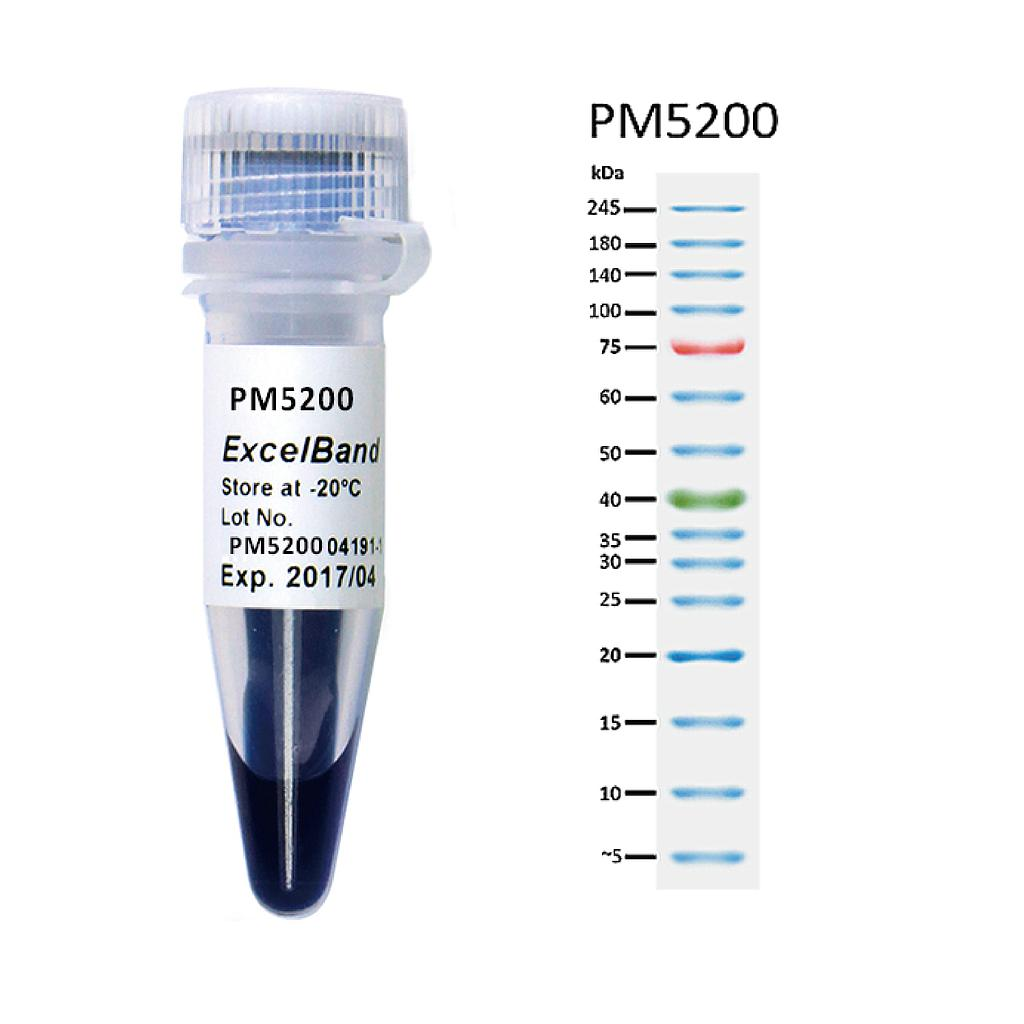
[PM5200] ExcelBand™ 3-color Pre-Stained Protein Ladder, Broad Range (3.5-245 kDa), 250 μl x 2
Facebook
X
Pinterest
Email
The PM5200 3-color Pre-Stained Protein Ladder Broad Range is a ready-to-use three-color protein standard with 15 pre-stained proteins covering a wide range of molecular weights from 5 to 245 kDa in Tris-Glycine Buffer (3.5 to 235 kDa in Bis-Tris (MOPS) buffer and Bis-Tris (MES) buffer). Proteins are covalently coupled with different chromophores for easy identification of bands, with three reference proteins carrying enhanced intensity corresponding to a blue band at 20 kDa, green at 40 kDa, and red at 75 kDa, respectively, as separated on SDS-PAGE (Tris-Glycine buffer). The PM5200 3-color Pre-Stained Protein Ladder Broad Range is designed for monitoring protein separation during SDS-polyacrylamide gel electrophoresis, verification of Western transfer efficiency on membranes (PVDF, nylon, or nitrocellulose) and for approximating the size of proteins.
Detail
Description
The PM5200 3-color Pre-Stained Protein Ladder Broad Range is a ready-to-use three-color protein standard with 15 pre-stained proteins covering a wide range of molecular weights from 5 to 245 kDa in Tris-Glycine Buffer (3.5 to 235 kDa in Bis-Tris (MOPS) buffer and Bis-Tris (MES) buffer). Proteins are covalently coupled with different chromophores for easy identification of bands, with three reference proteins carrying enhanced intensity corresponding to a blue band at 20 kDa, green at 40 kDa, and red at 75 kDa, respectively, as separated on SDS-PAGE (Tris-Glycine buffer). The PM5200 3-color Pre-Stained Protein Ladder Broad Range is designed for monitoring protein separation during SDS-polyacrylamide gel electrophoresis, verification of Western transfer efficiency on membranes (PVDF, nylon, or nitrocellulose) and for approximating the size of proteins.
Features
Ready-to-use — Premixed with a loading buffer for direct loading, no need to boil.
Three reference bands — 75 kDa (red), 40 kDa (green), and 20 kDa (blue)
Contents
Approximately 0.1~0.4 mg/ml of each protein in the buffer (20 mM Tris-phosphate (pH 7.5 at 25°C), 2% SDS, 0.2 mM DTT, 3.6 M urea, and 15% (v/v) glycerol).
Quality Control
Under suggested conditions, PM5200 ExcelBand™ 3-color Pre-Stained Protein Ladder Broad Range resolves 15 major bands in SDS-PAGE (Tris-Glycine, MOPS, and MES buffer) and after Western blotting to nitrocellulose membrane.
Storage
4°C for 3 months -20°C for long term storage
Other Products
Laboratory Large Capacity Freezer Dryer/ Lyophilizer SF7009,SF9009,SF7012,SF9012
Product Info
Document
Product Info
Techinical parameter
ItemNo
SF7009
SF9009
SF7012
SF9012
Ice condenser capacity
9kg
12kg
Ice condenser temperature
-70 C°
90℃
-70 C°
-90℃
Cold trap volume
15L
20L
Freeze dried chamber
High permeability organic glass/multi manifold external valve/stainless steel chamber
Sample shelf
●φ260mm/485mm.Single layer area 0.055m²/0.185m².3-10 layers/optional ● Electric heating/manual capping/optional
Vacuum pump
Extreme vacuum 5*10*mbar with a pumping capacity of 8m³/h optional pump of various types
Oil mist filter
Standard configuration
Vacuum pump connection pipe
Single forming stainless steel flexible pipe DN16 ISO-KF L-1.2m
Anti-corrosive treatment
Cold trap,condensing coil/all equipped with PTFE anti-corrosion treatment as standard. Freeze-drying organic solvents
Rapid isolation of both small and large species of DNA from urine
Convenient spin column format
Effective removal of PCR inhibitors
Purified DNA is highly suited to sensitive downstream applications
Allows for the purification of viral DNA from urine
Both high molecular weight DNA (greater than 1 kb in size; mostly cell associated) and the smaller DNA (150 – 250 bp; derived from the circulation) is effectively isolated and purified using a rapid and convenient spin column protocol. This kit can be used to isolate DNA from a broad range of viruses in urine as well. Salts, metabolic wastes, proteins and other contaminants are removed to yield inhibitor-free DNA for use in sensitive applications. The DNA is of excellent quality for various downstream applications such as PCR, qPCR and DNA fingerprinting, methylation studies and more.
This kit provides a fast, reliable and simple procedure for isolating DNA from urine volumes ranging from 50 μL to 1.75 mL of urine. Multiple samples can be processed in 30 minutes.
Urine DNA Isolation Kit (Slurry Format)
This kit provides a fast, reliable and simple procedure for isolating DNA from urine volumes ranging from 3 mL to 25 mL. Multiple samples can be processed in 30 minutes. Multiple samples can be processed in 45 minutes.
Urine DNA Isolation Maxi Kit (Slurry Format)
This kit provides a fast, reliable and simple procedure for isolating DNA from urine volumes ranging from 25 mL of urine up to 80 mL. Multiple samples can be processed in 45 minutes.
Background
DNA found in urine can be divided into 2 basic categories. The larger species, genomic-DNA (gDNA), is generally greater than 1 kb in size, and appears to be derived mainly from exfoliated cells. The second species is smaller, generally between 150 and 250 bp (apoptotic-DNA), and derives, at least in part, from the circulation. The second species is also considered as an RNA/DNA hybrid as reported by Halicka et al. (2000). Both types of DNA can be isolated reliably using this kit.
30 minutes hands-on time (plus a 1 hour incubation)
* Yield will vary depending on the type of sample processed
Storage Conditions and Product Stability All buffers should be kept tightly sealed and stored at room temperature. This kit is stable for 2 years after the date of shipment. The kit contains a ready-to-use Proteinase K, which is dissolved in a specially prepared storage buffer. The buffered Proteinase K is stable for up to 2 years after the date of shipment when stored at room temperature.
Bis-propargyl-PEG14 is a homobifunctional crosslinker that can participate in Click Chemistry to yield a stable triazole linkage with azide; copper is needed as a catalyst. With PEG chain embedded in the molecule, the hydrophilicity is greatly improved. Reagent grade, for research purpose. Please contact us for GMP-grade inquiries.
Document
Bis-propargyl-PEG14 is a homobifunctional crosslinker that can participate in Click Chemistry to yield a stable triazole linkage with azide; copper is needed as a catalyst. With PEG chain embedded in the molecule, the hydrophilicity is greatly improved. Reagent grade, for research purpose. Please contact us for GMP-grade inquiries.