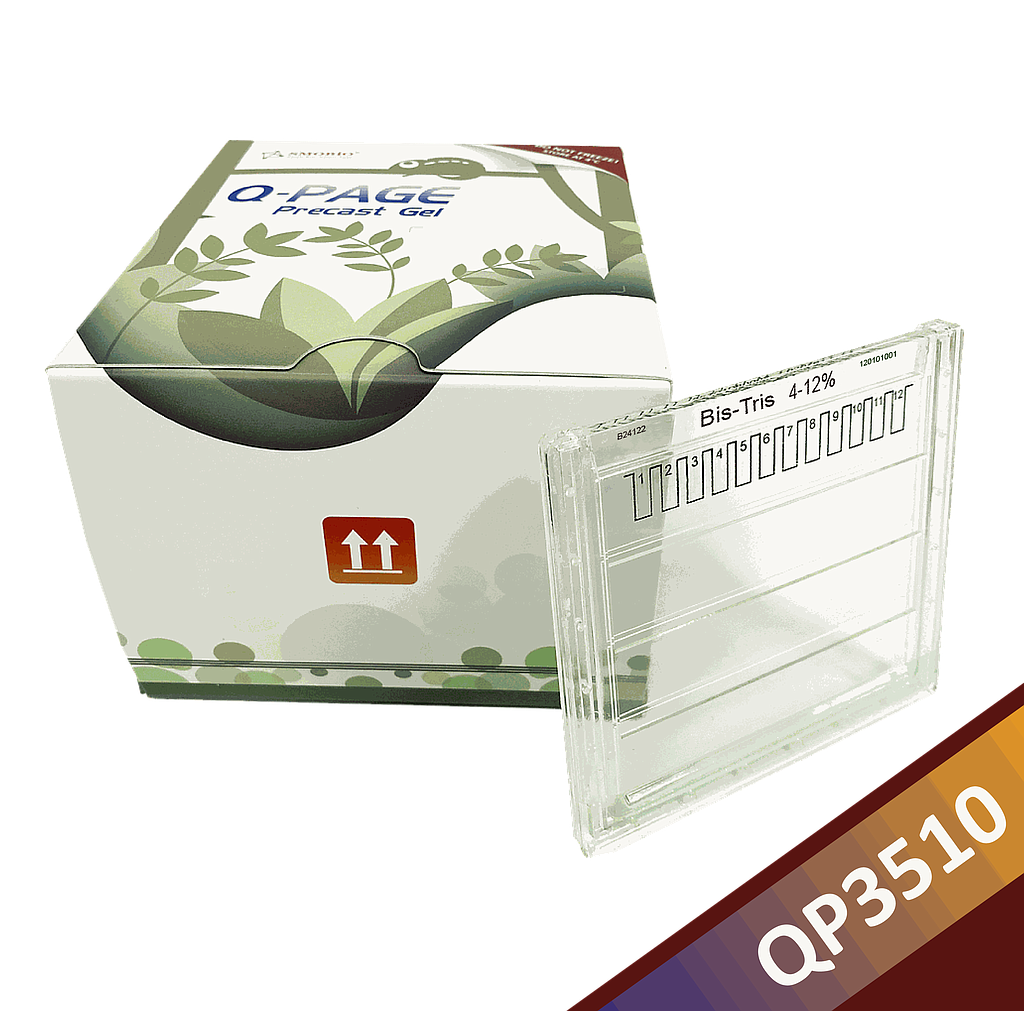
Q-PAGE™ Bis-Tris Precast Gel is a high-performance and easy to use precast polyacrylamide gel for electrophoresis in Bis-Tris buffer system (MOPS or MES). The optimized gel formula allows Q-PAGE™ Bis-Tris Precast Gel to show improved resolution, accurate results, and an extended shelf-life over conventional Laemmli Tris-HCl gels.
Q-PAGE™ Bis-Tris Precast Gels are available in gradient (4 to 12%) and fixed (8% and 12%) concentrations of polyacrylamide in 12-and 15-well formats. Two available cassette sizes, Mini (10 x 8.3 cm) and Midi (10 x 10 cm), are compatible with most popular protein electrophoresis systems. Q-PAGE™ Mini (QP2XXX) Gels are suitable for Bio-Rad® and other systems. Q-PAGE™ Midi (QP3XXX) Gels are suitable for Invitrogen® XCell SureLock® Mini-Cell, Invitrogen® Mini Gel Tank, Hoefer SE260, and other systems.
Detail
Description
Q-PAGE™ Bis-Tris Precast Gel is a high-performance and easy to use precast polyacrylamide gel for electrophoresis in Bis-Tris buffer system (MOPS or MES). The optimized gel formula allows Q-PAGE™ Bis-Tris Precast Gel to show improved resolution, accurate results, and an extended shelf-life over conventional Laemmli Tris-HCl gels.
Q-PAGE™ Bis-Tris Precast Gels are available in gradient (4 to 12%) and fixed (8% and 12%) concentrations of polyacrylamide in 12-and 15-well formats. Two available cassette sizes, Mini (10 x 8.3 cm) and Midi (10 x 10 cm), are compatible with most popular protein electrophoresis systems. Q-PAGE™ Mini (QP2XXX) Gels are suitable for Bio-Rad® and other systems. Q-PAGE™ Midi (QP3XXX) Gels are suitable for Invitrogen® XCell SureLock® Mini-Cell, Invitrogen® Mini Gel Tank, Hoefer SE260, and other systems.
Key Features
User-friendly gel cassette:
Numbered and framed wells for sample loading
With cassette opener for easy use
Enhanced gel performance:
Enhanced band sharpness
Better resolution of small proteins
Stable for shipping at ambient temperature
Easy compatibility:
Available as homogeneous and adjusted gradient gels for a wide range of protein separation.
Compatible with most popular protein electrophoresis systems
Storage and stability
Store Q-PAGE™ Precast Gels at 4°C for periods up to 12 months.
Do not freeze Q-PAGE™ Precast Gels Remove tape and comb before electrophoresis.
Keep Q-PAGE™ Precast Gels flat during storage.
Other Products
Flex Heater-Shaker Caddy and Calibration Adapter
Product Info
Document
Product Info
The Flex caddy allows the Heater-Shaker GEN1 to be installed on the Opentrons Flex deck and sit below the deck, enabling below-deck cable routing and labware placed on top of modules to remain closer to the deck surface. The calibration adapter is used to calibrate the location of the Heater-Shaker. Caddies and calibration adapters are specific to the type of module.
Note: This item does not include the Heater-Shaker. The module is available with or without the Flex Caddy and Calibration tool: Heater-Shaker Module GEN1
Document
The Flex caddy allows the Heater-Shaker GEN1 to be installed on the Opentrons Flex deck and sit below the deck, enabling below-deck cable routing and labware placed on top of modules to remain closer to the deck surface. The calibration adapter is used to calibrate the location of the Heater-Shaker. Caddies and calibration adapters are specific to the type of module.
Note: This item does not include the Heater-Shaker. The module is available with or without the Flex Caddy and Calibration tool: Heater-Shaker Module GEN1
All-in-one solution for inclusion body protein isolation and purification
Fast and convenient spin column protocol
Complete kit with Cell Lysis Reagent, Inclusion Body Solubilization Reagent, buffers and spin columns to purify proteins
Purification is based on spin column chromatography that uses Norgen’s resin separation matrix
These kits provide everything required to isolate and purify inclusion body proteins from induced bacterial cultures. First a proprietary Cell Lysis Reagent is used to selectively lyse the cells and release inclusion bodies in their solid form. Next, inclusion bodies are dissolved and their contents released using the provided IB Solubilization Reagent. Inclusion body proteins are then further purified using spin columns for rapid and convenient buffer exchange and desalting. This kit provides a convenient way to screen recombinants prior to scaling up.
ProteoSpin™ Inclusion Body Protein Isolation Micro Kit
The process is efficient and streamlined and can process up to 12 samples in only 60 minutes. Each spin column is able to recover up to 50 µg of acidic or basic proteins. Purified recombinant proteins are then ready for SDS-PAGE, 2D gels, Western blots, Mass Spectrometry analysis, and other applications.
ProteoSpin™ Inclusion Body Protein Isolation Maxi Kit
The procedure is efficient and streamlined and can process up to 4 samples in approximately 2 hours. Each spin column is able to recover up to 12 mg of acidic or basic proteins from 100 mL of induced bacterial culture. Purified recombinant proteins are then ready for SDS-PAGE, 2D gels, Western blots, Mass Spectrometry analysis, and other applications.
About Inclusion Bodies
Bacteria are widely used for the expression of different proteins. However, 70-80% of the proteins expressed in bacteria by recombinant techniques are typically contained in insoluble inclusion bodies (i.e., protein aggregates). The protein of interest found in these subcellular structures is often inactive, due to incorrect folding. The production rate of recombinant proteins stored in inclusion bodies is invariably higher than those synthesized as soluble proteins. The reason behind this is thought to be the resistance of insoluble proteins to proteolysis by cellular enzymes. In addition, separation of insoluble recombinant proteins in inclusion bodies is considerably easier than that of soluble proteins. These factors have been the major influences favoring scale-up of high-value proteins using bacterial fermentation for example. Procedures for the purification of the expressed proteins from inclusion bodies are often labour-intensive, time-consuming and not cost-effective. This kit provides the essential reagents for cell disruption, inclusion body solubilization and purification using spin column chromatography – all optimized to work together thereby simplifying the process and saving a tremendous amount of time and cost.
The Cell Lysis Reagent and IB Solubilization Reagent should be stored at 4°C upon receipt of this kit. All other solutions should be kept tightly sealed and stored at room temperature. This kit is stable for 2 years after the date of shipment. Once opened, the solutions should be stored at 4°C when not in use except for the pH Binding Buffers (Acidic and Basic). Some precipitation will occur with 4°C storage. This precipitation should be dissolved with slight heating to room temperature before using.
Component
Cat. 10300 (Micro – 25 preps)
Cat. 17700 (Maxi – 4 preps)
Wash Solution C
30 mL
130 mL
Wash Solution N
30 mL
130 mL
Binding BUffer A
4 mL
20 mL
Binding Buffer N
4 mL
20 mL
Elution Buffer C
8 mL
2 x 30 mL
Protein Neutralizer
4 mL
4 mL
Cell Lysis Reagent
15 mL
110 mL
IB Solubilization Reagent
2 mL
50 mL
Syringes, 1cc, slip tip
25
–
Needles (Bev, 20G x 1 inch)
25
–
Syringes, 10 mL, Luer-Lok™ Tip
–
4
Needles (18G x 1.5 inch)
–
4
Micro Spin Columns
25
–
Maxi Spin Columns (filled with SiC) inserted into 50 mL collection tubes
[DS1000] FluoroStain™ DNA Fluorescent Staining Dye (Green, 10,000X), 500 μl
Product Info
Document
Product Info
Description
The FluoroStain™ DNA Fluorescent Staining Dye is designed to be a safer replacement for conventional Ethidium bromide (EtBr) which poses a significant health and safety hazard for its users. The FluoroStain™ DNA Fluorescent Staining Dye offers at least 10 times sensitivity in DNA detection levels, and is capable of detecting double stranded DNA (dsDNA) fragments up to 0.04 ng in electrophoresis analysis. The FluoroStain™ DNA Fluorescent Staining Dye shows a high specificity to the dsDNA, with negligible background signal, making the destaining process entirely optional. FluoroStain™ DNA Fluorescent Staining Dye is compatible with both the conventional ultra violet gel-illuminating systems as well as the less harmful long wave length blue light illumination systems. The emission when bound to dsDNA is 522 nm, while its excitation peaks are at 270, 370 and 497 nm.
Features:
Excellent for post staining
Sensitivity: 0.04 ng DNA
A safer alternative to EtBr
Compatibility: suitable to blue or UV light
Increased cloning efficiency (blue light)
Storage
Protected from light 4°C for 12 months -20°C for 24 months
Document
The FluoroStain™ DNA Fluorescent Staining Dye is designed to be a safer replacement for conventional Ethidium bromide (EtBr) which poses a significant health and safety hazard for its users. The FluoroStain™ DNA Fluorescent Staining Dye offers at least 10 times sensitivity in DNA detection levels, and is capable of detecting double stranded DNA (dsDNA) fragments up to 0.04 ng in electrophoresis analysis. The FluoroStain™ DNA Fluorescent Staining Dye shows a high specificity to the dsDNA, with negligible background signal, making the destaining process entirely optional. FluoroStain™ DNA Fluorescent Staining Dye is compatible with both the conventional ultra violet gel-illuminating systems as well as the less harmful long wave length blue light illumination systems. The emission when bound to dsDNA is 522 nm, while its excitation peaks are at 270, 370 and 497 nm.