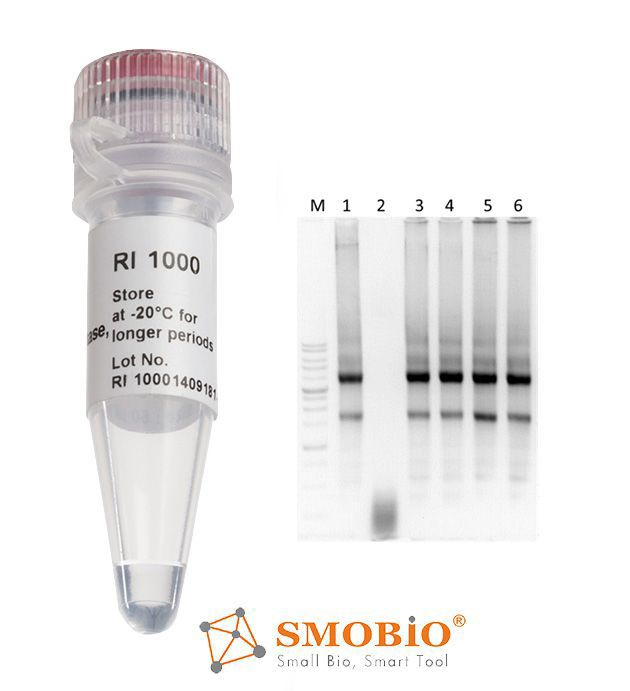
The RNAok™ RNase Inhibitor is a recombinant mammalian RNase inhibitor which possesses very high affinity for eukaryotic pancreatic-type ribonuclease. The RNAok™ RNase Inhibitor forms a 1:1 complex with pancreatic RNase A by noncovalent binding, presenting a noncompetitive inhibitory activity on these pancreatic enzymes. RNAok™ RNase Inhibitor is active against RNase A, RNase B, RNase C but not RNAse H, RNase I, RNase T1, RNase T2, and S1 nuclease. RNAok™ RNase Inhibitor is compatible with RT-PCR enzymes such as AMV, M-MLV and ExcelRT™ Reverse Transcriptase or Taq DNA polymerase.
Detail
Description
The RNAok™ RNase Inhibitor is a recombinant mammalian RNase inhibitor which possesses very high affinity for eukaryotic pancreatic-type ribonuclease. The RNAok™ RNase Inhibitor forms a 1:1 complex with pancreatic RNase A by noncovalent binding, presenting a noncompetitive inhibitory activity on these pancreatic enzymes. RNAok™ RNase Inhibitor is active against RNase A, RNase B, RNase C but not RNAse H, RNase I, RNase T1, RNase T2, and S1 nuclease. RNAok™ RNase Inhibitor is compatible with RT-PCR enzymes such as AMV, M-MLV and ExcelRT™ Reverse Transcriptase or Taq DNA polymerase.
Application
cDNA synthesis
in vitro translation
in vitro transcription
One-step RT-PCR
Separation and identification of specific ribonuclease activities
Storage Buffer
40 mM HEPES-KOH (pH 7.5), 100 mM KCl, 8 mM DTT, 0.1 mM EDTA, stabilizer and 50% (v/v) glycerol
Storage
-20°C for 24 months
Other Products
HiDi® 2x PCR Master Mix
Product Info
Document
Product Info
HiDi® stands for High Discrimination of mismatches at the 3’-terminus of primers in PCR. This myPOLS Biotec enzyme family is optimized for this feature and therefor, is the first choice for applications that rely on this property such as allele-specific PCR (asPCR) that is also termed allele-specific amplification (ASA).HiDi® 2x PCR Master Mix – ready to use mix simplifies your PCR setup. Only target-specific primers and template need to be added as the mix contains all components for a successful and reliable PCR. This ensures reproducible results, significantly reduces set-up times and the risk of pipetting errors.This PCR mix is also available with a full-length Taq DNA polymerase with a nuclease domain, featuring 100% compatibility with hydrolysis probes (TaqMan® probes etc.).Benchmarking with products of competitors conducted by us and others show that the HiDi® DNA polymerase family is the first choice for highly selective PCRs, such as genotyping by allele-specific PCR, HLA genotyping, analysis of single CpG methylation sites or the detection of mutations in a high background of wild-type sequences. By using HiDi® DNA polymerase, less than 10 copies of a mutation can be detected in a background of >10.000 wild-type copies straight away without any other tedious assay optimization.It has also been shown that HiDi® DNA polymerase family is highly suitable for quality control in CRISPR-Cas or TALEN-based applications.Several independently conducted studies show that HiDi® DNA polymerase is ideally suited for use in asPCR in numerous research areas ranging from mutation detection to genome editing. (read more)For research use and further manufacturing.In case you are aiming to use our RUO products as components or for your development of e.g. an IVD medical device, please contact us.
Casestudies: HiDi® DNA Polymerase: Applications from mutation detection to genome editing (read more)
Example Primer Design
Matching vs. mismatching nucleotide is placed at the 3′-end of the primer for best discrimination results.
Example Results – There´s no accounting for taste
Cilantro: some people love it in their food, some hate it. Here we are detecting a genomic SNP (rs72921001) in HeLa genomic DNA. This SNP is reported to be close to a number of genes coding for olfactory receptors. (Reference: Eriksson N. et al. (2012), “A genetic variant near olfactory receptor genes influences cilantro preference.”)
Considering, that only the C-allele specific primer is extended and yielding in a specific amplicon, we can conclude a genetic predisposition in disliking cilantro, as this SNP is significantly associated with detecting a soapy taste to cilantro.
Allele-specific PCRs were performed from 1 ng/µl of HeLa gDNA in the presence of a realtime dye, indicating the amplification of the C-allele specific primer only. The A-allele specific primer is discriminated, thus not amplified up to 50 cycles.
PCR products were subsequently analysed on a 2.5% agarose gel. Specific product is visualized by ethidium bromide staining at the amplicon length of 109 bp.
Document
HiDi® stands for High Discrimination of mismatches at the 3’-terminus of primers in PCR. This myPOLS Biotec enzyme family is optimized for this feature and therefor, is the first choice for applications that rely on this property such as allele-specific PCR (asPCR) that is also termed allele-specific amplification (ASA).
HiDi® 2x PCR Master Mix – ready to use mix simplifies your PCR setup. Only target-specific primers and template need to be added as the mix contains all components for a successful and reliable PCR. This ensures reproducible results, significantly reduces set-up times and the risk of pipetting errors.
t-Boc-aminooxy-PEG2-propargyl is a click chemistry crosslinker. The propargyl group is reactive with azide-bearing compounds or biomolecules via copper catalyzed Click Chemistry to yield a stable triazole linkage. t-Boc-aminooxy can be deprotected under mild acidic conditions. The hydrophilic PEG spacer increases solubility in aqueous media. Reagent grade, for research purpose. Please contact us for GMP-grade inquiries.
Document
t-Boc-aminooxy-PEG2-propargyl is a click chemistry crosslinker. The propargyl group is reactive with azide-bearing compounds or biomolecules via copper catalyzed Click Chemistry to yield a stable triazole linkage. t-Boc-aminooxy can be deprotected under mild acidic conditions. The hydrophilic PEG spacer increases solubility in aqueous media. Reagent grade, for research purpose. Please contact us for GMP-grade inquiries.
Attogene’ s RNase Inhibitor is a protein-based ribonuclease inhibitor which noncovalently binds and inactivates a wide variety of RNases in a range of temperature (37–65°C) and pH (5.5–8.5) conditions. This product is distinct from placental RNase Inhibitor protein in that it inactivates RNases I and T1 in addition to RNases A, B and C. NA2021 is distinct from RNase Inhibitor protein in that it is less expensive, have more robust interactions with RNAses.
MADE AND FUNCTIONALLY TESTED AT ATTOGENE (MADE IN AUSTIN TEXAS – USA)
Document
RNase Inhibitor (10,000 units) Concentration: 40 units/μL Volume: 0.25 mL Storage Conditions: Store at 2°C – 8°C Inhibits: RNases A, B, and C Supplied in: 1X PBS with 0.05% Sodium Azide.