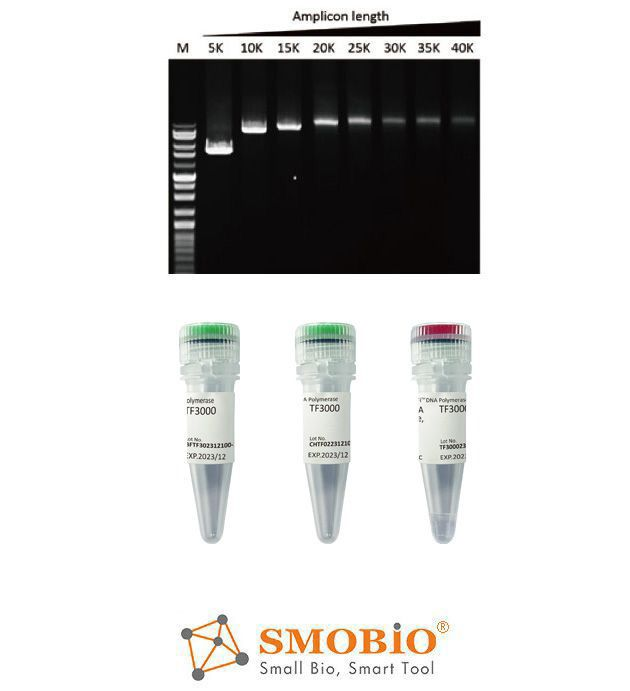
The G-HiFi™ DNA Polymerase is a new genetically modified, recombinant DNA polymerase suitable for GC-rich templates that are difficult to amplify. The fidelity of G-HiFi™ DNA Polymerase is 70 times higher than that of Taq DNA polymerase. The high extension rate of G-HiFi™ DNA Polymerase is achieved by blending the DNA polymerase with an elongation enhancer. The optimized 5X G-HiFi™ Buffer includes special ingredients that suppress non-specific amplification as well as plateau effect produced by conventional PCR. With the optimized 5X G-HiFi™ Buffer, G-HiFi™ DNA Polymerase is capable to amplify most templates, such as longer targets (up to 40 kb from lambda DNA) and that contain GC-rich sequences.
Detail
Description
The G-HiFi™ DNA Polymerase is a new genetically modified, recombinant DNA polymerase suitable for GC-rich templates that are difficult to amplify. The fidelity of G-HiFi™ DNA Polymerase is 70 times higher than that of Taq DNA polymerase. The high extension rate of G-HiFi™ DNA Polymerase is achieved by blending the DNA polymerase with an elongation enhancer. The optimized 5X G-HiFi™ Buffer includes special ingredients that suppress non-specific amplification as well as plateau effect produced by conventional PCR. With the optimized 5X G-HiFi™ Buffer, G-HiFi™ DNA Polymerase is capable to amplify most templates, such as longer targets (up to 40 kb from lambda DNA) and that contain GC-rich sequences.
Features
5’→3’ DNA polymerase activity
3’→5’ exonuclease (proofreading) activity
Suitable for GC-rich templates
High reaction rate: 7 seconds/kb
High fidelity: 70 times higher than Taq polymerase
Generates blunt end amplicons
Vast elongation capability (up to 40 kb)
Thermo-stable for more than 10 hrs at 95°C
Storage
[TF3000] G-HiFi™ DNA Polymerase
-20°C for 24 months
Other Products
Total Dietary Fiber Controls
Product Info
Document
Product Info
K-TDFC
SKU: 700004345
Contains 6 Controls: Use with K-TDFR, K-INTDF or K-RINTDF
Content:
Contains 6 Controls: Use with K-TDFR, K-INTDF or K-RINTDF
Shipping Temperature:
Ambient
Storage Temperature:
Short term stability: Ambient, Long term stability: See individual component labels
Stability:
> 2 years under recommended storage conditions
Analyte:
Dietary Fiber
For use with the Total Dietary Fiber Assay Kit. Contains barley β-glucan, high amylose maize starch, wheat starch, casein, pectin and larch galactan. Wheat arabinoxylan is available on request.
For use with the Total Dietary Fiber Assay Kit. Contains barley β-glucan, high amylose maize starch, wheat starch, casein, pectin and larch galactan. Wheat arabinoxylan is available on request.
RNA into DNA and PCR in one step? Then, this enzyme will simplify PCR analysis from RNA templates reducing labor and time. RT-KTQ2 was evolved from the thermostable KlenTaq DNA polymerase with no significant reverse transcriptase activity. Four mutations ensure that the variant is reverse transcriptase active and even PCR active, while maintaining the thermostability. This allows to perform reactions at high temperatures minimizing problems encountered with strong secondary structures in RNA that melt at elevated temperatures. For further information refer to the original publication.
Available upon request and for R&D use only – Contact Us
RT-KTQ2 DNA polymerase is supplied as a 5 µM solution containing glycerol and is supplied together with 10x reaction buffer.
The enzyme can also be used for real-time cycling, when adding a suitable dye.
Document
RNA into DNA and PCR in one step? Then, this enzyme will simplify PCR analysis from RNA templates reducing labor and time. RT-KTQ2 was evolved from the thermostable KlenTaq DNA polymerase with no significant reverse transcriptase activity. Four mutations ensure that the variant is reverse transcriptase active and even PCR active, while maintaining the thermostability. This allows to perform reactions at high temperatures minimizing problems encountered with strong secondary structures in RNA that melt at elevated temperatures. For further information refer to the original publication.
Milk samples are stable for 1 month at room temperature (or 1 week at 37°C) in the Preservation Solution
Fast and easy processing using a rapid spin-column format
DNA can be isolated and detected from as little as 100 µL of milk
Isolate high quality genomic DNA
Norgen’s Milk DNA Preservation and Isolation Kit is an all-in-one solution designed for 1) preservation of DNA in milk samples at ambient temperature; and 2) isolation of high quality DNA within a laboratory setting. The kit is provided with a Preservation Solution that allows for either immediate processing of milk samples, or allows for the storage of the milk samples for up to 1 month at room temperature prior to DNA isolation. Genomic DNA extracted from somatic cells and bacteria found in milk can be used in various applications. The isolated DNA can be used for the detection of biomarkers to diagnose a disease, follow the diseases progress or monitor the effects of a particular treatment. Milk DNA can also be used to diagnose particular types of infections. Milk DNA purified using Norgen’s kit is of the highest quality, and is compatible with a number of downstream applications including PCR, Southern Blot analysis, sequencing and microarray analysis.
Milk DNA Preservative
Norgen’s Milk DNA Preservation Solution is an aqueous storage buffer designed for rapid cellular lysis and subsequent preservation of DNA from fresh specimens. The preservative prevents the growth of Gram-negative and Gram-positive bacteria and fungi, and also inactivates viruses allowing the resulting non-infectious samples to be handled and shipped safely. In addition, the preservative eliminates the need to immediately process or freeze samples and allows the samples to be shipped to centralized testing facilities at ambient temperature. The components of the preservative allow samples to be stored for 1 month without any detectable DNA degradation.
Storage Conditions and Product Stability The Proteinase K should be stored at -20°C upon arrival and after reconstitution. All other solutions should be kept tightly sealed and stored at room temperature. This kit is stable for 2 years after the date of shipment.
Storage in Preservation Buffer 1) Storage at -20°C is recommended for archival samples and will provide optimal preservation. The preservation buffer will freeze at -20°C. Samples can be stored indefinitely at -70°C. 2) Samples can be stored at room temperature (25°C) for up to 1 month without significant loss of DNA quality. 3) DNA has also been successfully isolated from samples stored at 37°C 1 for one week.