[TP2000] ExcelTaq™ Blood Direct DNA Polymerase, 5 U/μl, 500 U
Facebook
X
Pinterest
Email
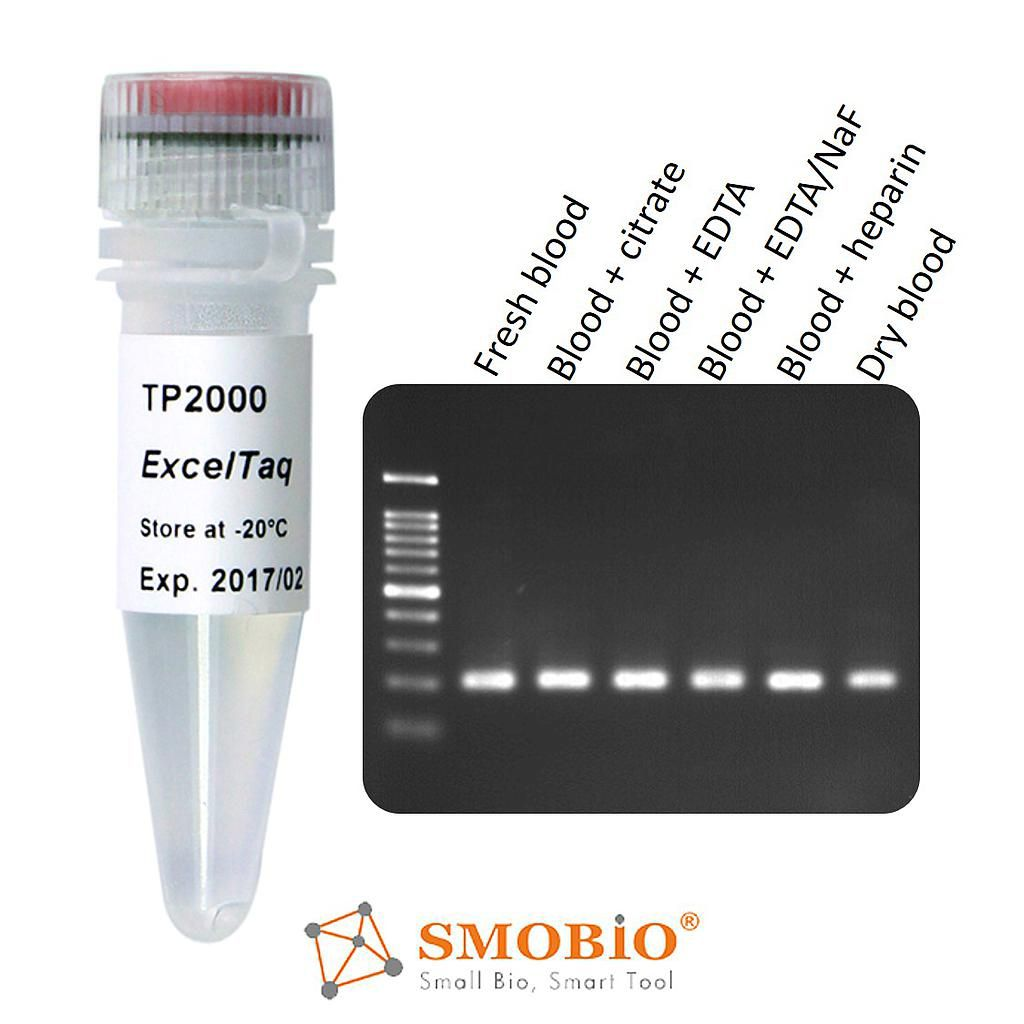
The ExcelTaq™ Blood Direct DNA Polymerase is designed for amplifying targeted DNA directly from whole blood, eliminating the need for a lengthy DNA isolation process. ExcelTaq™ Blood Direct DNA Polymerase is highly tolerant in the presence of PCR interfering/ inhibiting substances in blood, such as IgG, hemoglobin, and lactoferrin. ExcelTaq™ Blood Direct DNA Polymerase is compatible with most anticoagulants, such as citrate, EDTA, and heparin (Fig. 1). The ExcelTaq™ Blood Direct DNA Polymerase includes a pair of Positive Control Primers (CCR5) that are compatible with primate blood samples.
Detail
Description
The ExcelTaq™ Blood Direct DNA Polymerase is designed for amplifying targeted DNA directly from whole blood, eliminating the need for a lengthy DNA isolation process. ExcelTaq™ Blood Direct DNA Polymerase is highly tolerant in the presence of PCR interfering/ inhibiting substances in blood, such as IgG, hemoglobin, and lactoferrin. ExcelTaq™ Blood Direct DNA Polymerase is compatible with most anticoagulants, such as citrate, EDTA, and heparin (Fig. 1). The ExcelTaq™ Blood Direct DNA Polymerase includes a pair of Positive Control Primers (CCR5) that are compatible with primate blood samples.
Features
5’→3′ DNA polymerase activity
No detectable 3’→5′ exonuclease (proofreading) activity
Generates PCR products with 3′-dA overhangs
Compatible with most anticoagulants
Applications
Direct amplification of DNA from blood samples
High throughput screening without DNA purification
Suitable for multiplex PCR
Storage
-20°C for 24 months
4℃ for 6 months
Other Products
N-(Propargyl-PEG4)-N-bis(PEG4-acid) HCl saltอ
Product Info
Document
Product Info
N-(Propargyl-PEG4)-N-bis(PEG4-acid) is a branched crosslinking reagent with a propargyl group and two terminal carboxylic acids. The propargyl group can react with azide-bearing compounds or biomolecules via copper catalyzed azide-alkyne Click Chemistry to yield a stable triazole linkage. The terminal carboxylic acids can react with primary amino groups in the presence of activators (e.g. EDC, or HATU) to form a stable amide bond. Reagent grade, for research purpose. Please contact us for GMP-grade inquiries.
Document
N-(Propargyl-PEG4)-N-bis(PEG4-acid) is a branched crosslinking reagent with a propargyl group and two terminal carboxylic acids. The propargyl group can react with azide-bearing compounds or biomolecules via copper catalyzed azide-alkyne Click Chemistry to yield a stable triazole linkage. The terminal carboxylic acids can react with primary amino groups in the presence of activators (e.g. EDC, or HATU) to form a stable amide bond. Reagent grade, for research purpose. Please contact us for GMP-grade inquiries.
DBCO-amine TFA salt is a simple building block containing a DBCO moiety and an amine group. Amine is very reactive with NHS ester. DBCO is commonly used for copper-free Click Chemistry reactions.
Document
DBCO-amine TFA salt is a simple building block containing a DBCO moiety and an amine group. Amine is very reactive with NHS ester. DBCO is commonly used for copper-free Click Chemistry reactions.
Campylobacter jejuni is a curved, rod-shaped and microaerophillic gram negative bacterium. It is one of the most common causal agents of gastroenteritis with diarrhea as the main symptom. While infection of C. jejuni is seldom life-threatening, it is considered one of the most common food-borne bacteria with over 2 million people infected per year in US alone. Infection of C. jejuni usually results from consumption of poorly prepared food including undercooked meat (particularly poultry), untreated water or raw unpasteurized milk. Traditional identification of C. jejuni involves culturing, however the microaerophilic characteristic of this bacterium make the enrichment process laborious and costly.
Storage Conditions and Product Stability All kit components can be stored for 2 years after the date of production without showing any reduction in performance.
All kit components should be stored at -20°C upon arrival.