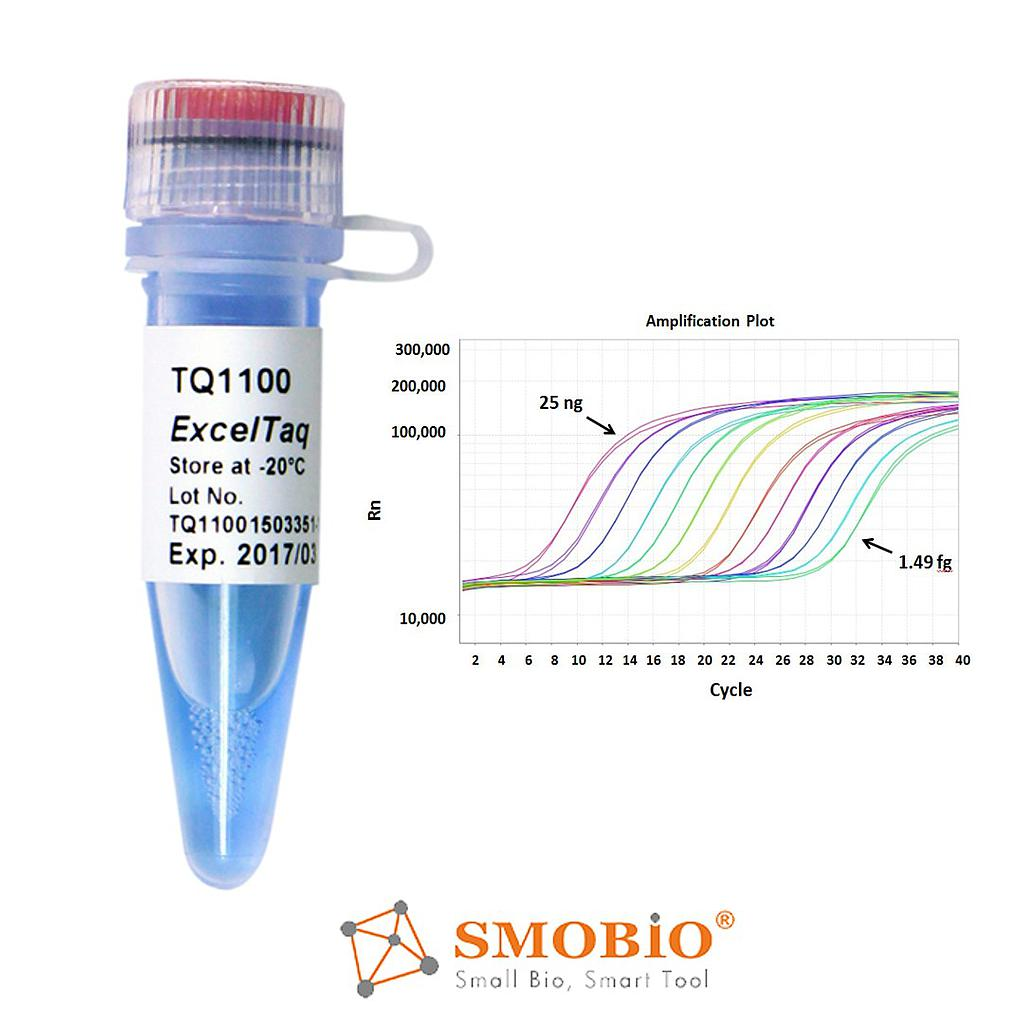
The ExcelTaq™ 2X Q-PCR Master Mix (SYBR, no ROX) is a ready-to-use reagent with all the essential components for quantitative real-time PCR (qPCR) except primers and template. The master mix features high sensitivity and signal intensity as well as low background and better compatibility with cDNA templates derived directly from reverse transcription reaction mixture. The ExcelTaq™ 2X Q-PCR Master Mix (SYBR, no ROX) contains hot-start Taq polymerase in an optimized buffer with dsDNA specific SYBR green fluorescent dye. This master mix allows for sensitive, precise amplification, real-time tracking of the amplification process, and simultaneous quantification for targeted DNA molecules. With inert smart blue contrast dye, the ExcelTaq™ 2X Q-PCR Master Mix (SYBR, no ROX) is ready-to-use and greatly reduces pipetting errors, while largely improving the reproducibility of the process. The ExcelTaq™ 2X Q-PCR Master Mix is also compatible with a ROX reference dye if recommended by the manufacturer of the qPCR system.
Detail
Description
The ExcelTaq™ 2X Q-PCR Master Mix (SYBR, no ROX) is a ready-to-use reagent with all the essential components for quantitative real-time PCR (qPCR) except primers and template. The master mix features high sensitivity and signal intensity as well as low background and better compatibility with cDNA templates derived directly from reverse transcription reaction mixture. The ExcelTaq™ 2X Q-PCR Master Mix (SYBR, no ROX) contains hot-start Taq polymerase in an optimized buffer with dsDNA specific SYBR green fluorescent dye. This master mix allows for sensitive, precise amplification, real-time tracking of the amplification process, and simultaneous quantification for targeted DNA molecules. With inert smart blue contrast dye, the ExcelTaq™ 2X Q-PCR Master Mix (SYBR, no ROX) is ready-to-use and greatly reduces pipetting errors, while largely improving the reproducibility of the process. The ExcelTaq™ 2X Q-PCR Master Mix is also compatible with a ROX reference dye if recommended by the manufacturer of the qPCR system.
Features
High sensitivity and signal intensity
Smart blue contrast dye as a visual aid for reaction setup
Better compatibility for reverse transcription
Low background
Storage
Protected from light. Aliquot to avoid multiple freeze-thaw cycles. -20°C for 12 months
Other Products
Methylation Specific Bisulfite Seq Library Prep Kit
Product Info
Document
Product Info
Bisulfite seq is a well know technology to detect DNA methylation and several technologies such as WGBS, RRBS, MeDIP-Seq, and MSBS are used for whole genome DNA methylation analysis. DNA methylation is important for regulation of cell development, differentiation and gene expression in molecular biology, genetics and epigenetics. Most methylated cytosines are found at CpG sites, and 70-80% of cytosines are methylated. The number of CpG sites in human genome is around 28 million, which is less than 1% of the genome compared with 4.4% expected.
Whole genome bisulfite sequencing (WGBS) is the most effective method of DNA methylation analysis. The only limitation is the sequencing cost is very high because the whole genome is sequenced including all the non-methylated regions.
Reduced Representation Bisulfite Sequencing (RRBS) is the reduced representation of a smaller fraction of the methylated CpG sites. RRBS combines restriction enzyme digestion and bisulfite sequencing, and enriches the sequencing for methylated CpG sites. It is an efficient technology for estimate the whole genome methylation patterns at the single base level. Although this allows a higher coverage depth and reduces the sequencing cost, the limitation is only 10% of the methylated CpG sites are covered.
Methylated DNA Immunoprecipitation Sequencing (MeDIP-Seq) is another whole genome enrichment technique used for selection of methylated DNA. Using antibodies against 5-methylcytosine, methylated DNA is enriched from whole genomic DNA via immunoprecipitation. 5-methylcytosine antibodies are incubated with fragmented genomic DNA and precipitated, followed by DNA purification and sequencing. There are several drawbacks of MeDIP-Seq: 1. Low resolution (150~200 bp) as opposed to the single base resolution; 2. Non-specific interaction due to antibody specificity and selectivity. 3. Bias towards hypermethylated regions.
The Methylation Specific Bisulfite Seq (MSBS) Library Prep Kit (illumina platform) was developed for construction of NGS libraries for methylated CpG sites using bisulfite treated DNA (20 ng – 500 ng) as input. The kit enriches methylated CpG regions, thus significantly reduce the sequencing cost. The kit estimates the whole genome methylation patterns at the single base level since it is based on a bisulfite-seq technology.
It is known that bisulfite treatment of completed NGS libraries causes tremendous damage to the libraries. By using bisulfite treated DNA as input, the kit overcomes the significant library loss due to the bisulfite conversion. The kit contains a mixture of PCR polymerases that have high-fidelity amplification and uracil tolerance which is ideal for bisulfite treated DNA.
Methylation Specific Bisulfite Seq Library Prep Kit Workflow
Three index types are available for the kit:
Non-index (Cat.# 30101): Libraries do not have index.
Index (Cat.# 30102): Each primer contains a unique barcode sequence of 6 bases to identify the individual library. Library multiplexing capacity is up to 48 samples. Index information can be downloaded here.
Unique dual index (Cat.# 30103): The multiplexing of bisulfite sequencing library is up to 96 samples with unique dual indexes. We used a Four-Base Difference Index System to generate indexes that have at least 4 bases different from each other in the 8-base index. The index primers remove NGS errors including index cross-contamination, index hopping, reads mis-assignment etc. Index information can be downloaded here.
Methylation Specific Bisulfite Seq advantages
Enrichment of methylated CpG sites
Single-base resolution
Low cost for sequencing
Fast
Total time: 1.5 hours
Hands-on time: 10 minutes
Simple workflow
Bisulfite treated DNA as input: From 20 ng to 500 ng
MSBS Library Prep Kit enriches CpG sites
High methylation regions and low methylation regions in human genome.
High methylation region in human genome.
Low methylation region in human genome.
Sequencing setting: Single-end 35 cycles (Read 1, 35 bases) recommended To maximize the methylated CpG enrichment, we recommend to sequence the MSBS libraries with single end 35 cycles (read1, 35 bases). This is because the enriched methylated CpG sites are mainly located around the beginning of read 1 sequences. Shorter single end reads tend to have better methylated CpG enrichment.
Document
Bisulfite seq is a well know technology to detect DNA methylation and several technologies such as WGBS, RRBS, MeDIP-Seq, and MSBS are used for whole genome DNA methylation analysis. DNA methylation is important for regulation of cell development, differentiation and gene expression in molecular biology, genetics and epigenetics. Most methylated cytosines are found at CpG sites, and 70-80% of cytosines are methylated. The number of CpG sites in human genome is around 28 million, which is less than 1% of the genome compared with 4.4% expected.
NGS Cell Free DNA Library Prep Kit (illumina and MGI Platforms)
Product Info
Document
Product Info
The NGS Cell Free DNA Library Prep Kit (illumina and MGI Platforms) was developed for the construction of high quality cell-free DNA (cfDNA) libraries using 1 ng to 50 ng of cell-free DNA as input. The kit has a simple work flow and a fast procedure. Multiplexing of the cell free DNA library is possible based on the index type.
NGS Cell Free DNA Library Prep Kit Workflow
The main source of cell-free DNA (cfDNA) is derived from apoptotic hematopoietic cells in blood and found in the plasma. The length of the cfDNA is about 150-200 bp in length. Circulating tumor DNA (ctDNA) derived from malignant tumors is a part of cfDNA. Both cfDNA and ctDNA can be used as a noninvasive biomarker since it offers a better approach in comparison to invasive tissue biopsies.
NGS has been used for cfDNA and ctDNA sequencing in the field of liquid biopsy as it provides a whole genome level of molecular profiling. One of the hurdles for cfDNA sequencing is the difficulty of library preparation from the limited amount of cfDNA obtained from plasma. Our cell-free NGS kit makes it easy to get enough libraries from limited input in just 1.5 hours.
Three index types are available for the NGS Cell Free DNA Library Prep Kit of the illumina platform:
Non-index (Cat.# 30029): Libraries do not have index.
Index(Cat.# 30031): Each of our index primers contains a unique 6-base index sequence that can be used for sample identification. Total 48 library multiplexing is possible. Index information can be downloaded here.
Unique dual index (Cat.# 30033): Cell-free DNA library multiplexing up to 96 samples is possible with the unique dual indexes. We have developed a Four-Base Difference Index System. The system have at least 4 bases different from each other in the 8 bases index length. The primers effectively minimize sequencing errors such as mis-assignment, index hopping, index contamination etc. Index information can be downloaded here.
Indexes are available for the MGI platform kits (Cat.# 34031).
Kit advantages:
Fast and simple protocol
Hands-on time is around 10 minutes
The total protocol time is only 1.5 hours
Easy procedure based on:
Ready-to-use master mix for easy setup of reactions
Less reaction components to simplify bench work
Less magnetic beads used for cleanup procedures: This can reduce more than 50% of the beads consumption
Guaranteed high library conversion efficiency
Low input cell-free DNA: From 1 ng to 50 ng
Comparison of library conversion efficiency with different samples under the same condition.
Comparison of library yield with different samples under the same condition.
Document
The NGS Cell Free DNA Library Prep Kit (illumina and MGI Platforms) was developed for the construction of high quality cell-free DNA (cfDNA) libraries using 1 ng to 50 ng of cell-free DNA as input. The kit has a simple work flow and a fast procedure. Multiplexing of the cell free DNA library is possible based on the index type.
CP0201J Triple Wrapped Irradiated Plate-Tryptic Soy Agar
Product Info
Document
Product Info
Introduction
Usages: For monitoring and detection of surface of equipment and personnel hygiene.
Advantage: 1.This series of products was filling at A level of environment, and final sterilization by Gamma ray irradiation, triple packaging insure sterility and long shelf life. 2.Each dish was marking label product name, batch number, expiration date .Information is available of traceability. 3.Inner additional desiccant, reducing formation of condensation water, while inner additional sterile paper and plastic bags for easier transfer and cultivation. 4.Triple packing dense bags to avoid the penetration of hydrogen peroxide; clean gas was filled as a buffer to reduce broken bags and dish in transit.. 5.This series of products is available to store at (2-25 ℃), shelf life of up to 6 months.
Storage: Store in a cool (2-25 ℃), dry place, away from bright light. Storage period of 6 months.