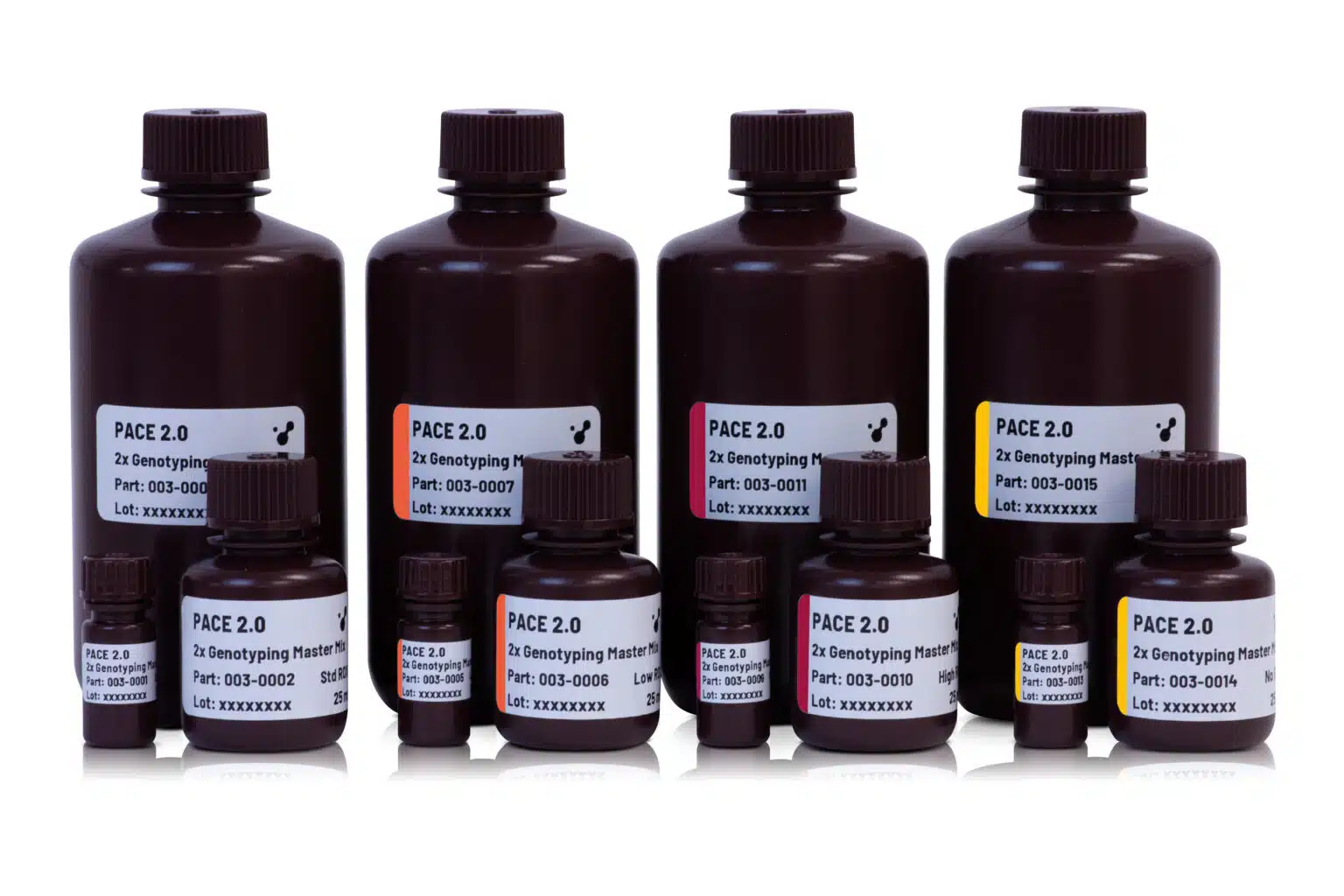
An enhanced PCR master mix for allele-specific assays. Improved signal to noise ratio and tight clustering. Developed specifically for genotyping direct from crude DNA samples.
PACE 2.0 Genotyping Master Mix ensures an unrivalled signal-to-noise ratio and produces tight data clusters, even when working with high-throughput, crude DNA preps, resulting in consistently exceptional performance. Efficiently streamline your workflow and reduce costs without compromising the quality of your results.
PACE 2.0 Genotyping Master Mix is an ideal solution for challenging starting material. PACE 2.0 has been specially formulated to overcome the obstacles presented by common PCR inhibitor compounds, such as phenols and tannins. Even notoriously tricky samples like oil palm and conifers can still be assayed using hot shot or other crude DNA prep methods and deliver reliable and accurate data.
PACE 2.0 Genotyping Master Mix uses a novel, universal, fluorescent reporting cassette to produce machine-readable fluorescent signals corresponding to genotypes. PACE 2.0 compatible genotyping assays are comprised of two competitive allele-specific forward primers (which differ in their terminal 3’ bases and unique 5’ tail sequences) and a common, reverse primer. PACE 2.0 Genotyping Master Mix is supplied with ROX normalising dye at a range of levels to ensure compatibility with your qPCR instrument or reader.
Genotyping assay designs are available from 3CR Bioscience through our free assay-design service; once designed, users can purchase assay primers independently or through 3CR Bioscience using our partial or full-assay validation service. PACE 2.0 Genotyping Master Mix is also compatible with KASP™ and Amplifluor® marker assays.
REQUIRED COMPONENTS
qPCR machine or Thermocycler + Fluorescent plate reader
PCR plate or equivalent and appropriate optically clear seal
Template DNA
PCR-grade water
Genotyping assays
Other Products
Propargyl-PEG1-acid
Product Info
Document
Product Info
Propargyl-PEG1-acid is a crosslinker with a propargyl group and a carboxylic acid group. The carboxylic acid reacts with primary amine under the activation of HATU or EDC. The propargyl group can participate in copper catalyzed azide-alkyne Click Chemistry reactions. Reagent grade, for research purpose. Please contact us for GMP-grade inquiries.
Document
Propargyl-PEG1-acid is a crosslinker with a propargyl group and a carboxylic acid group. The carboxylic acid reacts with primary amine under the activation of HATU or EDC. The propargyl group can participate in copper catalyzed azide-alkyne Click Chemistry reactions. Reagent grade, for research purpose. Please contact us for GMP-grade inquiries.
Isolate all sizes of circulating and exosomal RNA, including microRNA
Versatile urine input ranges
No phenol extractions
No carrier RNA
Bind and elute all RNA irrespective of size or GC content, without bias
Concentrate circulating RNA and exosomal RNA into flexible elution volumes
Purified RNA is suitable for a variety of downstream applications, including Small RNA Sequencing. Find out more information on Norgen’s NGS services
Purification is based on spin column chromatography that uses Norgen’s proprietary resin separation matrix
These kits provide a fast, reliable and convenient method to purify and concentrate high quality, high purity and inhibitor-free cell-free circulating RNA, including exosomal RNA as well as viral RNA from fresh, preserved or frozen urine samples. All components for the purification are provided in one convenient and fast kit for the easy processing of small input volumes of bodily fluids. The purified urine RNA is fully compatible with all downstream applications including PCR, qPCR, methylation-sensitive reverse transcription qPCR, reverse transcription PCR, Northern blotting, RNase protection and primer extension, expression array assays, and NGS.
Background
Recent evidence indicates that cell-free circulating RNA (cf-RNA) including exosomal RNA in urine contains valuable information for the discovery of biomarkers that can help for the early detection of certain cancer types and for monitoring the disease status as well as for the detection of any infectious pathogens. Exosomes can be found in saliva, blood, urine, amniotic fluid and malignant ascitic fluids, among other biological fluids. Evidence has been accumulating recently that these vesicles act as cellular messengers, conveying information to distant cells and tissues within the body. These exosomes may play a functional role in mediating adaptive immune responses to infectious agents and tumours, tissue repair, neural communication and transfer of pathogenic proteins. For this reason exosomal RNAs may serve as biomarkers for various diseases including cancer. The advantage for using urine as a source for cancer biomarkers is that it can be acquired in large quantities without using invasive procedures. In addition, repeated sampling from the same individual is applicable, which facilitates longitudinal studies. There are many advantages favouring the use of urinary nucleic acid for cancer biomarker discovery over blood, tissue samples or other bodily fluids, including: (1) urine is non-infectious for HIV and less infectious for many other pathogens; (2) the profile of urinary nucleic acid is similar to that in plasma or serum but with a lower concentration; (3) Nucleic acid purification from urine is technically much easier because of its low protein concentration (1000-fold lower than blood).
Urine Cell-Free Circulating RNA Purification Mini Kit
For sample volumes ranging from 2 mL to 10 mL. The first column will handle the large volume input of urine that is followed by a concentration on a mini column for a final elution of 50 µL to 100 µL.
For sample volumes ranging from 10 mL to 30 mL. The first column will handle the large volume input of urine that is followed by a concentration on a mini column for a final elution of 50 µL to 100 µL
All sizes including miRNA and small RNA (< 200 nt)
Elution Volume
50-100 μL
Time to Complete 10 Purifications
40-45 minutes
Average Yields
Variable depending on specimen
*Please check page 6 of the product insert for average yields and common RNA quantification methods.
Storage Conditions and Product Stability All buffers should be kept tightly sealed and stored at room temperature. These kits are stable for 2 years after the date of shipment. It is recommended to warm Lysis Buffer A for 20 minutes at 60°C if any salt precipitation is observed.
This kit is suitable for extracting total pathogen nucleic acid from a variety of clinical samples (including serum and plasma). The kit is based on super paramagnetic particles purification technology. Purified DNA/RNA is ready for downstream applications such as Real Time PCR, biochip analysis, NGS and other related experiments.
Details
Specifications
Features
Specifications
Main Functions
Extract Pathogen RNA/DNA from 0.5ml plasma, serum, body fluid, homogenate suspension, culture solution, cell suspension, soaking solution or concentrate pathogen solution for mNGS application, remove host background nucleic acid.
Applications
RT-PCR,Real Time PCR, biochip analysis, NGS
Products
Pathogen DNA / RNA
Purification method
Polydisperse magnetic beads
Purification technology
Magnetic beads technology
Process method
Manual or automatic
Sample type
low/cell-free samples such as plasma, serum, body fluid, homogenate suspension, culture solution, cell suspension, soaking solution or concentrate pathogen solution
Sample amount
0.5 ml
Adaptive instrument
Nucleic acid extractor, pipetting workstation
Principle
This product is based on the purification method of high binding magnetic particles. The sample is lysed and digested under the action of lysate and Protease. After adding magnetic particles and binding solution, DNA/RNA will be adsorbed on the surface of magnetic particles, and impurities such as proteins will be removed without adsorption. The adsorbed particles were washed with washing solution to remove proteins and impurities, washed with ethanol to remove salts, and finally DNA/RNA was eluted by Buffer NFW.
Kit Contents
Contents
R667200B
R6672-02B
Purification Times
24 Preps
96 Preps
2ml Bead Tubes
24
96
Proteinase K
12 mg
50 mg
Protease Dissolve Buffer
1.8 ml
3 ml
Buffer SDS (20%)
1.8 ml
8 ml
MagBind Particles
0.6 ml
2.5 ml
Buffer MLB
15 ml
60 ml
Buffer MW1*
13 ml
44 ml
Buffer MW2*
6 ml
50 ml
Buffer AVE
5 ml
30 ml
Storage and Stability
MagBind Particles and Proteinase K Solution should be stored at 2–8°C upon arrival. However, short-term storage (up to 8 weeks) at room temperature (15–25°C) does not affect their performance. The remaining kit components can be stored at room temperature (15–25°C) and are stable for 18 months under these conditions.
Document
This kit is suitable for extracting total pathogen nucleic acid from a variety of clinical samples (including serum and plasma). The kit is based on super paramagnetic particles purification technology. Purified DNA/RNA is ready for downstream applications such as Real Time PCR, biochip analysis, NGS and other related experiments.