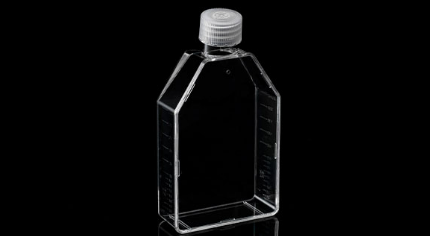
Cell Culture Flask surface is very smooth based on precise molding technology and it gives clear view when examined with microscope.
Volume: 25mL75mL175mL225mL
Detail
Cell Culture Flask T75
Cell Culture Flask surface is very smooth based on precise molding technology and it gives clear view when examined with microscope.
Volume: 25mL75mL175mL225mL
PRODUCT FEATURES
The product is made of medical grade USP CLASS VI polymer polystyrene
The product is made under a 100,00- class dust-free manufacturing site
Two kinds of product line up are providing.
For adherent cell culture: Initial adherence and proliferative property of cells via hydrophilic surface treatment.
For suspension cell culture: The surface is resistant to cell adherence, which minimizes damage or loss of cell.
Large mouthed design makes easy operation of pipet or cell scraper. The surface of flask is uniform and smooth, hence the clear view can be obtained when microscopic observation.
The hydrophobic filter cap can prevent invasion of fungi and bacteria without water absorb.
Gamma radiation sterilization
Non-Pyrogenic, DNase/Rnase free.
Other Products
Saliva RNA Collection and Preservation Devices
Product Info
Document
Product Info
Overview
Reliable and cost-effective
Non-invasive, user-friendly sample collection and preservation in one convenient kit
Preserved RNA is stable for up to 2 months at room temperature
Norgen’s Saliva RNA Collection and Preservation Devices are designed for simple and non-invasive saliva collection and preservation of RNA in saliva samples at ambient temperature. Each of the 50 Saliva RNA Collection and Preservation Devices consists of 3 components:
Saliva Collection Funnel and Collection Tube
Collection Tube Cap
Norgen’s Saliva RNA Preservative contained within a sealed squeezable ampoule
Saliva samples are collected by spitting inside the Collection Funnel which has been assembled with the Collection Tube. After collecting the required volume of saliva the Collection Funnel is removed and the contents of the Preservative Ampoule are then added and mixed with the collected saliva. The Saliva Collection Tube is subsequently sent to the laboratory for RNA isolation and analysis. RNA can be isolated from the preserved saliva samples using Norgen’s Saliva/Swab RNA Purification Kits (Cat# 69100, 69300). Each of Norgen’s Collection Tubes is labeled with a unique serial number that can be used for secure and anonymous tracking of the sample. The Saliva RNA in preserved samples is stable for up to 2 months at room temperature. This kit is ideal for collecting and preserving RNA samples for epidemiological and population studies.
Saliva RNA Preservative
Norgen’s Saliva RNA Preservative is an aqueous storage buffer designed for rapid cellular lysis and subsequent preservation of RNA from fresh specimens. The buffer eliminates the need to immediately process or freeze samples and allows the samples to be shipped to centralized testing facilities at ambient temperature. The components of the buffer allow samples to be stored for up to 2 months at room temperature.
When stored at room temperature, unused Norgen Saliva Preservative Tubes are stable through to the collect-before date without any reduction in performance. Please see the device insert or tube label for collect-before date.
Once collected, saliva RNA is stable for up to 2 months when kept tightly sealed and stored at room temperature.
The Collection Tube, the Collection Funnel and the Device Container of each individual Saliva RNA Collection and Preservation Device are recyclable.
Kit Components
Cat. RU53800 (50 Devices)
Individual Saliva RNA Collection and Preservation Devices
50
Donor Procedure Flowchart
1
Product Insert
1
Individual Saliva RNA Collection and Preservation Device Contents
This product is suitable for rapid extraction of DNA from tissue, cells, blood, saliva, swabs, blood spots, semen and other clinical samples. DNA can be used directly for PCR, quantitative PCR, Southern Blot, test of virus DNA and so on.
Details
Specifications
Features
Specifications
Main Functions
Isolation total DNA from blood, buffy coat, tissue and other samples
Applications
Second generation sequencing, PCR, real time PCR, etc.
Purification method
Polydisperse magnetic beads
Purification technology
Magnetic beads technology
Process method
Manual or automatic
Sample type
Anticoagulant blood, concentrated blood, buffy coat, lymphocytes and cultured cells
This product is based on the purification method of high binding magnetic particles. The sample is lysed and digested under the action of lysate and protease. DNA is released into the lysate. After adding magnetic particles and binding solution, DNA will be adsorbed on the surface of magnetic particles, and impurities such as proteins will be removed without adsorption. The adsorbed particles were washed with washing solution to remove proteins and impurities, washed with ethanol to remove salts, and finally DNA was eluted by Elution Buffer.
Advantages
High purity – OD 260 / 280 : 1.7- 1.9, OD 260 / 230 : 1.5 – 2.0
Economy – less than 50% of the price of Qiagen and other imported products
High yield – most optimal process, ensuring the recovery up to 90%
Strong processing ability – samples including animal blood, cultured cells, animal tissues, etc.
Proteinase K, RNase A, MagPure Particles should be stored at 2-8°C upon arrival. However, short-term storage (up to 24 weeks) at room temperature (15-25°C) does not affect their performance. The remaining kit components can be stored at room temperature (15-25°C) and are stable for at least 18 months under these conditions.
Experiment Data
Document
This product is suitable for rapid extraction of DNA from tissue, cells, blood, saliva, swabs, blood spots, semen and other clinical samples. DNA can be used directly for PCR, quantitative PCR, Southern Blot, test of virus DNA and so on.