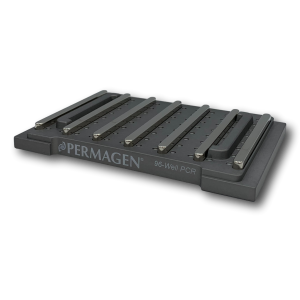
The Permagen 96-Well Side Pull Bar Magnet PCR Separation Plate was designed for use in manual or automation applications where pulling beads to one side of the wells is essential. Also available in a kit form which includes our MTP96 clear top plate for 0.2 mL PCR tubes and strips.
Detail
The Permagen 96-Well Side Pull Bar Magnet PCR Separation Plate was designed for use in manual or automation applications where pulling beads to one side of the wells is essential. Also available in a kit form which includes our MTP96 clear top plate for 0.2 mL PCR tubes and strips.
Most PCR plates are bent, leading to inconsistent lab results. Unlike most products, we have added two angled, partial frames around the top of our plate, this helps with two things, straightening out the PCR plate, and leading it to the proper location on the magnets when using an automated liquid handling robot.
Features include solid aluminum alloy construction and hard coat anodized finish for years of trouble-free use, and compatible with any magnetic beads
Double-Strand Specific dsDNase (dsDNase) is ideal for fast and effective removal of contaminating DNA from PCR master mixes.
Taq polymerases are commonly contaminated by bacterial DNA. This is a problem in PCR based bacterial typing and detection as it might cause false positive results. The unique properties of dsDNase make it suited for removal of contaminating DNA from PCR master mixes prior to addition of DNA template.
In figure 1, a PCR master mix was treated with different amounts of dsDNase before performing a qPCR to measure the contaminating bacterial DNA in the master mix. ArcticZymes dsDNase effectively removed contaminating DNA below known levels of the assay detection limits.
The dsDNase from Arctic shrimp (Pandalus borealis) is recombinantly produced in Pichia pastoris. It cleaves phosphodiester linkages in DNA to yield oligonucleotides with 5’-phosphate and 3’-hydroxyl termini.
The specific activity is estimated to be 30 times higher than that of bovine DNase I. In the presence of magnesium as only divalent cation and using oligos as a substrate, the activity towards dsDNA is 5000-fold higher than towards ssDNA.
The unique double strand-specificity allows specific degradation of dsDNA while leaving shorter ssDNA as primers and probes essentially intact. Easy inactivation by moderate heat (65°C) allows addition of DNA intended for analysis directly after removal of contaminating DNA.
Can be heat-inactivated by moderate heat treatment (65°C for 15 minutes)
Producing 5′-phospho-oligonucleotide products
Figures
Figure 1. The dsDNase effectively removes contaminated DNA
The dsDNase effectively removes contaminated DNA:
A PCR master mix was preincubated with various concentrations of dsDNase. After treatment, no DNA was amplified in non-template controls.
Properties
Specificity towards double-stranded DNA
Nucleic acid specificity has been tested towards double- and single-stranded DNA and RNA oligonucleotides. The specificity of dsDNase towards the substrate has been measured using 15-mer oligonucleotides with FAM at 5′ and DarkQuencher® 3′ (Eurogentec). The fluorescence is proportional to enzyme activity. Assay conditions: 25 mM Tris pH 7.5, 5 mM MgCl2, and 2 μM oligonucleotide.
Double-Strand Specific dsDNase (dsDNase) is ideal for fast and effective removal of contaminating DNA from PCR master mixes.
Taq polymerases are commonly contaminated by bacterial DNA. This is a problem in PCR based bacterial typing and detection as it might cause false positive results. The unique properties of dsDNase make it suited for removal of contaminating DNA from PCR master mixes prior to addition of DNA template.
Short term stability: 2-8oC, Long term stability: See individual component labels
Stability:
> 1 year under recommended storage conditions
Analyte:
D-Galacturonic Acid, D-Glucuronic Acid
Assay Format:
Spectrophotometer, Microplate, Auto-analyser
Detection Method:
Absorbance
Wavelength (nm):
340
Signal Response:
Increase
Linear Range:
5 to 150 µg of D-glucuronic acid or D-galacturonic acid per assay
Limit of Detection:
~ 15.5 mg/L
Reaction Time (min):
~ 10 min at 25oC or ~ 5 min at 37oC
Application examples:
Hydrolysates of plant material and polysaccharides and other materials.
Method recognition:
Novel method
The D-Glucuronic/D-Galacturonic test kit is a simple, reliable and accurate method for the measurement and analysis of D-hexuronic acids (specifically D-glucuronic acid and D-galacturonic acid) in plant extracts, culture media/supernatants and other materials.
Note for Content: The number of manual tests per kit can be doubled if all volumes are halved. This can be readily accommodated using the MegaQuantTM Wave Spectrophotometer (D-MQWAVE).
Mega-Calc™ software tool is available from our website for hassle-free raw data processing
Standard included
Suitable for manual, microplate and auto-analyser formats
Document
The D-Glucuronic/D-Galacturonic test kit is a simple, reliable and accurate method for the measurement and analysis of D-hexuronic acids (specifically D-glucuronic acid and D-galacturonic acid) in plant extracts, culture media/supernatants and other materials.
MutS Homolog 6 (MSH6) is a protein involved in the mismatch repair pathway. This protein is commonly associated with hereditary non-polyposis colorectal cancer, and mutations in this gene are correlated with the development of sporadic colorectal carcinoma. Studies have shown that mutations in MSH6, when co-indicated with mutations in MSH1 and MSH2, contribute to the development of sporadic colorectal carcinoma. Use of Anti-MSH2 is optimized when paired with MSH6, MLH1, and PMS2 in an IHC panel.