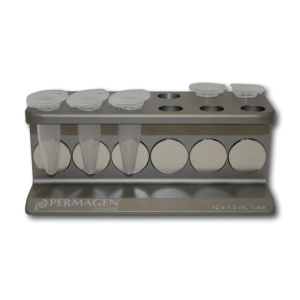
Permagen’s 12 x 1.5 mL Microfuge Tube Magnetic rack is designed for magnetic bead separations from up to 12 tubes
Detail
Permagen’s 12 x 1.5 mL Microfuge Tube Magnetic rack is designed for magnetic bead separations from up to 12 tubes
Accommodates many common 1.5 mL Microcentrifuge and some 2.0 mL tubes
Tubes are angled and beads will be pulled to back wall allowing easy aspiration and tip tracking down the front wall of the tubes without disturbing bead pellet
Purification and enrichment of intact exosomes from plasma, serum, urine, cell culture media and saliva in less than 30 minutes.
Versatile sample input ranging from 50 µL to 10 mL
Plasma/Serum Exosome Purification Mini Kit (50 µL – 1 mL Plasma/Serum)
Plasma/Serum Exosome Purification Midi Kit (1 mL – 4 mL Plasma/Serum)
Plasma/Serum Exosome Purification Maxi Kit (4 mL – 10 mL Plasma/Serum)
Exosome purification is based on Norgen’s proprietary resin separating matrix through exosomes’ surface proteins.
No precipitation reagents, overnight incubation, protease or coagulant treatments required
No time-consuming ultracentrifugation, filtration or special syringes required
Purify intact exosomes with a size ranging from 40-200 nm depending on sample input type
Purified exosomes are compatible with functional studies.
Purified exosomes are free from any RNA-binding proteins
Purified exosomes are compatible with NanoSight® or Electron Microscopy for assessing the approximate exosome size range and concentration.
Exosomal RNA can be extracted from the purified exosomes using Norgen’s Exosomal RNA Purification technology or any other RNA extraction method.
The Plasma/Serum Exosome Purification Kits provide a fast, reliable and convenient method to purify and enrich for intact exosomes from different plasma/serum sample volumes ranging from 50 µL to 10 mL. These kits also allow for the purification of intact extracellular vesicles (EVs) from different plasma/serum sample volumes, and these EVs are ready for any downstream application. The purification is based on Norgen’s proprietary resin.
These kits provide a clear advantage over other available methods since they do not require any special instrumentation, ultracentrifugation, precipitation reagents or any protease treatments. More importantly, the purified exosomes will not be contaminated with any other RNA-binding proteins that may contaminate your exosomal RNA, which is essential if studying exosomal transcripts.
NanoSight® Analysis
Exosomes enriched with Norgen’s Plasma/Serum Exosome Purification Kits can be analyzed using NanoSight® for assessing the approximate exosome size range and concentration
Exosomal RNA Analysis
To purify exosomes and isolate exosomal RNA, choose the Plasma/serum Exosome Purification and RNA isolation kits. The protocol is divided into 2 parts and an aliquot of purified exosomes can be taken for applications like NTA/TEM etc. before processing them for RNA isolation. Or you can use the Exosomal RNA Isolation Kit if you’ve already purified exosomes using a Norgen kit or another method. . Exosomal RNA isolation is based on Norgen’s proprietary resin without the need for phenol extractions or carrier RNA. This RNA is ideal for gene expression analysis using RT-qPCR, microarray, or NGS and for biomarker discovery.
Variable depending on the plasma/serum input volume
Time to Complete 10 Purifications
15 – 30 minutes
Storage Conditions and Product Stability All buffers should be kept tightly sealed and stored at room temperature. This kit is stable for 2 years after the date of shipment.
Important Note This kit is suitable for the purification of exosomes from fresh or frozen serum or plasma prepared from blood collected on either EDTA or Citrate. Plasma samples prepared from blood collected on heparin should not be used as heparin can significantly interfere with many downstream applications such as RT-PCR.
Blood samples contain rich DNA, including mitochondrial DNA, genomic DNA, circulating DNA (mostly released into blood after tumor cell apoptosis) in white blood cells, as well as parasitic viral or microbial DNA. These DNA are important parameters in clinical testing or diagnosis, which are also valuable materials for medical research. There are three main issues with extracting DNA from blood samples:
1. The sample is highly infectious, posing great harm to operators and the environment.
2. The source of DNA is complex and aportion of the nucleic acid, such as viral DNA or free DNA, may be lost during the operation, leading to downstream detection failure;
3. Blood sample contains a large amount of impurities and inhibitory factors.
Currently there are many methods available for extracting DNA from whole blood samples, such as phenol chloroform extraction, salting out method, etc. However, these methods require pre-treatment of blood sample, which removes red blood cells and isolate white blood cells in the first step. Due to the requirement that it cannot inactivate or kill pathogens during the process of removing red blood cells, the waste liquid (red blood cell lysate) and consumables may be contaminated by pathogens and become infectious, posing a danger to the entire laboratory environment and operators. In addition, during the process of removing red blood cells, useful nucleic acid information such as viruses, microorganisms, or circulating DNA is also lost, leading to experiment or detection failures.
The HiPure Blood DNA Kits series provided by Magen Company uses silica gel column purification technology, which can directly lyse whole blood samples without the need for white blood cell separation. Whole blood samples are directly mixed with lysates and proteases, resulting in the inactivation of pathogens, greatly reducing the infectivity, environmental pollution, and the chance of operators being infected. Due to the direct lysis and digestion of samples, except lymphocyte DNA, other circulating DNA as well as DNA from viruses and microorganisms, can also be recovered.
This product provides fast and easy methods for purification of total DNA for reliable PCR and Southern blotting. Total DNA (e.g., genomic, viral, mitochondrial) can be purified from whole blood, tissue and culture cells.
Details
Specifications
Features
Specifications
Main Functions
Isolation total DNA from 10ml blood and 1g tissue using Maxi column
Applications
PCR, southern bolt and virus detection, etc
Purification method
Maxi spin column
Purification technology
Silica technology
Process method
Manual (centrifugation or vacuum)
Sample type
Tissue, cell, blood, saliva, swab, blood spot, semen and other clinical samples
Sample amount
3-10ml
Elution volume
≥700μl
Time per run
≤90 minutes
Liquid carrying volume per column
4ml
Binding yield of column
5mg
Principle
This product is based on silica column purification. The sample is lysed and digested with lysate and protease, DNA is released into the lysate. Transfer to an adsorption column. Nucleic acid is adsorbed on the membrane, while protein is not adsorbed and is removed with filtration. After washing proteins and other impurities, Nucleic acid was finally eluted with low-salt buffer (10mm Tris, pH9.0, 0.5mm EDTA).
Advantages
High quality DNA – meet a variety of downstream applications, including PCR, qPCR, enzyme digestion, hybridization, etc.
Fast – without separation of leukocytes, organic extraction or ethanol precipitation
Simple – all nucleic acids can be obtained by direct digestion
Pertinence – specially designed for isolating DNA from 3-10ml blood and related body fluids
Wide applicability – handle a variety of liquid samples
Proteinase K, RNase A should be stored at 2-8°C upon arrival. However, short-term storage (up to 12 weeks) at room temperature (15-25°C) does not affect their performance. The remaining kit components can be stored at room temperature (15-25°C) and are stable for at least 18 months under these conditions.
Blood samples contain rich DNA, including mitochondrial DNA, genomic DNA, circulating DNA (mostly released into blood after tumor cell apoptosis) in white blood cells, as well as parasitic viral or microbial DNA. These DNA are important parameters in clinical testing or diagnosis, which are also valuable materials for medical research. There are three main issues with extracting DNA from blood samples: