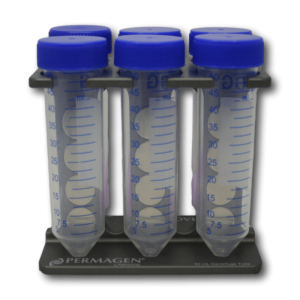
Permagen’s 50 mL Centrifuge Tube Magnetic rack is designed for magnetic bead separations from up to six, 50 mL Centrifuge tubes
Detail
Permagen’s 50 mL Centrifuge Tube Magnetic rack is designed for magnetic bead separations from up to six, 50 mL Centrifuge tubes
Accommodates any common 50 mL Centrifuge Tubes
Beads will be pulled to back wall allowing easy aspiration and tip tracking down the front wall of the tubes without disturbing bead pellet
Features include solid aluminum alloy design with hard coat finish for years of trouble-free use, rubber feet to help prevent slipping on work bench, less tippy than common plastic products, and fast separations using any magnetic beads
Nucleic acid testing (NAT) is the method of choice for detection and quantification of a wide range of micro organisms. Primerdesign manufactures and supplies high quality quantitative real-time PCR kits for the detection and simultaneous quantification of numerous significant pathogens . A copy number standard curve is provided for quantification and an the internal extraction template (DNA or RNA), controls for the quality of the nucleic acid extraction and eliminates false negative results.
The kit is designed with the broadest possible detection profile to ensure that all clinically relevant strains and subtypes are detected. Target sequences are selected by working with data from key opinion leaders in the field. Multiple sequence alignments and unprecedented real-time PCR expertise in design and validation ensure the best possible kit. Details of the target and priming specificity are included in the individual handbooks above.
Packaged, optimised and ready to use. Expect Better Data.
Document
Exceptional value for money Rapid detection of all clinically relevant subtypes Positive copy number standard curve for quantification Highly specific detection profile High priming efficiency Broad dynamic detection range (>6 logs) Sensitive to < 100 copies of target
Accurate controls to confirm findings
150 reactions
For isolation and cultivation of Listeria monocytogenes.
Principle:
Peptone provide carbon and nitrogen sources; yeast extract powder and starch provide carbon and nitrogen sources, vitamins and growth factors; sodium chloride maintains osmotic equilibrium; glucose carbon source; agar as medium coagulant.
Preservation and isolation of both cf-DNA and cf-RNA from a single tube
Fixative-free preservative, no cross-linking of DNA
Preserve cf-DNA/ct-DNA for 30 days at ambient temperature and for up to 8 days at 37°C
Preserve cf-RNA for 30 days at ambient temperature
Preserve Circulating Tumour Cells (CTCs) for 14 days at ambient temperature
No plasma volume loss after shipping/transportation
Prevent hemolysis allowing better separation of plasma
Prevent apoptosis of blood cells and fragmentation of genomic DNA
Produce high quality/quantity of plasma cf-DNA/ct-DNA/cf-RNA
Vacuumed to draw 8.7 mL of blood in 10 mL tubes
The procedure for plasma isolation using this kit is compliant with ISO 20186-3:2019
Norgen’s cf-DNA/cf-RNA Preservative Tubes are closed, evacuated plastic tubes for the collection and the preservation of cf-DNA, circulating tumor DNA, cf-RNA and circulating tumor cells in human whole blood samples during storage and shipping. Using these tubes in combination with Norgen’s Plasma/Serum Cell-Free Circulating DNA Purification Kits or Norgen’s Plasma/Serum RNA Purification Kits enables the purification and concentration of an inhibitor-free cf-DNA/ct-DNA/cf-RNA in a very small elution volume. Plasma recovered from Norgen’s cf-DNA/cf-RNA Preservative Tubes is also compatible with any other cf-DNA and/or cf-RNA purification method. The purified cf-DNA, ct-DNA and cf-RNA are compatible with any downstream application assays, including PCR, qPCR, rt-qPCR, methylation-sensitive PCR, Southern Blot analysis, gene expression analysis, microarrays and NGS.
This product is for research use only and not for use in diagnostic procedures.
Performance
Norgen’s cf-DNA/cf-RNA Preservative Tubes abridge the collection/processing of whole blood for the subsequent purification of cf-DNA and/or cf-RNA. The cf-DNA/cf-RNA Preservative Tubes preserve and inhibit the programmed cell-death (apoptosis) of the blood, hence preventing the release of intracellular DNA/RNA into plasma. Whole blood samples can be shipped and stored at room temperature for the subsequent processing of plasma. The cf/ct DNA and cf-RNA levels are stable for up to 30 days at room temperature. The cf-DNA is also stable for up to 8 days at 37°C. When blood collected on Norgen’s cf-DNA/cf-RNA tubes is processed for plasma recovery no buffy coat will be generated and the Circulating tumor cells (CTCs) will be located at the bottom of the tube with the blood sediment. CTCs are stable for 14 days at room temperature where it can be extracted from the blood sediment or from whole preserved blood for cell sorting or for cf/DNA or cf-RNA purification.
Plasma samples produced from the whole blood sample collected into Norgen’s cf-DNA/cf-RNA Preservative Tubes and purified using Norgen’s Plasma/Serum Cell-Free Circulating DNA Purification Kits or Norgen’s Plasma/Serum RNA Purification Kits yield concentrated, high-quality and inhibitor-free cf-DNA/ct-DNA or cf-RNA for any downstream application.
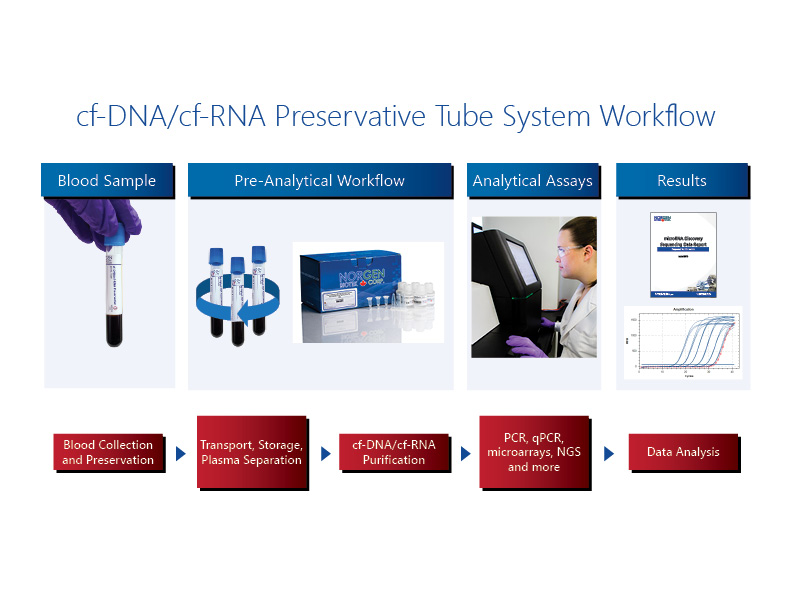
Workflow
NOTE: This product is for research use only. For the CE marked version, see Cat. Dx63950
Up to 30 days at room temperature (15-25°C) Up to 8 days at 37°C
Length of cf-RNA Preservation
Up to 30 days at room temperature (15-25°C)
Length of CTCs Preservation
Up to 14 days at room temperature (15-25°C)
Storage Conditions and Product Stability
When stored at 15-30°C, unfilled Norgen cf-DNA/cf-RNA Preservative Tubes are stable through the expiration date. See tube label for expiry date.
Short-term storage/shipping at -20°C to 37°C for up to 10 days is acceptable for unfilled Norgen cf-DNA/cf-RNA Preservative Tubes.
Do not freeze unfilled Norgen cf-DNA/cf-RNA Preservative Tubes for long term storage over 10 days. Freezing unfilled tubes may lead to loss of vacuum and precipitation may occur.
Cell-free DNA in blood samples collected in Norgen’s cf-DNA/cf-RNA Preservative Tubes is stable for up to 30 days when stored at room temperature (15-25°C)
Cell-free DNA in blood samples collected in Norgen’s cf-DNA/cf-RNA Preservative Tubes is stable for up to 8 days when stored at 37ºC.
Cell-free RNA in blood samples collected in Norgen’s cf-DNA/cf-RNA Preservative Tubes is stable for up to 30 days when stored at room temperature (15-25°C)
Circulating tumor cells (CTCs) in blood samples collected in Norgen’s cf-DNA/cf-RNA Preservative Tubes are stable for up to 14 days at room temperature (15-25ºC).