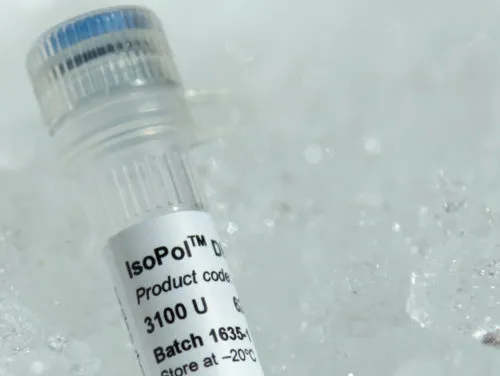
These DNA polymerases are ideal for Isothermal Amplification
IsoPol® BST+ is a heat-tolerant BST polymerase (large fragment) with enhanced strand-displacement activity. IsoPol® BST+ is active from 25 to 65°C. It is lacking 5’-3’- and 3’-5’-exonuclease activity.
IsoPol® BST+ is a heat-tolerant BST polymerase (large fragment) with enhanced strand-displacement activity. IsoPol® BST+ is active from 25 to 65°C. It is lacking 5’-3’- and 3’-5’-exonuclease activity.
Key features
IsoPol® BST+ lacks 5’-3’- and 3’-5’-exonuclease activity.
Inactivation – IsoPol® BST+ is completely inactivated after one minute incubation at 95°C
Enhanced strand displacement and processivity.
Increased salt tolerance.
IsoPol® BST+ Glycerol FREE
Is the popular choice f or isothermal applications such as LAMP and RT-LAMP at point-of-care diagnostics for its superior amplification performance and robustness. The enzyme is offered in a 1X storage buffer at a concentration < 300 U/µl
IsoPol® BST+ High Concentration Glycerol FREE
(IsoPol® BST+ HC Glycerol FREE) is used to ease the product development processes in sequencing technologies, solid phase amplification and several isothermal technologies. Same performance as IsoPol® BST+ (i.e., high processivity, relative SDA, and relative activity) with the only difference that it is offered in a 2X storage buffer at a concentration > 500 U/
Key features
High concentration
High purity
Lyophilisation and automation friendly
Figures
Properties
Other Products
Biotin-PEG4-alkyne
Product Info
Document
Product Info
Biotin-PEG4-alkyne is a PEG linker containing a biotin group and a terminal alkyne. Biotin is useful for affinity-based applications such as pull-down assays or for ligating with streptavidin proteins while terminal alkynes are used in copper (I) click chemistry with azides to form stable triazoles with a target molecule. The inclusion of a PEG linker in this molecule improves its aqueous solubility.
Document
Biotin-PEG4-alkyne is a PEG linker containing a biotin group and a terminal alkyne. Biotin is useful for affinity-based applications such as pull-down assays or for ligating with streptavidin proteins while terminal alkynes are used in copper (I) click chemistry with azides to form stable triazoles with a target molecule. The inclusion of a PEG linker in this molecule improves its aqueous solubility.
Plasmid DNA is ready for various downstream applications including restriction digestion, bacterial transformation, sequencing and more
Available in 4 formats: MiniPrep, MiniPrep (Magnetic Bead System), 96-Well MiniPrep (Magnetic Bead System), and MaxiPrep
These kits are designed for the rapid preparation of plasmid DNA from Escherichia coli.
Plasmid MiniPrep Kit
This kit is designed for the rapid preparation of plasmid DNA from small cultures of Escherichia coli using convenient spin columns. The plasmid DNA is preferentially purified from other cellular components such as genomic DNA and RNA. This kit is able to purify plasmids up to 13,000 bp in size, and the typical purification yield is up to 20 μg from 1.5 mL of bacterial culture. Purified DNA is of excellent quality for transformation, restriction enzyme digestion, sequencing and more. Also available in a 96-well format.
Plasmid MiniPrep Kit (Magnetic Bead System and High Throughput Magnetic Bead System)
Norgen’s Plasmid MiniPrep Kit (Magnetic Bead System) is designed for the rapid preparation of plasmid DNA from small batch cultures of Escherichia coli. Norgen’s magnetic beads bind DNA under optimized salt concentrations and release the bound DNA under low salt and slightly alkali conditions. The plasmid DNA is preferentially purified from other cellular components such as genomic DNA and RNA. The purified plasmids are fully digestible with all restriction enzymes tested, and are completely compatible with real-time PCR and NGS.
Norgen’s Plasmid MiniPrep Kit (Magnetic Bead System) is also available in a 96-well (HT) format for high throughput applications. Purification with the 96-well plates can be integrated with a robotic automation system.
Plasmid MaxiPrep Kit
This kit is designed for the rapid spin column preparation of plasmid DNA from up to 100 mL of Escherichia coli cultures. The kit allows for the isolation of plasmid DNA with final endotoxin levels of 0.1 EU/µg of DNA or less. The kit is able to purify plasmids up to 13,000 bp in size, and typical yields from a 100 mL culture for a high copy number plasmid are between 0.4 and 1.0 mg. The purified DNA is fully digestible with all restriction enzymes tested, and is completely compatible with manual or automated sequencing to achieve 95-100% accuracy.
All solutions should be kept tightly sealed and stored at room temperature. This kit is stable for 1 year after the of shipment. The RNase should be stored at -20°C upon arrival. The Resuspension Solution AZ should be stored at 4°C upon addition of RNase enzyme.
Component
Cat. 13300 (50 preps)
Cat. 46400 (250 preps)
Cat. 46500 (4 preps)
Cat. 46600 (20 preps)
Cat. 60300 (50 preps)
Cat. 63000 (192 preps)
Resuspension Solution AZ
12 mL
60 mL
20 mL
100 mL
12 mL
2 x 20 mL
Lysis Buffer N
40 mL
80 mL
40 mL
2 x 80 mL
40 mL
2 x 40 mL
Buffer TN
20 mL
130 mL
55 mL
2 x 130 mL
20 mL
1 x 55 mL 1 x 20 mL
Wash Solution E
12 mL
2 x 18 mL
–
–
–
–
Elution Buffer K
8 mL
30 mL
–
–
8 mL
2 x 8 mL
Wash Solution J
–
–
25 mL
3 x 25 mL
–
–
Elution Buffer J
–
–
24 mL
120 mL
–
–
RNase A
1 vial
1 vial
1 vial
1 vial
1 vial
1 vial
Magnetic Bead Suspension
–
–
–
–
1 x 1.1 mL
4 x 1.1 mL
Spin Columns
50
250
–
–
–
–
Collection Tubes
50
250
–
–
–
–
DNA Maxi Spin Columns with Collection Tubes (Clear ring in column)
–
–
4
20
–
–
Maxi Spin Filter Columns with Collection Tubes (Grey ring in column)
NGS Low Input DNA Library Prep Kit (illumina and MGI Platforms)
Product Info
Document
Product Info
The NGS Low Input DNA Library Prep Kit (illumina and MGI Platforms) was developed for construction of high quality NGS libraries with low input DNA amount from 1 ng to 400 ng. The kit allows scientist to study samples with limited DNA such as tumor samples, patient samples, and other specially collected samples (FACS sorting etc.). The kit has high library conversion efficiency with as little as 1 ng DNA input. The fast and simple 1.5-hour protocol makes libraries with even coverage and low GC-bias based our unique chemistry for DNA end-polishing and ligation.
The kit needs double strand DNA fragments (blunt and/or sticky) as input DNA for NGS library preparation, and is compatible with DNA fragments generated from both enzymatic approach (for example, BioDynami DNA fragmentation enzymes, Cat.# 40061 and Cat.# 40062) and mechanical approaches such as sonication and nebulization etc.
NGS Low Input DNA Library Prep Kit Workflow
Three index types are available for the NGS Low Input DNA Library Prep Kit of illumina platform:
Non-index (Cat.# 30022): Libraries do not have index.
Index (Cat.# 30024): Each of our index primers contains a unique barcode sequence with 6 bases that can be used to identify the low input DNA libraries. Library multiplexing up to 48 samples is possible. Index information can be downloaded here.
Unique dual index (Cat.# 30025): Library multiplexing up to 96 low input DNA libraries is possible with unique dual indexes with our Four-Base Difference Index System. The system allows us to make indexes for the libraries that have at least 4 bases different from each other in the 8-base barcode length. Our unique dual index primers can reduce sequencing errors such as de-multiplexing errors, amplification errors, mis-assignment of reads, index cross-contamination, and also index hopping. The kit includes 96 pre-mixed unique pairs of index primers. Index information can be downloaded here.
Indexes are available for the MGI platform kits (Cat.# 34024).
Kit advantages:
Fast protocol
The hands-on time is only 10 minutes
The total protocol time is around 1.5 hours
Simple procedure
Ready-to-use master mix makes it simple for reaction setup
Less reaction components
Less magnetic beads required for cleanup steps: Save the cost more than 50%
Low input DNA amount: Starts from 1 ng of DNA
Comparison of library conversion efficiency under the same NGS library preparation condition. Input DNA amounts are 1 ng and 10 ng, respectively. DNA was mechanical sheared with Covaris before library prep. BioDynami kit: NGS Low Input DNA Library Prep Kit (Cat. #30022).
Comparison of library yield under the same NGS library prep condition. Input DNA amounts are 1 ng, 10 ng, and 100 ng. DNA was mechanical sheared with Covaris before library prep. BioDynami kit (Cat. #30022). PCR cycle numbers were indicated.