The PCR Decontamination Kit can remove contaminating DNA in PCR master mixes, without reduction of PCR sensitivity.
Detail
OverView
The PCR Decontamination Kit can remove contaminating DNA in PCR master mixes, without reduction of PCR sensitivity.
The double-strand specific property of the dsDNase allows decontamination with primers and probe present.
Efficient for end-point PCR, probe-based qPCR, and some SYBR based qPCR mixes.
Contaminating bacterial DNA can be reduced to levels below the detection limit.
Fast and easy protocol.
Flat NTCs (No Template Controls).
Decontamination of master mixes without reduction of sensitivity has always been a challenge. Especially when minor amounts of DNA are targeted, contaminating DNA is a major problem. Any loss of sensitivity in the qPCR assay caused by the decontamination protocol is unacceptable.
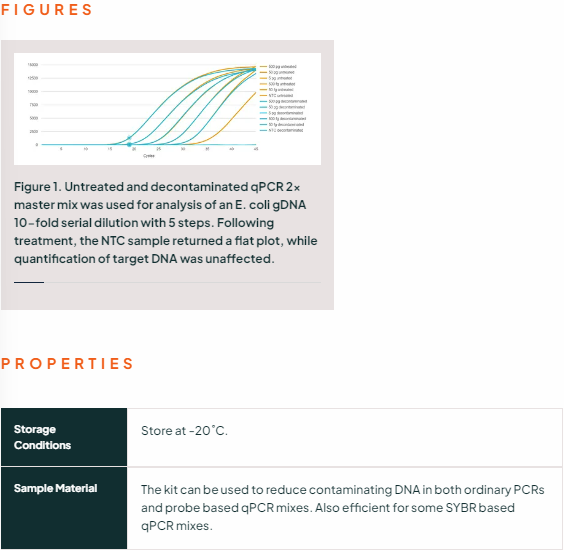
In Figure 1, it is demonstrated that the PCR decontamination kit can remove contaminating DNA from a qPCR mix to non-detectable levels (flat NTC), without affecting the sensitivity of the qPCR.
Xenotropic murine leukemia virus-related virus (XMRV) is a gammaretrovirus. The virus was first described in 2006 and has since been isolated from human biological samples. XMRV belongs to the family Retroviridae and the genus gammaretrovirus. It has a single-stranded RNA genome that replicates through a DNA intermediate. The virus gets its name due to its close relationship with the murine leukemia viruses (MuLVs). The viral genome is approximately 8100 nucleotides in length and is 95% identical with several endogenous retroviruses of mice. While gammaretroviruses have well-characterized oncogenic effects in animals, they have not been shown to cause human cancers. However, XMRV was recently discovered in human prostate cancers and is the first gammaretrovirus known to infect humans. In addition to prostate cancer, a possible association with chronic fatigue syndrome has been reported, however it has yet to be established whether XMRV is a cause of this disease.
The causal role of XMRV in cancer has yet to be established and the virus does not appear to be capable of transforming cells directly. In prostate cancer, XMRV protein has been found in tumour-associated but nonmalignant stromal cells, but not in the actual prostate cancer cells. This raises the possibility that the virus may support tumorigenesis. In other studies, XMRV proteins and nucleic acids were found in malignant cells.
Storage Conditions and Product Stability All kit components can be stored for 1 year after the date of production without showing any reduction in performance.
All kit components should be stored at -20°C upon arrival. Repeated thawing and freezing (> 2 x) of the Master Mix and Positive Control should be avoided, as this may affect the performance of the assay. If the reagents are to be used only intermittently, they should be frozen in aliquots.
[DL1000] ExcelDye™ 6X DNA Loading Dye, Orange, 5 ml x 2
Product Info
Document
Product Info
Description
The ExcelDye™ 6× DNA Loading Dye (Orange) is pre-mixed buffer for tracking the DNA sample during the electrophoresis on agarose or polyacrylamide gels. It contains one dye (Orange G) for tracking the DNA migration. The Orange G migrates at approximately 30 bp on a standard 2% TAE agarose gel (50 bp on 1% TAE agarose gel). The included glycerol keeps the DNA at the bottom of the well and the presence of EDTA chelates divalent metal ions to prevent the process of metal-dependent nuclease.
Composition
0.15% Orange G
10 mM Tris-HCl (pH 8.0)
60% glycerol
60 mM EDTA
Storage
4°C for 12 months -20°C for 36 months
Document
The ExcelDye™ 6× DNA Loading Dye (Orange) is pre-mixed buffer for tracking the DNA sample during the electrophoresis on agarose or polyacrylamide gels. It contains one dye (Orange G) for tracking the DNA migration. The Orange G migrates at approximately 30 bp on a standard 2% TAE agarose gel (50 bp on 1% TAE agarose gel). The included glycerol keeps the DNA at the bottom of the well and the presence of EDTA chelates divalent metal ions to prevent the process of metal-dependent nuclease.
Nucleic acid testing (NAT) is the method of choice for detection and quantification of a wide range of micro organisms. Primerdesign manufactures and supplies high quality quantitative real-time PCR kits for the detection and simultaneous quantification of numerous significant pathogens . A copy number standard curve is provided for quantification and an the internal extraction template (DNA or RNA), controls for the quality of the nucleic acid extraction and eliminates false negative results.
The kit is designed with the broadest possible detection profile to ensure that all clinically relevant strains and subtypes are detected. Target sequences are selected by working with data from key opinion leaders in the field. Multiple sequence alignments and unprecedented real-time PCR expertise in design and validation ensure the best possible kit.
Details of the target and priming specificity are included in the individual handbooks above.
Packaged, optimised and ready to use. Expect Better Data.
Document
Exceptional value for money Rapid detection of all clinically relevant subtypes Positive copy number standard curve for quantification Highly specific detection profile High priming efficiency Broad dynamic detection range (>6 logs) Sensitive to < 100 copies of target
Accurate controls to confirm findings