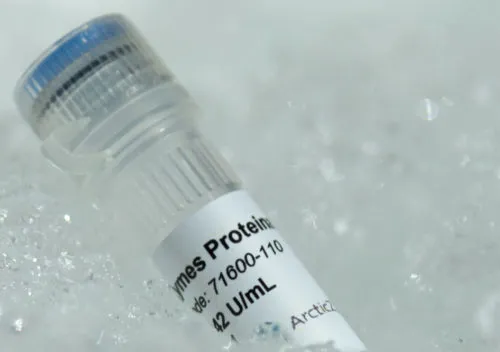
ArcticZymes Proteinase is an unspecific endopeptidase originating from an Arctic marine microbial source. It has broad substrate specificity and is easy to inactivate after use.
Histones and other proteins are known to protect nucleic acids from interacting optimally with other DNA binding proteins and enzymes. ArcticZymes Proteinase is ideally suited for transforming chromatin and other dense nucleic acids to naked DNA. The enzyme is easy to heat-inactivate. This allows thermal inactivation at temperatures allowing RNA integrity as well as avoiding dissociation of dsDNA.
Detail
OverView
ArcticZymes Proteinase is an unspecific endopeptidase originating from an Arctic marine microbial source. It has broad substrate specificity and is easy to inactivate after use.
Histones and other proteins are known to protect nucleic acids from interacting optimally with other DNA binding proteins and enzymes. ArcticZymes Proteinase is ideally suited for transforming chromatin and other dense nucleic acids to naked DNA. The enzyme is easy to heat-inactivate. This allows thermal inactivation at temperatures allowing RNA integrity as well as avoiding dissociation of dsDNA.
Key Features
Easy to inactivate after use: 15 – 30 min at 55 – 60°C
Broad substrate specificity
Active at high salt concentrations
Compatible with downstream DNA analyses
Available in Glycerol FREE formulation
Applications
Lysis and releasing nucleic acid from single-cells and small tissue samples
Optimization of DNA/RNA yields from nucleic acids when added to extraction procedures
Short term stability: 2-8oC, Long term stability: See individual component labels
Stability:
> 2 years under recommended storage conditions
Analyte:
Ethanol
Assay Format:
Spectrophotometer, Microplate, Auto-analyser
Detection Method:
Absorbance
Wavelength (nm):
340
Signal Response:
Increase
Linear Range:
0.25 to 12 µg of ethanol per assay
Limit of Detection:
0.093 mg/L
Reaction Time (min):
~ 5 min
Application examples:
Wine, beer, cider, alcoholic fruit juices, spirits, liqueurs, low-alcoholic / non-alcoholic beverages, pickles, fruit and fruit juice, chocolate products, vinegar, jam, bread and bakery products, honey, soy sauce, dairy products, cosmetics, pharmaceuticals and other materials (e.g. biological cultures, samples, etc.).
Method recognition:
Methods based on this principle have been accepted by AOAC (AOAC Method 2019.08, First Action), IFU, EBC Method 9.3.1, MEBAK and ASBC Method Beer 4-F
The Ethanol test kit is a simple, reliable and accurate method for the measurement and analysis of ethanol in beverages and foodstuffs.
Note for Content: The number of manual tests per kit can be doubled if all volumes are halved. This can be readily accommodated using the MegaQuantTM Wave Spectrophotometer (D-MQWAVE).
DBCO-PEG24-TFP ester is a heterobifunctional PEG linker with an azide-reactive DBCO and an amine-reactive TFP ester that is less susceptible to hydrolysis than an NHS ester. The PEG linker improves the water solubility of the compound. Reagent grade, for research purpose. Please contact us for GMP-grade inquiries.
Document
DBCO-PEG24-TFP ester is a heterobifunctional PEG linker with an azide-reactive DBCO and an amine-reactive TFP ester that is less susceptible to hydrolysis than an NHS ester. The PEG linker improves the water solubility of the compound. Reagent grade, for research purpose. Please contact us for GMP-grade inquiries.
DBCO-PEG36-TFP ester is an amine-reactive, labeling reagent used to modify proteins, antibodies, and other amine-containing biopolymers. The hydrophilic PEG spacer arm provides a long and flexible connection that minimizes steric hindrance involved with ligation to complementary azide-containing molecules. The TFP ester is less susceptible to undergo hydrolysis compared to the NHS ester. Reagent grade, for research purpose. Please contact us for GMP-grade inquiries.
Document
DBCO-PEG36-TFP ester is an amine-reactive, labeling reagent used to modify proteins, antibodies, and other amine-containing biopolymers. The hydrophilic PEG spacer arm provides a long and flexible connection that minimizes steric hindrance involved with ligation to complementary azide-containing molecules. The TFP ester is less susceptible to undergo hydrolysis compared to the NHS ester. Reagent grade, for research purpose. Please contact us for GMP-grade inquiries.