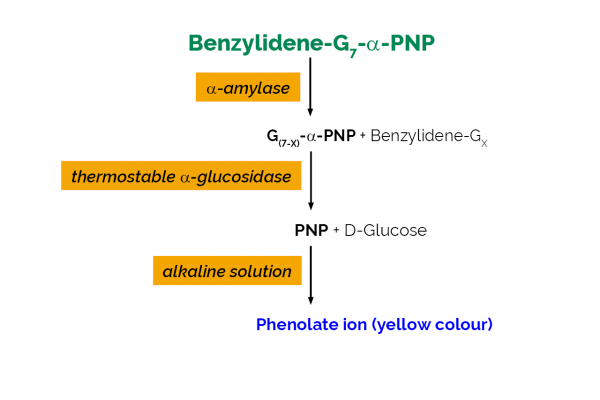
The Ceralpha Method: α-Amylase test kit is suitable for the specific measurement and analysis of α-amylase in cereal grains and fermentation broths (fungal and bacterial).
Detail
K-CERA
SKU: 700004273
100 assays per kit
Content:
100 assays per kit
Shipping Temperature:
Ambient
Storage Temperature:
Short term stability: 2-8oC, Long term stability: See individual component labels
Stability:
> 2 years under recommended storage conditions
Analyte:
α-Amylase
Assay Format:
Spectrophotometer, Auto-analyser
Detection Method:
Absorbance
Wavelength (nm):
400
Signal Response:
Increase
Limit of Detection:
0.003 U/g
Reproducibility (%):
~ 3%
Total Assay Time:
~ 30 min
Application examples:
Cereal flours, fermentation broths and other materials.
Method recognition:
AACC Method 22-02.01, AOAC Method 2002.01, ICC Standard No. 303, RACI Standard Method and CCFRA (Flour Testing Working Group Method 0018)
The Ceralpha Method: α-Amylase test kit is suitable for the specific measurement and analysis of α-amylase in cereal grains and fermentation broths (fungal and bacterial).
All reagents stable for > 2 years after preparation
Very specific
Simple format
Mega-Calc™ software tool is available from our website for hassle-free raw data processing
Standard included
Validation of Methods
Other Products
Preserved Blood RNA Purification Kit II (for use with PAXgene Blood RNA Tubes)
Product Info
Document
Product Info
Overview
Compatible with PAXgene Blood RNA Tubes
Isolate true total RNA including siRNA and microRNA
No phenol extractions
Purify high-quality RNA in 30 minutes
Purified RNA is suitable for a variety of downstream applications, including Small RNA Sequencing. Find out more information on Norgen’s NGS services
Purification is based on spin column chromatography that uses Norgen’s proprietary resin separation matrix
Norgen’s Preserved Blood RNA Purification Kit II provides a rapid method for the isolation and purification of total RNA from blood that has been preserved using PAXgene Blood RNA Tubes*. The kit purifies all sizes of RNA, from large mRNA and ribosomal RNA down to microRNA (miRNA) and small interfering RNA (siRNA). The RNA is preferentially purified from other cellular components such as proteins, without the use of phenol or chloroform.
Purification is based on spin column chromatography using Norgen’s proprietary resin as the separation matrix. Norgen’s proprietary resin provides superior affinity to the full size range of RNA molecules, resulting in large and small RNA (miRNA) purification with better linearity and sensitivity. The purified RNA is of the highest integrity, and can be used in a number of downstream applications including real time RT-PCR, RT-PCR, Northern blotting, RNase protection and primer extension, expression profiling, miRNA cloning and amplification and Next Generation Sequencing.
* PAXgene Blood RNA Tubes are a product of PreAnalytiX GmbH. PAXgene Blood RNA Tubes are not provided.
Storage Conditions and Product Stability All solutions should be kept tightly sealed and stored at room temperature. This kit is stable for 1 year after the date of shipment. The DNase I should be stored at -20°C.
This product is suitable for rapid extraction of total DNA from tissue, cells, blood, saliva, swabs, blood spots, semen and other clinical samples. DNA can be used directly for PCR, quantitative PCR, Southern Blot, test of virus DNA and so on.
Details
Specifications
Features
Specifications
Main Functions
Isolation total DNA from tissue / blood / body fluid / swab /dry blood spots
Applications
PCR, qPCR, southern bolt and virus detection, etc.
Purification method
Mini spin column
Purification technology
Silica technology
Process method
Manual (centrifugation or vacuum)
Sample type
Tissue, cell, blood, saliva, swab, blood spot, semen and other clinical samples
This product is based on silica Column purification. The sample is lysed and digested with lysate and protease, DNA is released into the lysate. Transfer to an adsorption column. Nucleic acid is adsorbed on the membrane, while protein is not adsorbed and is removed with filtration. After washing proteins and other impurities, nucleic acid was finally eluted with low-salt buffer (10mm Tris, pH9.0, 0.5mm EDTA).
Advantages
High quality DNA – meet a variety of downstream applications, including PCR, qPCR, enzyme digestion, hybridization, etc.
Fast – without separation of leukocytes, organic extraction or ethanol precipitation
Simple – all nucleic acids can be obtained by direct digestion
Wide applicability – It can handle various liquid samples, animal tissues and cultured cells
Kit Contents
Contents
IVD3018
Purification Times
100
HiPure DNA Mini Columns I
100
2ml Collection Tubes
2 x 100
Buffer ATL
60 ml
Buffer AL
60 ml
Buffer GW1
44 ml
Buffer GW2
50 ml
Proteinase K
60 mg
Protease Dissolve Buffer
5 ml
Buffer AE
15 ml
Storage and Stability
Proteinase K should be stored at 2–8°C upon arrival. However, short-term storage (up to 12 weeks) at room temperature (15–25°C) does not affect their performance. The remaining kit components can be stored at room temperature (15–25°C) and are stable for at least 18 months under these conditions. The entire kit can be stored at 2–8°C, but in this case buffers should be redissolved before use. Make sure that all buffers are at room temperature when used.
Experiment Data
Document
This product is suitable for rapid extraction of total DNA from tissue, cells, blood, saliva, swabs, blood spots, semen and other clinical samples. DNA can be used directly for PCR, quantitative PCR, Southern Blot, test of virus DNA and so on.
Biocolor’s Purple-Jelley assay kit is the perfect tool for accurate measurement of hyaluronic acid / Hyaluronan levels in your samples. This colorimetric assay is optimised for quantitative analysis in-vivo, tissue-derived hyaluronic acid / Hyaluronan and includes full step-by-step instructions.
Colorimetric Detection (655nm) (Endpoint)
Hyaluronic Acid: A gentle giant!
Hyaluronic acid, in its hydrated form, is a unique carbohydrate polymer, often referred to as a ‘gentle giant.’ It consists of a lengthy, flexible, non-branching chain with a repeating disaccharide pattern. This disaccharide is composed of alternating uronic acid and aminosugar units.
Why is our kit called ‘Purple-Jelley’?
Discovering the J-Aggregate Effect in Cyanine DyesIn 1936, Edwin Jelley made a fascinating observation, documented it in a letter to Nature (Nature 138, 1009 – 1010). He noted a peculiar behaviour of certain cyanine dyes, that when dissolved in 5 M NaCl, they dyes exhibited a third absorbance peak at a longer wavelength, around 650nm. In deionized water, however, they displayed only a double peak at approximately 540nm and 570nm. The 650nm peak in concentrated dye solutions resulted from the aggregation of dye molecules and was later termed a ‘J-aggregate,’ in honor of Edwin Jelley. The J-aggregate is known as a supra-molecular complex, formed by stacking individual dye molecules.
Subsequent research in the 1960s, notably by Kay et al. (J. Physical Chem. 68, 1896 – 1906), revealed that various biological polymers, including proteins, DNA, polar lipids, and glycosaminoglycans, could also induce this third absorbance peak. This phenomenon led to the development of the Purple-Jelley assay, named after the purple color of the dye reagent and Edwin Jelley himself.
An overview of the Purple-Jelley assay steps:
During the assay, hyaluronic acid is selectively purified during the assay sample preparation protocol. This is then reacted with the Purple-Jelley dye reagent, and the absorption of the characteristic third wavelength recorded. By comparison with a calibration curve the hyaluronic acid content of the sample can be measured.
Step 1. The assay protocol takes tissue samples through a sequential sample preparation protocol which involves enzymatic protein digestion, followed by precipitation and purification of GAGs, culminating in the precipitation of purified Hyaluronic acid.
Step2. The processed sample is then incubated for 10 minutes with the Purple-Jelley dye reagent, forming a coloured product which can be measured spectrophotometrically.
Step 3. The Hyaluronic acid content of unknown samples can be calculated by comparison against a calibration curve prepared using a standard comprising hyaluronic acid (supplied with the kit).
Assay range
10 – 100µg/ml
Limit of Detection
10µg/ml
Detection Method
Colorimetric Detection (655nm) (Endpoint)
Measurements per kit
100 in total (allows a maximum of 46 samples to be run in duplicate alongside a standard curve).
Suitable Samples
In-vivo: Hyaluronic acid purified from in-vivo tissues. The kit protocol involves extraction and purification of hyaluronic acid prior to reaction with the Purple-Dye reagent.
Precautions
This kit is designed for research use only. Not for use in diagnostic procedures. Kit requires access to a centrifuge, as well as a spectrophotometer/colorimeter capable of colorimetric, absorbance detection at 655nm. Specific sample preparation protocols may require customer to provide further reagents, consult assay manual for further information.
2. Hyaluronan Reference Standard (1x 5ml, 0.2mg/ml soluble Hyaluronic Acid)
3. Precipitating Reagent (2x 34ml)
4. Sodium Chloride (1x 20ml)
5. Cetylpyridinium Chloride (1x 20ml)
6. TRIS-buffered Saline (5x tablets)
7. 2ml screw-cap tubes for preparation of samples.
8. Assay kit manual
NB: Additional reagents may be required for sample preparation prior to assay. Consult manual or contact us for further details.
Document
Biocolor’s Purple-Jelley assay kit is the perfect tool for accurate measurement of hyaluronic acid / Hyaluronan levels in your samples. This colorimetric assay is optimised for quantitative analysis in-vivo, tissue-derived hyaluronic acid / Hyaluronan and includes full step-by-step instructions.