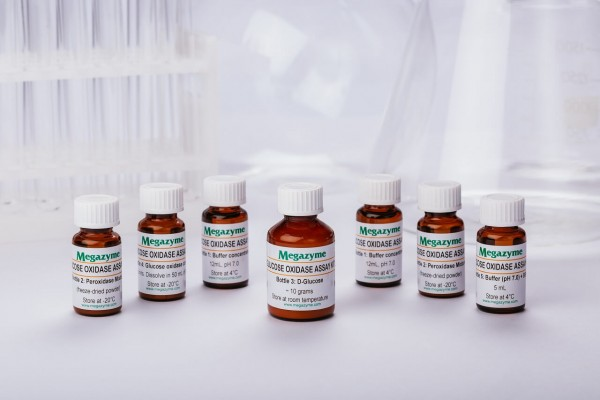
The Glucose Oxidase assay kit is a simple procedure for the rapid and reliable measurement and analysis of glucose oxidase activity in industrial enzyme preparations and bread improver mixtures.
Short term stability: 2-8oC, Long term stability: See individual component labels
Stability:
> 2 years under recommended storage conditions
Analyte:
Glucose Oxidase
Assay Format:
Spectrophotometer, Microplate, Auto-analyser
Detection Method:
Absorbance
Wavelength (nm):
510
Signal Response:
Increase
Linear Range:
0.01 to 0.08 U/mL of glucose oxidase per assay
Limit of Detection:
10 U/L
Reaction Time (min):
~ 20 min
Application examples:
Enzyme preparations, and other materials (e.g. biological cultures, samples, etc.).
Method recognition:
Novel method
The Glucose Oxidase assay kit is a simple procedure for the rapid and reliable measurement and analysis of glucose oxidase activity in industrial enzyme preparations and bread improver mixtures.
All reagents stable for > 12 months after preparation
Simple format
Mega-Calc™ software tool is available from our website for hassle-free raw data processing
Standard included
Suitable for manual, microplate and auto-analyser forma
Other Products
Plasma/Serum Exosome and Free-Circulating RNA Isolation Kits
Product Info
Document
Product Info
Overview
Isolate all sizes of RNA, including microRNA, irrespective of size or GC content, without bias.
Versatile sample input ranges
Isolate all sizes of free-circulating RNA, including microRNA
The purified exosomal RNA is free from any circulating RNA-binding proteins
No phenol extractions, Proteinase K treatment, nor carrier RNA
No time-consuming ultracentrifugation, filtration nor special syringes are required
No precipitation reagents, nor overnight incubation required
Concentrate isolated exosomal RNA and are free-circulating RNA into a flexible elution volume ranging from 50 µL to 100 µL
Purification is based on spin column chromatography that uses Norgen’s proprietary resin separation matrix
These kits provide a fast, reliable and convenient method to sequentially isolate and concentrate exosomal RNA as well as Free-Circulating RNA from different plasma/serum sample volumes. The purification is based on spin column chromatography that employs Norgen’s proprietary resin. These kits are designed to isolate all sizes of RNA, including microRNA as well as all sizes of the free-circulating protein-bound RNA, including microRNA. These kits provide a clear advantage over other available kits in that they do not require any special instrumentation, protein precipitation reagents, extension tubes, phenol/chloroform or protease treatments. Moreover, these kits allow the user to elute into a flexible elution volume ranging from 50 µL to 100 µL. The RNA isolated from the purified exosomes is free from any protein-bound circulating RNA and is of the highest integrity. Moreover, the free-circulating, protein-bound, RNA is free from any exosomal RNA. The purified RNA can be used in a number of downstream applications including real time PCR, reverse transcription PCR, Northern blotting, RNase protection and primer extension, and expression array assays.
Plasma/Serum Exosome and Free-Circulating RNA Isolation Mini Kit
For sample volumes ranging from 50 µL to 1 mL.
Plasma/Serum Exosome and Free-Circulating RNA Isolation Midi Kit
For sample volumes ranging from 1 mL to 4 mL.
Plasma/Serum Exosome and Free-Circulating RNA Isolation Maxi Kit
All sizes, including miRNA and small RNA (< 200 nt)
Elution Volume
50 – 100 µL
Time to Complete 10 Purifications
35 – 40 minutes
Average Yields*
Variable depending on specimen
*Please check page 5 of the product insert for the average yields and the common RNA quantification methods
Storage Conditions and Product Stability All solutions should be kept tightly sealed and stored at room temperature. This kit is stable for 2 years after the date of shipment. It is recommended to warm Lysis Buffer A for 20 minutes at 60°C if any salt precipitation is observed.
Important Note This kit is suitable for the purification of exosomes from fresh or frozen serum or plasma prepared from blood collected on either EDTA or Citrate. Plasma samples prepared from blood collected on heparin should not be used as heparin can significantly interfere with many downstream applications such as RT-PCR.
AZscript™ Reverse Transcriptase (RT) is an RNA-dependent DNA polymerase used to synthesize complementary DNA (cDNA) from an RNA template.
While originating from Moloney Murine Leukemia Virus (M-MLV), AZscript RT has been engineered for increased thermostability and reduced RNase H activity.
In cDNA synthesis a higher reaction temperature can reduce RNA secondary structures and improve efficiency and specificity of the reaction.
Furthermore, a reduction in RNase H activity increases performance of the cDNA synthesis, especially for longer transcripts.
The combination of these tailored features ensures that AZscript Reverse Transcriptase provides an effective and reliable solution for various cDNA synthesis applications.
Key Features
Increased thermostability.
Reduced RNase H activity.
Applications
cDNA synthesis
Demonstrated performance in RT-qPCR
Figures
Document
AZscript™ Reverse Transcriptase (RT) is an RNA-dependent DNA polymerase used to synthesize complementary DNA (cDNA) from an RNA template.
40nm Colloidal Gold for Lateral Flow is a highly stable and uniform 40 nm gold nanoparticles can be supplied in a range from 1 OD to 100 OD. The quality and performance of a conjugate is critical to successful lateral flow test manufacturing. Our products are made in USA and produced in a state-of-the-art manufacturing facility that enable rapid turnaround times while ensuring batch to batch consistency and reliability.
Bulk pricing and manufacturing supply contracts available.
Functionally Tested in Lateral Flow
Specifications 1OD 40nm Gold (1L)
Number of particles/mL
5.2-7.2 x 10¹⁰
Gold Concentration (mg/mL)
3.7-4.2 x 10⁻²
Molar Concentration (moles/liter)
8-12 x 10-11
Particle Diameter
40 nm /- 1.5
Document
Number of particles/mL 5.2-7.2 x 10¹⁰ • Gold Concentration (mg/mL) 3.7-4.2 x 10⁻² • Molar Concentration (moles/liter) 8-12 x 10-11 • Particle Diameter 40 nm /- 1.5