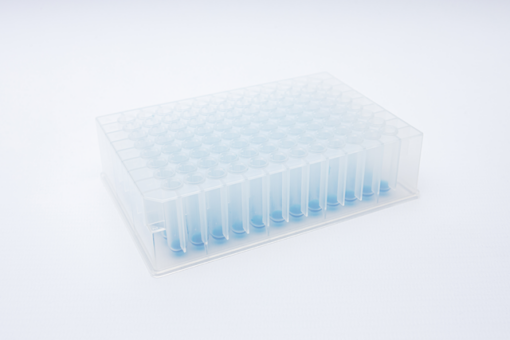
Working volume of 1.0ml Round well with ‘Round bottom. High uniformity from well to well Raised well rims for reliable closing with heat sealing. Easy and reliable stacking Good centrifugation stability up to 6,000 × g for faster protocols and improved sample quality Manufactured under DNase/ RNase free environment without slip agents, plasticizers or biocides – Materials which could have a negative effect on bioassays Pure, virgin polypropylene guarantees good extractible performance, high resistance to chemicals, good mechanical stress and working with temperature extremes Autoclavable (121 °C, 20 min)
Detail
Overview
Working volume of 1.0ml
Round well with ‘Round bottom.
High uniformity from well to well
Raised well rims for reliable closing with heat sealing.
Easy and reliable stacking
Good centrifugation stability up to 6,000 × g for faster protocols and improved sample quality
Manufactured under DNase/ RNase free environment without slip agents, plasticizers or biocides – Materials which could have a negative effect on bioassays
Pure, virgin polypropylene guarantees good extractible performance, high resistance to chemicals, good mechanical stress and working with temperature extremes
Autoclavable (121 °C, 20 min)
Other Products
PACE® NANO GENOTYPING MASTER MIX
Product Info
Document
Product Info
ABOUT
Step into the future of high-throughput PCR genotyping with PACE Nano! Backed by decades of expertise in high-throughput genotyping reagent manufacturing, our groundbreaking product is engineered specifically to excel in low and ultra-low volume reactions. Say goodbye to performance variability as PACE Nano Genotyping Master Mix and PACE Genotyping Assays raise the bar for reliability and performance in the field.
With superior cost-effectiveness and versatile compatibility, PACE Nano Genotyping Master Mix ensures consistent results across diverse platforms, samples, and markers, including 384- and 1536-well PCR, Array Tape™, SNPline™ and Gene Mathematica from HC Scientific, available from 3CR Bioscience, supporting reaction volumes as low as 0.8 µL. Join the revolution today and elevate your research with PACE Nano.
Cost-Effective: Produce more high-quality data faster and at a much lower cost compared to competitors, reducing reagent expenses without compromising on quality.
Optimised for Low and Ultra-Low Volume PCR Genotyping: PACE Nano Genotyping Master Mix is specifically tailored for enhanced performance in miniaturised PCR genotyping, for reaction volumes as low as 0.8 µL and for high-throughput and automated processing with accurate, reliable results.
Consistent Data Across Assays: PACE Nano reduces variability in assay performance, enhancing the robustness and efficiency of high throughput, miniaturised and automated workflows.
Backed by 20 Years of Expertise: Designed and manufactured with 20 years of experience in high-throughput genotyping reagents, ensuring reliability and quality.
Scalability: Our PACE® genotyping reagents are platform agnostic, so you can adapt to changing throughput requirements effortlessly, ensuring flexibility and efficiency at every stage of your genotyping workflow.
PACE Nano Global Product Support: Benefit from a stable supply chain and unparalleled global product support, tailored to your needs regardless of size or throughput. Supported by the highest quality-assurance processes, ensuring reliability and consistency.
REQUIRED COMPONENTS
qPCR machine or Thermocycler + Fluorescent plate reader
PCR plate or equivalent and appropriate optically clear seal
Magnetic bead nucleic acid purification technology uses nano or micron superparamagnetic material as the matrix, generally black ferric oxide or yellowish brown ferricoxide as the magnetic material. The surface of bead is coated with appropriate functional groups, which can adsorb nucleic acid. Magnetic beads commonly used for nucleic acids, containing carboxyl groups, hydroxyl groups, or silicon groups. Silicon-based magnetic beads are the most common, and its principle of adsorbing nucleic acid is consistent with the classical glass milk purification technology or glass fiber filter membrane purification method. Magpure particle is a kind of polydisperse fast speed silica magnetic beads. The core is ferricoxide, accounting for 50%, and the surface coating is silica, accounting for 50%. The product can be used for plasmid extraction, gel DNA recovery, product purification, genomic DNA and RNA extraction, and viral nucleic acid extraction.
Details
Specifications
Features
Specifications
Concentration
40 mg/ml
Appearance
Suspension of dark brown particles
Surface functional group
Si-OH, Silanol
Dispersibility
Monodisperse,spherical
Particle size
1.0-1.5 μm
Preservation conditions
Room Temperature, valid for up to 2 years.It is recommended to store in 2-8°C to prevent microbial growth.
Magnetic response speed
~30 seconds
Settling velocity
>3 minutes
High salt mediated binding
>2M guanidine isothiocyanate, DNA recovery up to 80%
Alcohol mediated binding
2M guanidine hydrochloride / isopropanol (30%), and the recovery of DNA / RNA was as high as 85%
PEG8000 mediated binding
The recovery of DNA/RNA was up to 85%
DNase/RNase
Not detected
DNA residue
Not detected
Recommended application
Genomic DNA extraction, RNA extraction, viral nucleic acid extraction, circulating DNA isolation
Principle
Highsalt mediated binding: in the solution containing 2-4M guanidine isothiocyanate, Magpure particles can selectively recover DNA molecules, and impurities such as protein polysaccharides are not adsorbed.
Alcohol mediated binding: in the solution containing guanidine salt and alcohol (>25%), Magpure particles can selectively recover DNA/RNA molecules, and proteins and other impurities are not adsorbed.
After biological samples are treated with digestive solution or lysis Buffer, DNA/RNA is released from cells, organelles and protein complexes (ribosomes and nucleosomes) into reagents. After Magpure particles and binding solution are added, DNA/RNA is adsorbed to the surface of Magpure particles to form DNA/RNA bead complex. Under the action of the magnetic field, the magnetic beads are separated and collected, and the impurities such as protein are removed with the waste liquid. After two or three steps of further cleaning, the DNA/RNA magnetic bead complex is resuspended in sterilized water or TE buffer, and the DNA/RNA falls off from the surface of the magnetic beads, so as to achieve the purpose of purification.
gDNA/RNA Isolation from Blood, Tissue, Plant, Swab, Spots, Stool, Soil and etc.Viral DNA/RNA IsolationAgarose Gel DNA Purification
DNA/RNA Isolation from low nucleic acid content samplesPlasmid IsolationDNA/RNA Clean Up
Circulating DNA IsolationViral Nucleic acid IsolationgDNA Isolation FFPE DNA/RNA Isolation
Plasmid extractiongel DNA recoverygenomicDNA/RNA extraction viral nucleic acid extractionCirculating DNA extraction
DNA/RNA Clean Up and concentrationDNA/RNA Isolation from low nucleic acid content samplesResearch immuno assays
The MagPure magnetic-particle technology combines the speed and efficiency of silica-based DNA purification with the convenient handling of magnetic particles. DNA binds to the silica surface of the magnetic particles in the presence of a chaotropic salt. DNA bound to the particles is then efficiently washed, considerably improving the purity of DNA. High-quality DNA is eluted. The automated purification procedure completely removes enzymes, nucleotides, and other contaminants and inhibitors. Purified DNA is suitable for direct use in downstream applications, such as sequencing and microarray analysis.
Document
Magnetic bead nucleic acid purification technology uses nano or micron superparamagnetic material as the matrix, generally black ferric oxide or yellowish brown ferricoxide as the magnetic material. The surface of bead is coated with appropriate functional groups, which can adsorb nucleic acid. Magnetic beads commonly used for nucleic acids, containing carboxyl groups, hydroxyl groups, or silicon groups. Silicon-based magnetic beads are the most common, and its principle of adsorbing nucleic acid is consistent with the classical glass milk purification technology or glass fiber filter membrane purification method. Magpure particle is a kind of polydisperse fast speed silica magnetic beads. The core is ferricoxide, accounting for 50%, and the surface coating is silica, accounting for 50%. The product can be used for plasmid extraction, gel DNA recovery, product purification, genomic DNA and RNA extraction, and viral nucleic acid extraction.
[PM2800] ExcelBand™ 3-color Extra Range Protein Marker (10-310 kDa), 250 μl x 2
Product Info
Document
Product Info
Description
The PM2800 ExcelBand™ 3-color Extra Range Protein Marker is a ready-to-use three-color protein standard with 13 pre-stained proteins covering an extra range of molecular weights from 10 to 310 kDa in Tris-Glycine buffer (9 to 290 kDa in Bis-Tris (MOPS) buffer and 10 to 290 kDa in Bis-Tris (MES) buffer). Proteins are covalently coupled with a blue chromophore except for three reference bands (one green and two red bands at 25 kDa and 75, 310 kDa respectively) when separated on SDS-PAGE in Tris-Glycine buffer. The PM2800 ExcelBand™ 3-color Extra Range Protein Marker is designed for monitoring protein separation during SDS-polyacrylamide gel electrophoresis, verification of Western transfer efficiency on membranes (nitrocellulose, PVDF, or nylon) and for approximating the size of proteins. The marker is supplied in the gel loading buffer and is ready to use. Do NOT heat, dilute, or add reducing agents before loading.
Features
Ready-to-use — Premixed with a loading buffer for direct loading, no need to boil.
Three reference bands — 310 kDa (red), 75 kDa (red) and 25 kDa (green)
Contents
Approximately 0.1~0.4 mg/ml of each protein in the buffer (20 mM Tris-phosphate (pH 7.5 at 25℃), 2 % SDS, 0.2 mM Dithiothreitol, 3.6 M Urea, and 15 % (v/v) Glycerol).
Quality Control
Under suggested conditions, PM2800 3-color Extra Range Protein Marker resolves 13 major bands in SDS-PAGE (Tris-Glycine buffer, MOPS, and MES buffer) and after Western blotting to nitrocellulose membrane.
Storage
4°C for 3 months -20°C for long term storage
Document
The PM2800 ExcelBand™ 3-color Extra Range Protein Marker is a ready-to-use three-color protein standard with 13 pre-stained proteins covering an extra range of molecular weights from 10 to 310 kDa in Tris-Glycine buffer (9 to 290 kDa in Bis-Tris (MOPS) buffer and 10 to 290 kDa in Bis-Tris (MES) buffer). Proteins are covalently coupled with a blue chromophore except for three reference bands (one green and two red bands at 25 kDa and 75, 310 kDa respectively) when separated on SDS-PAGE in Tris-Glycine buffer. The PM2800 ExcelBand™ 3-color Extra Range Protein Marker is designed for monitoring protein separation during SDS-polyacrylamide gel electrophoresis, verification of Western transfer efficiency on membranes (nitrocellulose, PVDF, or nylon) and for approximating the size of proteins. The marker is supplied in the gel loading buffer and is ready to use. Do NOT heat, dilute, or add reducing agents before loading.