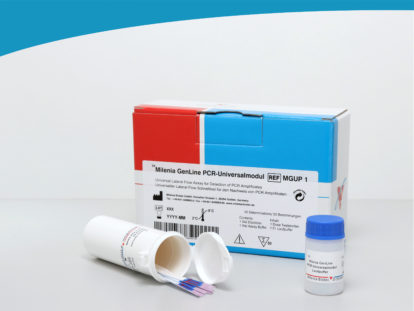
Name of Product PCR Universal Module Catalog Number MGUP 1 Short Info The PCR Universal Module consists of lateral flow dipsticks for the detection of Genomic Amplificates (beer germs, juice germs)
Method/Platform Lateral Flow Dipstick Range/Assay Sensivity Detection of amplification products from Milenia GenLine PCR Modules Test Principle The technological basis for the GenLine tests is the polymerase chain reaction (PCR) combined with lateral flow Tests.
Detail
Name of Product
PCR Universal Module
Catalog Number
MGUP 1
Short Info
The PCR Universal Module consists of lateral flow dipsticks for the detection of Genomic Amplificates (beer germs, juice germs)
Method/Platform
Lateral Flow Dipstick
Range/Assay Sensivity
Detection of amplification products from Milenia GenLine PCR Modules
Test Principle
The technological basis for the GenLine tests is the polymerase chain reaction (PCR) combined with lateral flow Tests.
Brief Instructions
The PCR reagents and the samples are prepared.
After the addition of the sample to the PCR reagents, the PCR is started.
The resulting PCR products are detected by a simple lateral flow test Strip
Storage
2°C to 8°C
Components
Lateral flow dipsticks
Other Products
bis-PEG4-endo-BCN
Product Info
Document
Product Info
bis-PEG4-endo-BCN is a homobifunctional click chemistry linker, PEG increase its aqueous solubility. The BCN group enable copper free click chemitry with azide-tagged molecules. Reagent grade, for research purpose. Please contact us for GMP-grade inquiries.
Document
bis-PEG4-endo-BCN is a homobifunctional click chemistry linker, PEG increase its aqueous solubility. The BCN group enable copper free click chemitry with azide-tagged molecules. Reagent grade, for research purpose. Please contact us for GMP-grade inquiries.
Opentrons OT-2 Single-Channel Electronic Pipettes automate liquid handling and pipetting for most daily wetlab applications. Best for low to medium throughput workflows with high precision.
Document
Opentrons OT-2 Single-Channel Electronic Pipettes automate liquid handling and pipetting for most daily wetlab applications. Best for low to medium throughput workflows with high precision.
HL-SAN efficiently removes nucleic acids from buffers typically used in protein purification. Due to its high salt tolerance, it is the obvious choice for host-cell DNA removal in settings where salt is added to reduce aggregation. Especially efficient for removing nucleic acids from proteins with high affinity for DNA and RNA. Proven performance during lysis and early stages of protein purification processes, as well as high-salt eluates. Cold-adapted enzyme with excellent performance also at ambient temperatures and during over-night digestion at 4°C.
Optimum activity at high salt concentration (0.5 M NaCl)
Active at low temperatures (20% at 6ºC)
Easily inactivated
Broad pH range
Temperature stable
Figures
Figure 1. Optimum activity in solutions with high salinity
HL-SAN has optimum activity at ∼0.5 M NaCl, but operates at a broad range of [NaCl] and [KCl]. The activity of HL-SAN was tested in a 25 mM Tris-HCl buffer, pH 8.5, 5 mM MgCl2 with varying [NaCl] or [KCl]. The maximum activity was set to 100%.
Figure 2. Temperature and activity
HL-SAN has optimum activity at ~35°C, but works over a broad temperature range (20% activity at 10°C and 50°C). The activity of HL-SAN was tested in a 25 mM Tris-HCl buffer, pH 8.5 containing 5 mM MgCl2 and 0.5 M NaCl.
Fig 3. The effect of MgCl2 and MnCl2 concentration on the HL-SAN activity.
The activity of HL-SAN was tested in a 25 mM Tris-HCl buffer, pH 8.5, 0.5 M NaCl and with varying concentrations of MgCl2 or MnCl2. The activity of the sample containing 5 mM MgCl2 was set to 100%.
Figure 4. HL-SAN activity vs pH/[NaCl]
The activity of HL-SAN was tested in a 25 mM Tris-HCl buffer with different pHs and different concentrations of NaCl. All buffers contained 5 mM MgCl2. The nature of the buffer was pH-dependent, but generally the NaCl-optimum was the same in all buffers/pHs. The exception was etanolaminbuffer at pH 9 and pH 9.5 in which the NaCl-optimum was shifted to the left (not shown).
Without NaCl, the specificity towards ssDNA and dsDNA is similar. At 0.5 M NaCl, the activity towards dsDNA increases, while the activity towards ssDNA is unaffected.
Figure 6. HL-SAN digests ssDNA to ~5-13 nt, and dsDNA to ~5-7 nt
The size of the end products from ssDNA varies from ~5-13 nt, while dsDNA is digested to around ~5-7 nt. The size of the end products seems to depend on the DNA sequence. Substrates 1 and 2 were ssDNA with different sequences and substrates 3 and 4 were dsDNA with similar sequences but with a FAM-label at different ends. Substrate 5 was dsDNA with the same sequence as substrate 3 and 4 but with a FAM-label at both ends.
Figure 7. HL-SAN activity decreases with increasing concentrations of glycerol
The activity of HL-SAN was tested in a 25 mM Tris-HCl buffer, pH 8.5, 5 mM MgCl2, 0.5 M NaCl and with increasing concentrations of glycerol. The activity of the control not containing glycerol was set to 100%.
Figure 8. The activity of HL-SAN at different concentrations of imidazole
The activity of HL-SAN was tested in a 25 mM Tris-HCl buffer, pH 8.5, 5 mM MgCl2, 0.5 M NaCl and with varying concentrations of imidazole. The activity of the control not containing imidazole was set to 100%.
Document
HL-SAN efficiently removes nucleic acids from buffers typically used in protein purification. Due to its high salt tolerance, it is the obvious choice for host-cell DNA removal in settings where salt is added to reduce aggregation. Especially efficient for removing nucleic acids from proteins with high affinity for DNA and RNA. Proven performance during lysis and early stages of protein purification processes, as well as high-salt eluates. Cold-adapted enzyme with excellent performance also at ambient temperatures and during over-night digestion at 4°C.