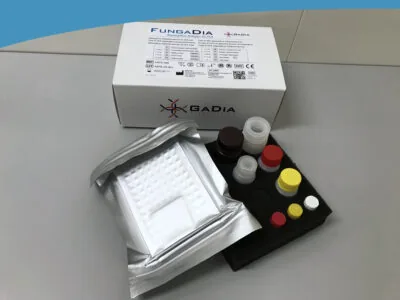
This ELISA kit is for the quantitative detection of specific Aspergillus Galactomannan Antigen in Serum or Bronchoalveolar Lavage (BAL).
This product is manufactured by GaDia Diagnostics in Switzerland and distributed in Germany exclusively by Milenia Biotec.
Detail
Name of Product
Aspergillus Antigen (Galactomannan) – ELISA
Catalog Number
ASPE-096
Short Info
This ELISA kit is for the quantitative detection of specific Aspergillus Galactomannan Antigen in Serum or Bronchoalveolar Lavage (BAL).
This product is manufactured by GaDia Diagnostics in Switzerland and distributed in Germany exclusively by Milenia Biotec.
Method/Platform
ELISA in microplate format, TMB, λ=450 nm
Range/Assay Sensivity
Limit of Detection (LOD): 0,5 ng/ml Limit of Quantification (LOQ): 1,0 ng/ml
Test Principle
FungaDia Aspergillus Galactomannan ELISA Detection Kit is a one-step enzyme sandwich microplate immunoassay which detects galactomannan in human serum and BAL fluid. Galactomannan antigen in the sample bind to anti-galactomannan antibodies (sensitized on the microtiter plates) and conjugate (monoclonal antibody/peroxidase). The presence of Galactomannan Antigen is detected with substrate TMB.
Other Products
DBCO-PEG4-alcohol
Product Info
Document
Product Info
DBCO-PEG4-alcohol is a PEG linker containing a DBCO moiety and a terminal primary hydroxyl group. The hydroxyl can react with a variety of functional groups and the hydrophilic PEG spacer arm can provide better solubility to labeled molecules. DBCO is commonly used for copper-free Click Chemistry reactions. Reagent grade, for research purpose. Please contact us for GMP-grade inquiries.
Document
DBCO-PEG4-alcohol is a PEG linker containing a DBCO moiety and a terminal primary hydroxyl group. The hydroxyl can react with a variety of functional groups and the hydrophilic PEG spacer arm can provide better solubility to labeled molecules. DBCO is commonly used for copper-free Click Chemistry reactions. Reagent grade, for research purpose. Please contact us for GMP-grade inquiries.
Magen’s HiPure columns are prepared by high quality glass fiber filter membrane as raw materials through membrane cutting, membrane release, ring release, ring pressing, gland, weighing and other processes. HiPure nucleic acid adsorption columns have the characteristics of long-term stability and high binding capacity. Experiments show that the highest binding capacity and binding efficiency of HiPure nucleic acid adsorption columns are basically unchanged when stored at room temperature for 4 years.
The series of nucleic acid columns produced by Magen Biotech are based on carefully selected imported glass fiber membranes (GF/B, GF/D, GF/F). Columns production processes such as polypropylene injection molding materials, injection molding process, and downstream membrane packing and compression rings are strictly controlled. This is to ensure that the column has extremely high adsorption capacity and long-term stability. Compared with conventional products on the market, Magen’s columns are with varieties, and binding rate will not change when stored at room temperature for 4 years.
Details
Specifications
Features
Specifications
Recommended application
Small amounts of nucleic acid isolation, viral nucleic acid from cell free samples
Preservation conditions
Room temperature
Stability
Up to 4 years
Filter membrane
High quality glass fiber filter GF/F, 2 layers
Membrane aperture
0.7μm
Maximum binding yield of plasmid
30 μg
Maximum yield of alcohol mediated Binding
100 μg
Single liquid carrying capacity of column
900 μl
Minimum elution volume
80 μl
Withstand centrifugal force
5,000 x g
Centrifuge
Low speed centrifuge, Swing out Rotor, can placed a height of 6.5cm square, (height of HiPure DNA Plate & 1.6ml Collection Plate: height, 6.2cm)
Adsorption Mechanism
Based on the negatively charged DNA skeleton, it has a high affinity for positively charged glass fibers. In high salt and ethanol solutions, DNA/RNA binds to glass fiber and interacts with hydrophilic matrix on silica through hydrogen bond. DNA/RNA is tightly bound. All pollutants can be removed by washing solution. At high salt concentration, nucleic acids selectively bind to silica gel membrane, while other pollutants, mainly proteins, are removed by membrane washing.
Ordering information
CAT.No.
Product Name
Package
C13130
HiPure DNA Plate (2 x GF/F)with 1.6ml Collection Plate
10/Bag
Purchase Guide
Item No.
Product Name
Membrane type/number of layers
Collection tubes
Plasmid DNA binding capacity (Physical adsorption)
Note: GF/B pore size is for 1.0μM glass fiber membrane; GF/F pore size is for 0.7μm glass fiber membrane.
Document
Magen’s HiPure columns are prepared by high quality glass fiber filter membrane as raw materials through membrane cutting, membrane release, ring release, ring pressing, gland, weighing and other processes. HiPure nucleic acid adsorption columns have the characteristics of long-term stability and high binding capacity. Experiments show that the highest binding capacity and binding efficiency of HiPure nucleic acid adsorption columns are basically unchanged when stored at room temperature for 4 years.
PC-Biotin-PEG4-PEG4-alkyne is useful for introducing a biotin moiety to azide-containing biomolecules using Cu(I)-catalyzed Click Chemistry. The extended hydrophilic spacer arm provides better solubility to the labeled molecules in aqueous media. Captured biomolecules can be efficiently photoreleased using near-UV, low intensity lamp (e.g. 365 nm lamp at 1-5 mW/cm2). Reagent grade, for research purpose. Please contact us for GMP-grade inquiries.
Document
PC-Biotin-PEG4-PEG4-alkyne is useful for introducing a biotin moiety to azide-containing biomolecules using Cu(I)-catalyzed Click Chemistry. The extended hydrophilic spacer arm provides better solubility to the labeled molecules in aqueous media. Captured biomolecules can be efficiently photoreleased using near-UV, low intensity lamp (e.g. 365 nm lamp at 1-5 mW/cm2). Reagent grade, for research purpose. Please contact us for GMP-grade inquiries.