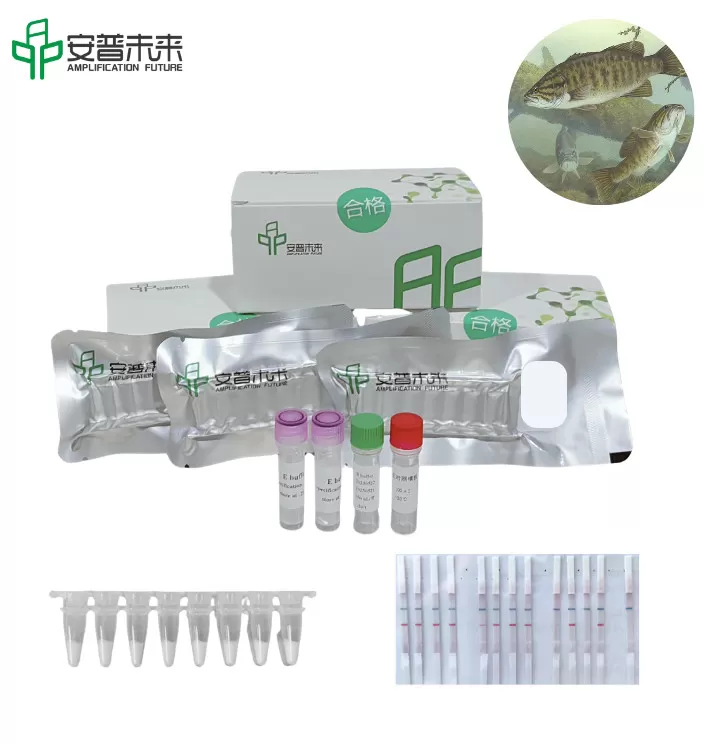
Overall solution for thermostatic detection of largemouth bass rhabdovirus
Facebook
X
Pinterest
Email
This kit is based on a rapid nucleic acid amplification technology at room temperature and constant temperature: at room temperature and constant temperature (generally 39ºC~42ºC), with the help of auxiliary proteins and single-strand binding proteins,the recombinase and primers form a complex; Source search and combine the target homology domain, at this time, a D-loop region is formed at the homology position and strand exchange begins;along with the dissociation of the recombinase from the complex,the polymerase also binds to the 3′ end of the primer and begins chain extension.It is suitable for laboratory-level DNA amplification and DNA amplification for other detection purposes.
Detail
Product Details
Sensitivity:
High
Kit Type:
RNA
Format:
Lyophilized
Reaction Volume:
50 μL
Reagents:
Enzymes, Buffers, And Primers
Product Name:
Overall Solution For Thermostatic Detection Of Largemouth Bass Rhabdovirus
• For sizing and quantification of double strand DNA fragments. • Composed of ten bands as shown on right. • The 4 kb band with higher concentration is easily distinguishable from the others. • Premixed with 6X DNA loading buffer for direct gel loading.
Document
1 kb DNA Ladder in 1% agarose gel
• For sizing and quantification of double strand DNA fragments. • Composed of ten bands as shown on right. • The 4 kb band with higher concentration is easily distinguishable from the others. • Premixed with 6X DNA loading buffer for direct gel loading.
How to use: 1.Suspend 18g in 1L of distilled water, stirring heated to boiling to completely dissolve, autoclave at 121℃ for 15 minutes. 2.Diluted and treated samples.
Quality control:
Item
The name and number of strain
Growth
Colony Color
1
Escherichia coli ATCC25922
Good
Turbid broth,slight precipitate
2
Staphylococcus aureus ATCC25922
Good
Turbid broth,slight precipitate
Storage: Keep container tightly closed, store in a cool, dry place, away from bright light. Storage period of 3 years.
MagZol Reagent is a reagent system for the isolation of total RNA from cells and tissues. The reagent, a single-phase solution consisting of phenol and guanidine isothiocyanate, is modification of the single-step RNA isolation method developed by Chomczynski and Sacchi. The sample is homogenized and lysed in MagZol Reagent which maintains the integrity of the RNA, while disrupting and denaturing endogenous RNases and other cellular components. Extraction of the lysate with chloroform further denatures proteins and separates the mixture into an organic and an aqueous phase. RNA remains exclusively in the aqueous phase, and is subsequently recovered by isopropanol.
This method is suitable for small quantities of tissue (<100mg) and cells (<5 X10⁶), and large quantities of tissue (up to 1g) and cells (<108), of human, animal, plant, or bacterial origin. The simplicity of the MagZol Reagent method allows simultaneous processing of a large number of samples. The entire procedure can be completed in one hour. Total RNA prepared in this manner can be used for Northern blot analysis, dot blot hybridization, poly(A) + selection, in vitro translation, RNase protection assay, and molecular cloning. For use in amplification by thermal cycling, treatment of the isolated RNA with RNase-free DNase I is recommended when the two amplimers lie within a single exon.
Details
Specifications
Features
Specifications
Main Functions
RNA isolation solvent (substitution for Trizol/Qiazol reagent)
Applications
RT-PCR, Northern hybridization, poly (a) enrichment, etc.
Extensive – suitable for various kinds of biological samples, including animals, plants, cultured cells, bacteria, etc.
High yield – efficient cleavage releases more RNA
High purity – purified RNA is suitable for various downstream applications
Flexible – sample amount can be adjusted according to the demand
High cost performance compared with similar products
Storage and Stability
MagZol Reagent should be stored at 2-8°C upon arrival and is stable for at least 24 months under the condition. However, short-term storage (up to 12 weeks) at room temperature (15-25°C) does not affect its performance.
Experiment Data
Document
MagZol Reagent is a reagent system for the isolation of total RNA from cells and tissues. The reagent, a single-phase solution consisting of phenol and guanidine isothiocyanate, is modification of the single-step RNA isolation method developed by Chomczynski and Sacchi. The sample is homogenized and lysed in MagZol Reagent which maintains the integrity of the RNA, while disrupting and denaturing endogenous RNases and other cellular components. Extraction of the lysate with chloroform further denatures proteins and separates the mixture into an organic and an aqueous phase. RNA remains exclusively in the aqueous phase, and is subsequently recovered by isopropanol.