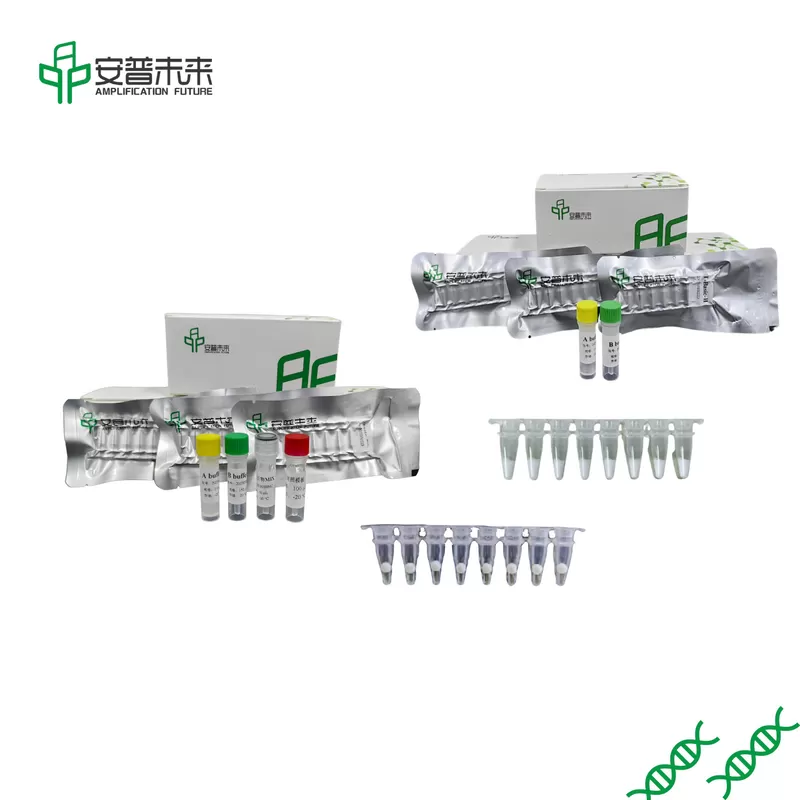
Amplification kits come in a variety of reagent forms such as freeze-dried powder, freeze-dried microspheres, and master mix. (This paragraph can be marked in different forms)
Detail
Payment & Shipping Terms
Minimum Order Quantity
48T
Price
USD$3.8/T
Packaging Details
16T/Bag,48T/Box
Delivery Time
6 working days
Payment Terms
T/T, MoneyGram
Supply Ability
100000T/Month
Product Description
Amplification kits come in a variety of reagent forms such as freeze-dried powder, freeze-dried microspheres, and master mix. (This paragraph can be marked in different forms)
product:
DNA Isothermal Rapid Amplification Kit (Fluorescent type) DNA Isothermal Rapid Amplification Kit (Colloidal gold test strip type) RNA Isothermal Rapid Amplification Kit (Basic Type)-II
…
Nucleic acid detection process: sampling, nucleic acid extraction, nucleic acid amplification, and result analysis. There are corresponding products that can be applied for the experimental steps after the sampling operation, which are more suitable for on-site rapid inspection needs.
Other Products
PCR Universal Module
Product Info
Document
Product Info
Name of Product
PCR Universal Module
Catalog Number
MGUP 1
Short Info
The PCR Universal Module consists of lateral flow dipsticks for the detection of Genomic Amplificates (beer germs, juice germs)
Method/Platform
Lateral Flow Dipstick
Range/Assay Sensivity
Detection of amplification products from Milenia GenLine PCR Modules
Test Principle
The technological basis for the GenLine tests is the polymerase chain reaction (PCR) combined with lateral flow Tests.
Brief Instructions
The PCR reagents and the samples are prepared.
After the addition of the sample to the PCR reagents, the PCR is started.
The resulting PCR products are detected by a simple lateral flow test Strip
Storage
2°C to 8°C
Components
Lateral flow dipsticks
Document
Name of Product PCR Universal Module Catalog Number MGUP 1 Short Info The PCR Universal Module consists of lateral flow dipsticks for the detection of Genomic Amplificates (beer germs, juice germs)
Method/Platform Lateral Flow Dipstick Range/Assay Sensivity Detection of amplification products from Milenia GenLine PCR Modules Test Principle The technological basis for the GenLine tests is the polymerase chain reaction (PCR) combined with lateral flow Tests.
HiPure Insect DNA Kits provides a simple and rapid solution for total DNA extraction of insect tissue samples. This kit is based on silica gel column purification technology without toxic phenol chloroform extraction and time-consuming alcohol precipitation. The whole extraction process only takes 30 minutes. HiPure Insect DNA Kit can process tissue samples less than 10mg at a time. Hipure Insect DNA 96 kit can process 96 insect tissue samples at a high throughput. The obtained DNA can be directly used in PCR, Southern blot, viral DNA detection and other experiments.
Details
Specifications
Features
Specifications
Main Functions
Isolation total DNA from <10 mg insect tissue
Applications
PCR, southern bolt and virus detection, etc
Purification method
Midi spin column
Purification technology
Silica technology
Process method
Manual (centrifugation or vacuum)
Sample type
Insect tissue samples
Sample amount
<10 mg
Elution volume
≥15μl
Time per run
≤30 minutes
Liquid carrying volume per column
800μl
Binding yield of column
100μg
Principles
This product is based on silica column purification. The sample is lysed and digested with lysate and protease, DNA is released into the lysate. Transfer to an adsorption column. Nucleic acid is adsorbed on the membrane, while protein is not adsorbed and is removed with filtration. After washing proteins and other impurities, Nucleic acid was finally eluted with low-salt buffer (10mm Tris, pH9.0, 0.5mm EDTA).
Advantages
High purity DNA – can be used in sensitive downstream applications such as multiplex and quantitative pcr
Fast – several samples can be extracted in less than 30 minutes
Good repeatability – suitable for extracting high-yield DNA from insect tissue samples
Safe – without phenol chloroform extraction and alcohol precipitation
Kit Contents
Contents
D312902
D312903
Purification Times
50
250
HiPure DNA Mini Columns I
50
250
2ml Collection Tubes
50
250
Buffer ITL
30 ml
120 ml
Buffer IL*
30 ml
120 ml
Buffer GW1*
22 ml
110 ml
Buffer GW2*
20 ml
2 x 50 ml
Proteinase K
24 mg
120 mg
Protease Dissolve Buffer
1.8 ml
15 ml
Buffer AE
15 ml
60 ml
Storage and Stability
Proteinase K should be stored at 2-8°C upon arrival. However, short-term storage (up to 12 weeks) at room temperature (15-25°C) does not affect their performance. The remaining kit components can be stored at room temperature (15-25°C) and are stable for at least 18 months under these conditions. The entire kit can be stored at 2–8°C, but in thiscase buffers should be redissolved before use. Make sure that all buffers areat room temperature when used.
Document
HiPure Insect DNA Kits provides a simple and rapid solution for total DNA extraction of insect tissue samples. This kit is based on silica gel column purification technology without toxic phenol chloroform extraction and time-consuming alcohol precipitation. The whole extraction process only takes 30 minutes. HiPure Insect DNA Kit can process tissue samples less than 10mg at a time. Hipure Insect DNA 96 kit can process 96 insect tissue samples at a high throughput. The obtained DNA can be directly used in PCR, Southern blot, viral DNA detection and other experiments.
The Milenia GenLine Extraction System is an universal kit which is intended for the isolation of analytes from swabs for further processing.
Method/Platform
Swab Sample Collection System
Range/Assay Sensivity
Test Principle
Brief Instructions
Storage
room temperature
Components
1000 pcs. of reaction tubes (1,5 ml) and 1000 pcs. of mini purification column
Document
Name of Product Milenia GenLine Extraction System Catalog Number MGES 1 Short Info The Milenia GenLine Extraction System is an universal kit which is intended for the isolation of analytes from swabs for further processing.
Method/Platform Swab Sample Collection System Range/Assay Sensivity Test Principle