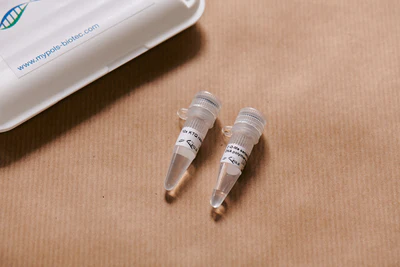
Interested in the analysis of DNA or RNA modifications? Then this DNA polymerase could simplify your site-specific analysis of such modifications. The 2′-O-Me sensitive DNA polymerase was engineered to catalyse DNA synthesis from both DNA and RNA and to quantify 2′-O-methylation of nucleotides site-specifically from RNA by real-time PCR. For further information refer to the original publication.
Detail
Interested in the analysis of DNA or RNA modifications? Then this DNA polymerase could simplify your site-specific analysis of such modifications. The 2′-O-Me sensitive DNA polymerase was engineered to catalyse DNA synthesis from both DNA and RNA and to quantify 2′-O-methylation of nucleotides site-specifically from RNA by real-time PCR. For further information refer to the original publication.
Available upon request and for R&D use only – Contact Us
The 2′-O-Me sensitive DNA polymerase is supplied as a 5 µM solution containing glycerol and is supplied together with 10x reaction buffer.
The enzyme can also be used for real-time cycling, when adding a suitable dye.
endo-BCN-PEG3-Boc-amine is a click chemistry linker containing a Boc-protected amine. The protected amine can be deprotected under mild acidic conditions. The BCN group enable copper free click chemistry with azide-tagged molecules. Reagent grade, for research purpose. Please contact us for GMP-grade inquiries.
Document
endo-BCN-PEG3-Boc-amine is a click chemistry linker containing a Boc-protected amine. The protected amine can be deprotected under mild acidic conditions. The BCN group enable copper free click chemistry with azide-tagged molecules. Reagent grade, for research purpose. Please contact us for GMP-grade inquiries.
The cfDNA Purification Kit (Magnetic Beads) was developed for cell free DNA (cfDNA) enrichment by separating genomic DNA contamination from isolated cfDNA samples.
Many diagnostic technologies for detection of disease signals in cfDNA begin with isolation and purification of DNA from liquid biopsy that include urine, plasma, cerebrospinal fluid. The most widely explored biotechnology is assays used to detect cancer-derived plasma cfDNA. Silica-based magnetic bead cfDNA isolation kits can reliably extract total DNA from plasma, but typically yield a large variation in cfDNA that includes the presence of genomic DNA that often depends on tumor stage, tumor size, or healthy status individuals. Most of the commercial cfDNA isolation kits can’t specifically recover the cfDNA while leaving the high molecular weight genomic DNA behind. The presence of genomic DNA can lead to decreased sensitivity or inconsistent results in downstream applications such as next-generation sequencing (NGS), PCR, QPCR, and digital PCR etc.
Therefore, an additional purification step to enrich cfDNA before downstream methods helps to improve signal from fragments that originate from cancer cells. A proportion of cancer-derived cfDNA fragment signals are below 100 bp and are often not detectable except by qPCR or single-stranded DNA based library preparation for NGS (1, 2, 3). Furthermore only 1% of cancer-derived fragments are found above 400 bp (1, 2). Capture of size-selected fragments between 90-150 bp improved detection of cancer by 2-4 fold (4). Furthermore, TF-bound and protected cfDNA fragments are also being investigated for active cancer-specific signals down to 35-80 bp (5, 6).
This kit uses Dual Solid Phase Reversible Immobilization (SPRI) technology for cfDNA purification. Most Dual SPRI procedures do NOT recover fragments below 100 bp. The kit can be used for the enrichment of cfDNA isolated from liquid biopsies, plasma, serum, and urine. The kit separates cfDNA (50-500 bp) and genomic DNA, and recovers of 90% of the cfDNA without the high molecular weight genomic DNA with high efficiency. Fragments at 500 bp and above may also be retained. Both the 50-500 bp and >500 bp DNA fractions can be used for downstream applications such as single-stranded or double stranded NGS library prep, qPCR, ddPCR, and other methods.
Features
Separation of cfDNA and genomic DNA; Recovery of both types of DNA
Recovery of cfDNA (50-500 bp)
As short as 50 bp can be recovered
Recovery of high molecular weight genomic DNA
Removal of unwanted components and other impurities
Automation friendly
Examples of cfDNA purification. Both cfDNA and genomic DNA can be recovered separately.
The range of recovered small DNA fragments is from 50 to 500 bp. The input DNA are mixtures of sheared small DNA fragments and intact genomic DNA. The ratios of sheared DNA fragments versus genomic DNA are indicated.
Recovery rates of cfDNA and genomic DNA.
Document
Many diagnostic technologies for detection of disease signals in cfDNA begin with isolation and purification of DNA from liquid biopsy that include urine, plasma, cerebrospinal fluid. The most widely explored biotechnology is assays used to detect cancer-derived plasma cfDNA. Silica-based magnetic bead cfDNA isolation kits can reliably extract total DNA from plasma, but typically yield a large variation in cfDNA that includes the presence of genomic DNA that often depends on tumor stage, tumor size, or healthy status individuals. Most of the commercial cfDNA isolation kits can’t specifically recover the cfDNA while leaving the high molecular weight genomic DNA behind. The presence of genomic DNA can lead to decreased sensitivity or inconsistent results in downstream applications such as next-generation sequencing (NGS), PCR, QPCR, and digital PCR etc.
Heat-Labile Exonuclease I (HL-ExoI) is a 3’ – 5’ exonuclease, specific for single stranded DNA. The enzyme is recombinantly produced in E. coli. HL-ExoI is active at 25 – 37°C and inactivated by 1 minute incubation at 80°C or 15 minutes at 60°C.
HL-ExoI is used for degradation of ssDNA such as primers and oligos. It is also ideal for treatment of sensitive samples and useful in the development of novel molecular diagnostics applications.
Key Features
3’-5’ exonuclease specific for single stranded DNA
High activity at 25 – 37°C
Easily heat-inactivated by 1 min incubation at 80°C, or 15 min at 60°C
Moderate salt tolerance
Application
Removal of primers post-PCR prior to DNA sequencing or SNP detection
Figures
Properties
Quality Control
ArcticZymes is dedicated to the quality of our products. We manufacture all products at our ISO 13485 certified facility in Norway.
Document
Heat-Labile Exonuclease I (HL-ExoI) is a 3’ – 5’ exonuclease, specific for single stranded DNA. The enzyme is recombinantly produced in E. coli. HL-ExoI is active at 25 – 37°C and inactivated by 1 minute incubation at 80°C or 15 minutes at 60°C.