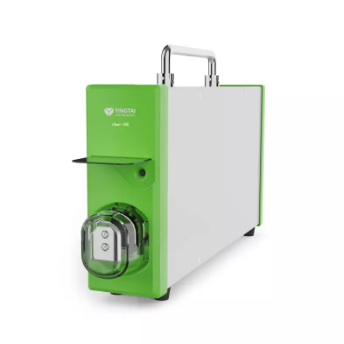
A device that uses the principle of high-frequency oscillation to generate heat through the friction of molecules in PVC hoses, thereby melting the PVC hose and achieving the sealing effect. This device is also referred to as a pipe sealing machine in some places.
Detail
Heat Sealing Time:
0.5~2s
Heat Sealing Tube Outer Diameter:
2~6mm
Indicator Light Colors:
Red/Blue
RF Frequency:
40.68MHz
Grounding Protection:
Class l
Spacing Adjustment
65,70,75,80,85,90,95,100mm
Power Consumption:
250W during operation,10Win standby
Power Supply:
100V~120V/220V~240V AC
Weight:
4.5kg
Dimensions:
336×65×173mm
Operating Temperature:
0~40℃
Storage Temperature:
-20~70℃
Other Products
R4151 HiPure Plant RNA Mini Kit
Product Info
Document
Product Info
Introduction
The Kit provides fast purification of high-quality RNA from plants, cell, tissues, and yeast using silica-membrane spin columns with a binding capacity of 100μg RNA. There is no need for phenol/chloroform extractions and time-consuming steps such as CsCl gradient ultracentrifugation or precipitation with isopropanol or LiCl. RNA purified using the RaPure Total RNA Purification System can be used for applications such as RT-PCR, Northern blotting, poly A+ RNA (mRNA) purification, nuclease protection, and in vitro translation.
Details
Specifications
Features
Specifications
Main Functions
Isolation total RNA from <150 mg simple plant sample without chloroform
Applications
RT-PCR, qPCR, Northern hybridization, second generation sequencing, nucleic acid protection, in vitro translation
Purification method
Mini spin column
Purification technology
Silica technology, DNA filtration technology
Process method
Manual (centrifugation or vacuum)
Sample type
Economic crops
Sample amount
≤150 mg
Elution volume
≥30μl
Time per run
≤25 minutes
Liquid carrying volume per column
800µl
Binding yield of column
100µg
Principle
The Kit isolates total RNA from up to 150mg plant tissue. A short workflow enables RNA isolation with genomic DNA removal in less than 25 min. Samples are first lysed and homogenized. The lysate is passed through a DNA Mini column, ethanolis added to the flow-through, and the sample is applied to an RNA column. RNA binds to the membrane and contaminants are washed away. High-quality RNA is eluted in as little as 30µl water using the Kit.
Advantages
Efficient removal of DNA – unique genomic DNA removal column without DNase treatment
High quality – high purity total RNA can be directly used in various sensitive downstream applications
Fast – several samples can be extracted in 25 minutes by column method
Safe – no phenol chloroform extraction required
Sensitive – RNA can be recovered at the level of PG
Broad spectrum – various types of plant samples can be processed by diversity of operating procedures
Kit Contents
Contents
R415102
D415103
Purification Times
50 Preps
250 Preps
HiPure DNA Mini Column II
50
250
HiPure RNA Mini Columns
50
250
2ml Collection Tubes
100
2 x 250
Buffer RLC
50 ml
200 ml
Buffer PRC1
50 ml
200 ml
Buffer RW1
50 ml
200 ml
Buffer RW2*
20 ml
2 x 50 ml
RNase Free Water
10 ml
30 ml
Storage and Stability
The Kit can be stored dry at room temperature (15-25°C) and are stable for at least 18 months under these conditions. Make sure that all buffers are at room temperature when used. During shipment, crystals or precipitation may form inthe Buffer RLC/PRC1. Dissolve by warming buffer to 37°C.
Purchase Guide
1. When dealing with woody or uncommon samples, R4150 is recommended first. R4150 contains two polysaccharide/polyphenol lysis buffer, which is the most universal product.
2. R4151 is recommended for handling common economic crop samples for the first time. Strong lysis solution can be used to process easy-extraction samples. The amount of corn or rice leaves samples can reach up to 300mg.
3. R4165 adopts CTAB/chloroform method, which can also handle a large number of difficult-to-extraction plants, but requires contact with chloroform substitutes, which is less safe than other kits. This kit uses DNase Ⅰ to remove DNA, which is also a good choice for extracting polysaccharide/polyphenol-rich plant samples.
4. R4014 is recommended for fruit/starch plant samples, which uses improved trizol pre-treatment, single column operation and is more economical.
Select the right purification kit to get impactful results:
The Kit provides fast purification of high-quality RNA from plants, cell, tissues, and yeast using silica-membrane spin columns with a binding capacity of 100μg RNA. There is no need for phenol/chloroform extractions and time-consuming steps such as CsCl gradient ultracentrifugation or precipitation with isopropanol or LiCl. RNA purified using the RaPure Total RNA Purification System can be used for applications such as RT-PCR, Northern blotting, poly A+ RNA (mRNA) purification, nuclease protection, and in vitro translation.
Escherichia coli (E.coli) O157:H7 Quantified Bacterial DNA Standards
Product Info
Document
Product Info
Overview
Quantified standard to be used as a positive control or PCR quantification standard
Vigorously quantified using multiple methods
Includes partial sequence of STX-1 subunit A, and STX-2 subunit A genes (please refer to product insert for more details)
Compatible with E. coli O157:H7 TaqMan PCR Detection Kit and E. coli O157:H7 TaqMan PCR Detection Probe/Primer and Control Set
E. coli O157:H7 is a rod-shaped, gram negative bacterium. It is an enterohemorrhagic strain of the common E. coli bacterium and infection by the O157:H7 strain is commonly associated with hemorrhagic colitis. E. coli O157:H7 is recognized by its somatic (cell wall) antigen (O157) and its flagella antigen (H7). In addition, E. coli O157:H7 is known to produce Shiga-like toxins, which cause severe symptoms. While most patients can recover from the infection, up to 15% of the patients may develop hemolytic uremic syndrome, a type of kidney failure that could be fatal. Infection of E. coli O157:H7 usually results from consumption of poorly prepared food including undercooked meat (particularly ground beef), untreated water or raw unpasteurized milk.
Norgen’s E. coli O157:H7 Quantified Bacterial DNA Standards are cloned fragments of the two Shiga-like toxin regions purified using Norgen’s sample preparation technology. They include partial sequences of STX-1 subunit A gene and STX-2 subunit A gene. Please refer to Appendix A for sequence information. The purified DNA is quantified vigorously using multiple methods including spectrophotometry, gel densitometry and real-time PCR. It is intended to be used as positive controls or PCR quantification standards for E. coli O157:H7. This product is compatible with Norgen Biotek’s E. coli O157:H7 Taqman PCR Detection Kit (Cat. TM41350) and E. coli O157:H7 Taqman PCR Detection Probe/Primer and Control Set (Cat. TM41310).
Storage Conditions Upon receipt, store Norgen’s E. coli O157:H7 Quantified Bacterial DNA Standards at -20°C or lower. Avoid multiple freeze-thaw cycles. If needed, prepare smaller working aliquots and store at -20°C or lower.
This product speeds and simplifies nucleic acid size selection for fragment library preparation for next generation sequencing.
Details
Specifications
Features
Specifications
Main Functions
Selectively recover DNA from PCR products and enzymatic reaction solution (Replace Beckmen or agencourt SPRISelect)
Applications
Prepare DNA library for second generation sequencing
Purification technology
Magnetic beads technology
Process method
Manual or automatic
Sample type
DNA products, restriction endonuclease systems, or other enzymatic reaction solution
Sample amount
Appropriate
Recovery
80%
Operation time
≤50 minutes
Principle
The MagSelect method contains magnetic particles in an optimized binding buffer to selectively bind DNA fragments 100bp and larger to paramagnetic beads. Excessprimers, nucleotides, salts, and enzymes can be removed using a simple washing procedure. The result is a more purified PCR product.
Advantages
High recovery – up to 80%
High throughput – using magnetic beads purification technology
Kit Contents
Contents
XP-5
XP-50
XP-500
MagSelect Beads
5 ml
50 ml
500 ml
Storage and Stability
MagSelect XP should be stored at 2-8°C upon arrival and is stable up to 18 months under the condition. However, short-term storage (up to 12 weeks) at room temperature (15-25°C) does not affect its performance. Shake the reagent well before use. It should appear homogenous and consistent in color.
DO NOT FREEZE.
Document
This product speeds and simplifies nucleic acid size selection for fragment library preparation for next generation sequencing.