


K-AMIAR
SKU: 700004261
96 assays (manual) / 960 assays (microplate) / 960 assays (auto-analyser)
| Content: | 96 assays (manual) / 960 assays (microplate) / 960 assays (auto-analyser) |
| Shipping Temperature: | Ambient |
| Storage Temperature: | Short term stability: 2-8oC, Long term stability: See individual component labels |
| Stability: | > 2 years under recommended storage conditions |
| Analyte: | Ammonia, Nitrogen, YAN |
| Assay Format: | Spectrophotometer, Microplate, Auto-analyser |
| Detection Method: | Absorbance |
| Wavelength (nm): | 340 |
| Signal Response: | Decrease |
| Linear Range: | 0.2 to 7 µg of ammonia per assay |
| Limit of Detection: | 0.07 mg/L |
| Reaction Time (min): | ~ 5 min |
| Application examples: | Grape juice, wine, fruit juices, soft drinks, dairy products (e.g. milk), dietetic food, soy sauce, eggs and egg products, cheese, meat, processed meat, seafood, bakery products (and baking agents), fertilisers, pharmaceuticals, tobacco, cosmetics, water, Kjeldahl analysis, paper (and cardboard), water and other materials (e.g. biological cultures, samples, etc.). |
| Method recognition: | Methods based on this principle have been accepted by MEBAK |
Ammonia Assay Kit, for the rapid measurement and analysis of ammonia in all samples, including grape juice and wine (and other foods/beverages).
Note for Content: The number of manual tests per kit can be doubled if all volumes are halved. This can be readily accommodated using the MegaQuantTM Wave Spectrophotometer (D-MQWAVE).
Browse all nitrogen assay kits.

Advantages
Ammonia Assay Kit, for the rapid measurement and analysis of ammonia in all samples, including grape juice and wine (and other foods/beverages).

These kits provide a fast, reliable and convenient method to purify and concentrate high quality, high purity and inhibitor-free cell-free circulating and exosomal RNA using a convenient spin column method. These kits can purify RNA from fresh or frozen serum or plasma samples prepared from blood collected on either EDTA or Citrate. Plasma samples prepared from blood collected on heparin should not be used, as heparin can significantly interfere with many downstream applications such as RT-PCR. The purified plasma/serum RNA is fully compatible with all downstream applications including PCR, qPCR, methylation-sensitive reverse transcription qPCR, reverse transcription PCR, Northern blotting, RNase protection and primer extension, expression array assays, and NGS.
Background
Plasma/Serum cell-free circulating RNA or exosomal RNA has the potential to provide biomarkers for certain cancers and disease states. Exosomes are 40 – 150 nm membrane vesicles, which are secreted by most cell types. Exosomes can be found in saliva, blood, urine, amniotic fluid and malignant ascitic fluids, among other biological fluids. Evidence has been accumulating recently that these vesicles act as cellular messengers, conveying information to distant cells and tissues within the body. These exosomes may play a functional role in mediating adaptive immune responses to infectious agents and tumours, tissue repair, neural communication and transfer of pathogenic proteins. For this reason exosomal RNAs may serve as biomarkers for various diseases including cancer. As the RNA molecules encapsulated within exosomes are protected from degradation by RNAses they can be efficiently recovered from biological fluids, such as plasma or serum.
Plasma/Serum RNA Purification Mini Kit
This kit can purify RNA from fresh or frozen serum or plasma samples prepared from blood collected on either EDTA or Citrate, from volumes ranging from 50 µL to 200 µL. The purified plasma/serum RNA is eluted in a flexible final volume of 10 µL to 25 µL.
Plasma/Serum RNA Purification Midi Kit
This utilizes a two column method, and can purify RNA from fresh or frozen serum or plasma samples prepared from blood collected on either EDTA or Citrate, from volumes ranging from 250 µL to 1.5 mL. The first column will handle the large volume input of bodily fluids that is followed by a concentration on a mini column for a final elution of 50 µL to 100 µL.
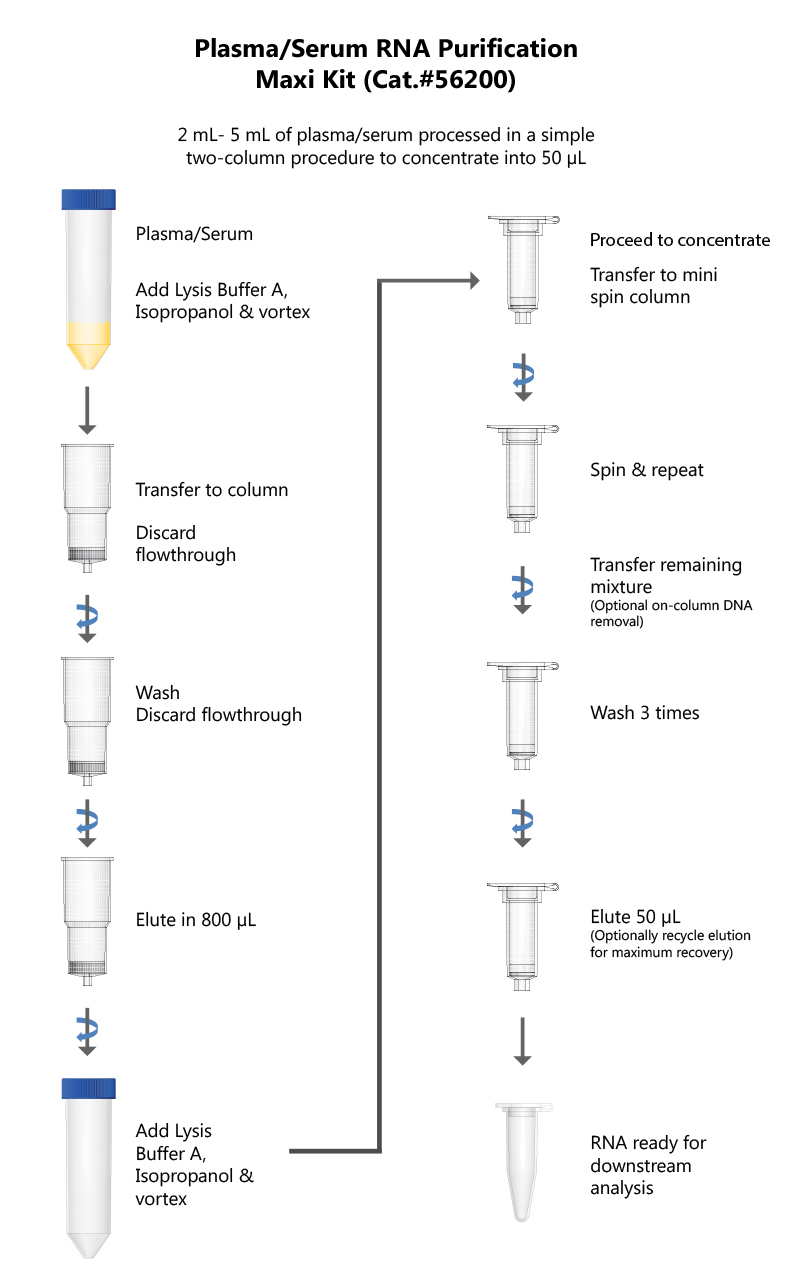
Plasma/Serum RNA Purification Maxi Kit
This kit can purify RNA from fresh or frozen serum or plasma samples prepared from blood collected on either EDTA or Citrate, from volumes ranging from 2 mL to 5 mL. The first column will handle the large volume input of bodily fluids that is followed by a concentration on a mini column for a final elution of 50 µL to 100 µL.
Isolate RNA after Purifying EVs and Exosomes
For Ultracentrifugation, Exoquick, and Filtration
| Cat. # | Name | Elution Volume | Plasma/Serum | Urine | Cell-Culture Media |
|---|---|---|---|---|---|
| 55000 | Plasma/Serum RNA Purification Mini Kit | 10 – 25 µL | 50 µL – 1 mL | 250 µL – 1 mL | 5 – 10 mL |
| 35300 | Total RNA Purification Micro Kit | 20 – 50 µL | 1 – 4 mL | 2 – 10 mL | 10 – 20 mL |
| 17200 | Total RNA Purification Kit | 50 – 100 µL | 4 – 10 mL | 11 – 30 mL | 20 – 35 mL |
Figure 1 / 13
Click for expanded view
| Kit Specifications | |
| Minimum Plasma/Serum Input | 2 mL |
| Maximum Plasma/Serum Input | 5 mL |
| Size of DNA Purified | All sizes, including miRNA and small RNA (<200 nt) |
| Elution Volume | 50-100 μL |
| Time to Complete 10 Purifications | 35-40 minutes |
| Average Yields* | Variable depending on specimen |
*Please check page 7 of the Product Insert for Average Plasma/Serum Yields and Common RNA Quantification Methods.
This kit is suitable for the isolation of RNA from fresh or frozen serum or plasma prepared from blood collected on either EDTA or Citrate. Plasma samples prepared from blood collected on heparin should not be used as heparin can significantly interfere with many downstream applications such as RT-PCR.
Storage Conditions and Product Stability
All solutions should be kept tightly sealed and stored at room temperature. This kit is stable for 2 years after the date of shipment. It is recommended to warm Lysis Buffer A for 20 minutes at 60°C if any salt precipitation is observed.
| Kit Components | Cat. 55000 (50 preps) | Cat. 56100 (20 preps) | Cat. 56200 (10 preps) |
|---|---|---|---|
| Lysis Buffer A | 2 x 20 mL | 100 mL | 1 x 130 mL 1 x 30 mL |
| Wash Solution A | 18 mL | 1 x 38 mL 1 x 18 mL | 38 mL |
| Elution Solution A | 6 mL | 6 mL | 6 mL |
| Elution Buffer F | – | 15 mL | 15 mL |
| Micro Spin Columns | 50 | – | – |
| Mini Spin Columns | – | 20 | 10 |
| Midi Spin Columns | – | 20 | – |
| Maxi Spin Columns | – | – | 10 |
| Collection Tubes | 50 | 20 | 10 |
| Elution Tubes (1.7 mL) | 50 | 20 | 10 |
| Product Insert | 1 | 1 | 1 |

Name of Product
Fasciola hepatica – IgG ELISA
Catalog Number
AF 9650
Short Info
Fasciolosis is one of the most frequently encountered autochthonous helminthic infections in Central Europe. The immunodiagnosis of Fasciola hepatica infections is challenged by high serological cross-reacitivity with other (hepatic) parasitological infections encountered in Central Europe, such as alveolar echinococcosis, toxocarosis and ascariosis, but also other parasitic infections acquired during overseas travel. The SAP-2 recombinant antigen shows a high specificity, especially with patients with other parasitic infections. It is a suitable serological test for routine diagnosis of human fasciolosis, particularly if the results are supported by clinical history.
This product is manufactured by Bordier Affinity Products in Switzerland and distributed in Germany exclusively by Milenia Biotec.
Method/Platform
ELISA in microplate format
Range/Assay Sensivity
77% sensitivity, 98% specificity
Test Principle
The kit provides all the material needed to perform 96 enzyme-linked immunosorbant assays (ELISA) on breakable microtitration wells sensitized with Fasciola hepatica recombinant antigen. Specific antibodies in the sample will bind to the antigen and washing will remove unspecific antibodies. The presence of parasite specific antibodies is detected with a Protein A – alkaline phosphatase conjugate. A second washing step will remove unbound conjugate. Revealing bound antibodies is made by the addition of pNPP substrate which turns yellow in the presence of alkaline phosphatase. Color intensity is proportional to the amount of Fasciola hepatica specific antibodies in the sample. Potassium phosphate is added to stop the reaction. Absorbance at 405 nm is read using an ELISA microplate reader.The test can be performed with automatic systems, but this must be validated by the user.
Brief Instructions
Storage
2-8° C
Components
ELISA wells, dilution buffer, washing solution, control sera, conjugate, substrate solution, stopping solution
12 x 8 strips (96 tests)
Fasciolosis is one of the most frequently encountered autochthonous helminthic infections in Central Europe. The immunodiagnosis of Fasciola hepatica infections is challenged by high serological cross-reacitivity with other (hepatic) parasitological infections encountered in Central Europe, such as alveolar echinococcosis, toxocarosis and ascariosis, but also other parasitic infections acquired during overseas travel. The SAP-2 recombinant antigen shows a high specificity, especially with patients with other parasitic infections. It is a suitable serological test for routine diagnosis of human fasciolosis, particularly if the results are supported by clinical history.