


The NGS Low Input DNA Library Prep Kit (illumina and MGI Platforms) was developed for construction of high quality NGS libraries with low input DNA amount from 1 ng to 400 ng. The kit allows scientist to study samples with limited DNA such as tumor samples, patient samples, and other specially collected samples (FACS sorting etc.). The kit has high library conversion efficiency with as little as 1 ng DNA input. The fast and simple 1.5-hour protocol makes libraries with even coverage and low GC-bias based our unique chemistry for DNA end-polishing and ligation.
The kit needs double strand DNA fragments (blunt and/or sticky) as input DNA for NGS library preparation, and is compatible with DNA fragments generated from both enzymatic approach (for example, BioDynami DNA fragmentation enzymes, Cat.# 40061 and Cat.# 40062) and mechanical approaches such as sonication and nebulization etc.

NGS Low Input DNA Library Prep Kit Workflow
Three index types are available for the NGS Low Input DNA Library Prep Kit of illumina platform:
Non-index (Cat.# 30022): Libraries do not have index.
Index (Cat.# 30024): Each of our index primers contains a unique barcode sequence with 6 bases that can be used to identify the low input DNA libraries. Library multiplexing up to 48 samples is possible. Index information can be downloaded here.
Unique dual index (Cat.# 30025): Library multiplexing up to 96 low input DNA libraries is possible with unique dual indexes with our Four-Base Difference Index System. The system allows us to make indexes for the libraries that have at least 4 bases different from each other in the 8-base barcode length. Our unique dual index primers can reduce sequencing errors such as de-multiplexing errors, amplification errors, mis-assignment of reads, index cross-contamination, and also index hopping. The kit includes 96 pre-mixed unique pairs of index primers. Index information can be downloaded here.
Indexes are available for the MGI platform kits (Cat.# 34024).
Kit advantages:

Comparison of library conversion efficiency under the same NGS library preparation condition. Input DNA amounts are 1 ng and 10 ng, respectively. DNA was mechanical sheared with Covaris before library prep. BioDynami kit: NGS Low Input DNA Library Prep Kit (Cat. #30022).

Comparison of library yield under the same NGS library prep condition. Input DNA amounts are 1 ng, 10 ng, and 100 ng. DNA was mechanical sheared with Covaris before library prep. BioDynami kit (Cat. #30022). PCR cycle numbers were indicated.

| Clone | IHC969 |
| Source | Mouse Monoclonal |
| Positive Control | Thyroid Gland |
| Dilution Range | 1:200 |
Tau proteins are abundant in neurons of the central nervous system, and function in microtubule stability and organization. Defects in Tau functioning and aggregation of these proteins have been clinically linked to a number of neurodegenerative disorders including Alzheimer’s disease, Parkinson’s disease, Pick’s disease (PiD), progressive supranuclear palsy (PSP), cortical basal degeneration (CBD), and frontotemporal dementia with parkinsonism linked to chromosome 17 (FTDP-17).

Features
1.Brushless frequency motor,in great torque, free maintenance, no powder pollution, quick in speed up and down.
2.Microprocessor control
3.Digital display in time, speed and RCF.
4. 10 kinds of program stored in the memory, 10 kinds of accelerating and decelerating speed for your choice.
5. Automatically electric lid lock, over speed, over temperature protection and imbalance protection.
6.High quality steel centrifuge body , stainless steel chamber, 3 tiers protection,safe and reliable.
7. Rotor is connected to spindle by specialized taper sleeve, loading simple and quick, no direction
TG16 Technical Parameter:
| Max. Speed | 16000rpm |
| Max. RCF | 20600×g |
| Max. Capacity | 6×100ml |
| Time Range | 0~99min |
| RPM/RCF Convert | Yes |
| Noise (dB) | ≤ 65 |
| Acc/Dec | 10 Kinds |
| Speed Accuracy | ±20r/min |
| Temperature Accuracy | ±1℃ |
| Voltage(V/Hz) | AC 220V/110V 50HZ/60HZ |
| Size (L x W x Hmm) | 513×370×320mm |
| Net Weight/Gross weight(Kg) | 48KG/55kg |
| Certificates | CE,ISO & Calibration report are available |
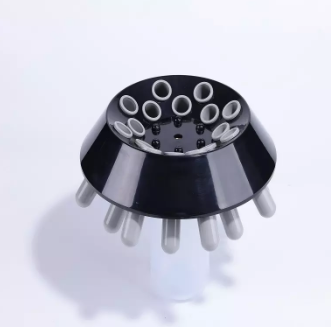
Matched Rotor for TG16
| Order No | Rotor | Max speed (rpm) | Max Volume(ml) | Max RCF (g) |
| G16-1 | Angle rotor | 14000 | 4×8PCR | 12070 |
| G16-2 | Angle rotor | 13000 | 6×8PCR | 16080 |
| G16-3 | Angle rotor | 14000 | 8×8PCR | 13390 |
| G16-4 | Angle rotor | 13000 | 12×8PCR | 17220 |
| G16-5 | Angle Rotor | 15000 | 30×0.5ml | 18510 |
| G16-6 | Angle Rotor | 14000 | 40×0.5ml | 19970 |
| G16-7 | Angle Rotor | 16000 | 12×1.5/2ml | 17940 |
| G16-8 | Angle Rotor | 15000 | 24×1.5/2ml | 20600 |
| G16-9 | Angle Rotor | 13500 | 30×1.5/2ml | 19340 |
| G16-10 | Angle Rotor | 11000 | 48×1.5/2ml | 12840 |
| G16-11 | Angle Rotor | 15000 | 16×5ml | 19350 |
| G16-12 | Angle Rotor | 14000 | 12×7ml | 16370 |
| G16-13 | Angle Rotor | 14000 | 6×10ml | 16460 |
| G16-14 | Angle Rotor | 13000 | 12×10ml | 14510 |
| G16-15 | Angle Rotor | 10000 | 12×15ml | 11840 |
| G16-16 | Angle Rotor | 5000 | 24×15ml | 3080 |
| G16-17 | Angle Rotor | 5000 | 30×15ml | 3830 |
| G16-18 | Angle Rotor | 12000 | 8×20ml | 14510 |
| G16-19 | Angle Rotor | 12000 | 6×30ml | 14000 |
| G16-20 | Angle Rotor | 11000 | 6×50ml | 13480 |
| G16-21 | Angle Rotor | 12000 | 6×70ml | 10810 |
| G16-22.1 | Angle Rotor | 12000 | 4x100ml | 14850 |
| G16-22 | Angle Rotor | 8000 | 6×100ml | 7280 |
| G16-23 | Angle Rotor | 12000 | 24 pieces capillary vessel | 15800 |
| G16-24 | Microplate rotor | 4000 | 2×3×48 Well | 2300 |