

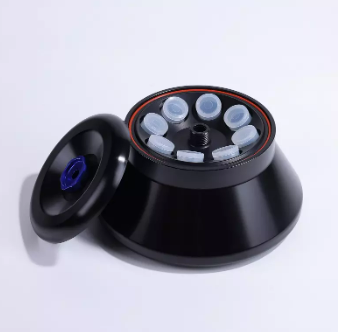

This product uses an improved salt precipitation purification method to provide a safe and economical solution for High Weight genomic DNA extraction from blood samples, tissue samples, cultured cells, oral swabs, bacteria, and other samples. The extraction does not require the use of toxic phenol chloroform or any expensive reagents, making it the most economical reagent kit for nucleic acid extraction at present. This kit has no limit onthe amount of sample used and can flexibly adjust various amounts of samples. The obtained DNA can be directly used for experiments such as PCR, enzyme digestion, Southern hybridization, and the Third-generation sequencing.
Principles
SolPure DNA Kits is an improved salt precipitation purification method. (Blood samples are lysed in red blood cell lysis buffer to remove red blood cells, and white blood cells are collected by centrifugation.) After lysis, DNA is released into the lysis buffer. RNA is removed by RNASE A. High salt solution is added to precipitate proteins and impurities. Centrifuge to remove precipitate and obtain supernatant containing only DNA. Add isopropanol to precipitate and recover DNA. Wash with 70% ethanol to remove salt, and finally add Buffer TE to dissolve DNA.
| Contents | D3317-01 | D3317-02 | D3317-03 |
| Purification Times | 10 | 50 | 250 |
| 10 x Buffer RBC | 4 ml | 50 ml | 100 ml |
| Buffer STE | 60 ml | 250 ml | 2 x 550 ml |
| Buffer SDS (20%) | 6 ml | 25 ml | 100 ml |
| Buffer PPS | 20 ml | 90 ml | 400 ml |
| Proteinase K | 12 mg | 50 mg | 240 mg |
| Protease Dissolve Buffer | 1.8 ml | 10 ml | 20 ml |
| RNase A | 5 mg | 20 mg | 60 mg |
| Buffer TE | 10 ml | 60 ml | 250 ml |
RNase A and Proteinase K should be stored at 2–8°C upon arrival. However, short-term storage (up to 4 weeks) at room temperature (15–25°C) does not affect its performance. The remaining kit components can be stored dry at room temperature (15–25°C) and are stable for at least18 months under these conditions. The entire kit can be stored at 2–8°C, but in this case buffers should be redissolved before use. Make sure that all buffers are at room temperature when used.
This product uses an improved salt precipitation purification method to provide a safe and economical solution for High Weight genomic DNA extraction from blood samples, tissue samples, cultured cells, oral swabs, bacteria, and other samples. The extraction does not require the use of toxic phenol chloroform or any expensive reagents, making it the most economical reagent kit for nucleic acid extraction at present. This kit has no limit onthe amount of sample used and can flexibly adjust various amounts of samples. The obtained DNA can be directly used for experiments such as PCR, enzyme digestion, Southern hybridization, and the Third-generation sequencing.

K-CellG3
180 / 360 assays per kit
| Content: | 180 / 360 assays per kit |
| Shipping Temperature: | Ambient |
| Storage Temperature: | Short term stability: 2-8oC, Long term stability: See individual component labels |
| Stability: | > 2 years under recommended storage conditions |
| Analyte: | endo-Cellulase |
| Assay Format: | Spectrophotometer, Auto-analyser |
| Detection Method: | Absorbance |
| Wavelength (nm): | 400 |
| Signal Response: | Increase |
| Limit of Detection: | 0.05 U/mL |
| Reproducibility (%): | ~ 3% |
| Total Assay Time: | ~ 20 min |
| Application examples: | Fermentation broths, industrial enzyme preparations and biofuels research. |
| Method recognition: | Novel method |
This product has been discontinued (read more).
The CellG3 assay reagent for the measurement of endo-cellulase (endo-1,4-β-glucanase) contains two components;
1) 4,6-O-benzylidene-2-chloro-4-nitrophenyl-β-D-cellotrioside (BCNPG3) and 2) thermostable β-glucosidase. The benzylidene blocking group prevents any hydrolytic action by the β-glucosidase on BCNPG3. Incubation with an endo-cellulase generates a non-blocked colourimetric oligosaccharide that is rapidly hydrolysed by the ancillary β-glucosidase. The rate of formation of 2-chloro-4-nitrophenol is therefore directly related to the hydrolysis of BCNPG3 by the endo-cellulase. The reaction is terminated and the phenolate colour is developed on addition of Tris buffer solution (pH 9.0).
Please note that a new assay kit (K-CellG5) is now available for the measurement of endo-cellulase. The CellG5 reagent contains a cellopentaose core and exhibits vastly improved sensitivity for some cellulases. In addition, the exchange of the benzylidene blocking group in CellG3 for 3-keto-butylidene in CellG5 improves the substrate’s water solubility significantly, allowing for a reduction in the concentration of DMSO required in the assay. As DMSO is known to inhibit certain cellulases, this is another benefit in using CellG5. Megazyme now recommends the use of K-CellG5 for all assays for the measurement of endo-cellulase.
Browse more cellulase and other enzyme activity assay kits.

The CellG3 assay reagent for the measurement of endo-cellulase (endo-1,4-β-glucanase) contains two components;
1) 4,6-O-benzylidene-2-chloro-4-nitrophenyl-β-D-cellotrioside (BCNPG3) and 2) thermostable β-glucosidase. The benzylidene blocking group prevents any hydrolytic action by the β-glucosidase on BCNPG3. Incubation with an endo-cellulase generates a non-blocked colourimetric oligosaccharide that is rapidly hydrolysed by the ancillary β-glucosidase. The rate of formation of 2-chloro-4-nitrophenol is therefore directly related to the hydrolysis of BCNPG3 by the endo-cellulase. The reaction is terminated and the phenolate colour is developed on addition of Tris buffer solution (pH 9.0).

Propargyl-PEG14-t-butyl ester consists of a propargyl group and a t-butyl protected carboxyl group. The propargyl group can be used in copper catalyzed Click Chemistry to yield a stable triazole linkage with azides. The t-butyl group can be hydrolyzed in acidic conditions. The hydrophilic PEG units help the molecule to have better solubility in aqueous environment. Reagent grade, for research purpose. Please contact us for GMP-grade inquiries.

Propargyl-PEG14-t-butyl ester consists of a propargyl group and a t-butyl protected carboxyl group. The propargyl group can be used in copper catalyzed Click Chemistry to yield a stable triazole linkage with azides. The t-butyl group can be hydrolyzed in acidic conditions. The hydrophilic PEG units help the molecule to have better solubility in aqueous environment. Reagent grade, for research purpose. Please contact us for GMP-grade inquiries.