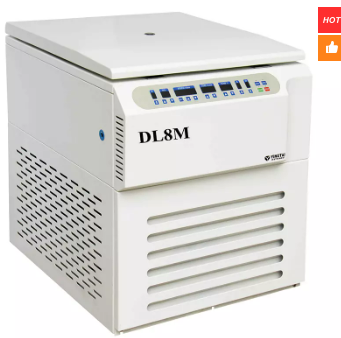
DL8M large capacity refrigerated centrifuge max capacity can hold 8x2000ml, can for 16pcs 500ml blood bags, can also for 8 bottles of 2000ml
Detail
DL8M Largest Capacity Refrigerated Centrifuge
Features
1. Widely used in the field of blood bank, pharmaceutical factory and laboratory.
2. Brushless frequency motor, in great torque, free maintenance, no powder pollution, quick in speed up and down.
3. Digital display which indicates the program, speed, time, RCF, temperature.
4. Micro computer control, there are 10 kinds of program and 10 kinds off acceleration and deceleration for your choice.
5. There are 4 kinds of rotors for your choice.
6. Electric lid lock, compact design, super speed and imbalance protection.
7. The centrifuge body is made of high-quality steel, safe and reliable.
DL8M Technical Parameter:
Max. Speed
8000rpm
Max. RCF
14900×g
Max. Capacity
8×2000ml(16*500ml blood bag)
Time Range
1~9h59min
RPM/RCF Convert
Yes
Noise (dB)
≤ 65
Temperature
-20~40℃
Acc/Dec
10 Kinds
Speed Accuracy
±20r/min
Temperature Accuracy
±1℃
Voltage(V/Hz)
AC 220V/380V 50HZ/60HZ
Dimensions (L x W x Hmm)
940×890×1000mm /
Net Weight(Kg)
600KG
Certificates
CE,ISO & Calibration report are available
Matched Rotors for DL8M
Order No.
Rotor No.
Max Speed (rpm)
Max Volume(ml)
Max. RCF(×g)
8M-1
Swing Rotor
4000
8 x 2000ml
5716
8M-2
Swing Rotor
4000
6×2400ml
5330
8M-3
Angle Rotor
8000
6×1000ml
14900
8M-4
Swing Rotor
4200
2×6×1000ml
5680
Other Products
Salmonella enterica TaqMan PCR Detection Kits
Product Info
Document
Product Info
Overview
Detection kits for Salmonella enterica
CE-IVD marked version available for in vitro diagnostic use
Available in TaqMan format for analysis
Salmonella enterica have emerged as significant foodborne pathogens that pose a serious public health problem. The symptoms of salmonellosis may include diarrhea, fever, vomiting, and abdominal cramps with elderly, new-born, and immunocompromised individuals the most susceptible. S. enterica is a facultatively anaerobic Gram-negative bacterium that could survive low temperatures and freezing. The majority of the 1.3 billion annual cases of Salmonella-caused human gastroenteritis result from ingestion of contaminated food products, such as raw or undercooked meat, seafood, and eggs, as well as raw or unpasteurized milk and dairy products. Salmonella infections are also contracted following consumption of fresh fruits or vegetables that have been contaminated by infected fertilizer.
Salmonella enterica TaqMan PCR Kit, 100 reactions
Ready to use format, including Master Mix for the target and PCR control to monitor for PCR inhibition and validate the quality
Specific Primer and Probe mix for the pathogen/virus/viroid of interest
Primer and Probe mix
Positive and negative control to confirm the integrity of the kit reagents
Salmonella enterica TaqMan PCR Probe/Primer Set and Controls, 100 reactions
Specific Primer/Probe mix and Positive Control for the pathogen/virus/viroid of interest
Nuclease-free water
Can be used together with Norgen’s PCR Master Mix (#28007) or customer supplied master mix
Storage Conditions and Product Stability All kit components can be stored for 2 years after the date of production without showing any reduction in performance.
All kit components should be stored at -20°C upon arrival.
This product provides fast and easy methods for purification of total DNA for reliable PCR and Southern blotting. Total DNA(e.g., genomic, viral, mitochondrial) can be purified from small volume of blood, tissue and dry blood spots.
Details
Specifications
Features
Specifications
Main Functions
Isolation total DNA from 1-10μl blood, <10mg tissue, urine, blood stain, seminal stain
Applications
PCR, southern bolt and virus detection, etc.
Purification method
Mini spin column
Purification technology
Silica technology
Process method
Manual (centrifugation or vacuum)
Sample type
Animal tissues, blood stain, urine, seminal stain and various forensic samples
Sample amount
Blood:1-100μl, Tissue:<10mg
Elution volume
Time per run
Liquid carrying volume per column
Binding yield of column
Principle
This product is based on silica Column purification. The sample is lysed and digested with lysate and protease, DNA is released into the lysate. Transfer to an adsorption column. Nucleic acid is adsorbed on the membrane, while protein is not adsorbed and is removed with filtration. After washing proteins and other impurities, nucleic acid was finally eluted with low-salt buffer (10mmTris, pH9.0, 0.5mm EDTA).
Advantages
Fast – several samples can be extracted in 20 minutes (after digestion)
High purity – purified DNA can be directly used in various downstream applications
High recovery – DNA can be recovered at the level of PG
Good repeatability – silica technology can obtain ideal results every time
Kit Contents
Contents
D312502
D312503
Purification Times
50 Preps
250 Preps
Buffer ATL
15 ml
60 ml
Buffer AL
15 ml
60 ml
Buffer GW1*
22 ml
66 ml
Buffer GW2*
20 ml
2 x 50 ml
Carrier RNA
310 μg
2 x 310 µg
Proteinase K
24 mg
120 mg
Protease Dissolve Buffer
1.8 ml
10 ml
Buffer AE
15 ml
60 ml
HiPure DNA Mini Columns I
50
2 x 125
2 ml Collection Tubes
100
5 x 100
Storage and Stability
Carrier RNA and Proteinase K should be stored at 2–8°C upon arrival. However, short-term storage (up to 12 weeks) at room temperature (15–25°C) does not affect its performance. The remaining kit components can be stored dry at room temperature (15–25°C) and are stable for at least 18 months under theseconditions.
Experiment Data
Document
This product provides fast and easy methods for purification of total DNA for reliable PCR and Southern blotting. Total DNA(e.g., genomic, viral, mitochondrial) can be purified from small volume of blood, tissue and dry blood spots.
Fasciolosis is one of the most frequently encountered autochthonous helminthic infections in Central Europe. The immunodiagnosis of Fasciola hepatica infections is challenged by high serological cross-reacitivity with other (hepatic) parasitological infections encountered in Central Europe, such as alveolar echinococcosis, toxocarosis and ascariosis, but also other parasitic infections acquired during overseas travel. The SAP-2 recombinant antigen shows a high specificity, especially with patients with other parasitic infections. It is a suitable serological test for routine diagnosis of human fasciolosis, particularly if the results are supported by clinical history.
This product is manufactured by Bordier Affinity Products in Switzerland and distributed in Germany exclusively by Milenia Biotec.
Method/Platform
ELISA in microplate format
Range/Assay Sensivity
77% sensitivity, 98% specificity
Test Principle
The kit provides all the material needed to perform 96 enzyme-linked immunosorbant assays (ELISA) on breakable microtitration wells sensitized with Fasciola hepaticarecombinant antigen. Specific antibodies in the sample will bind to the antigen and washing will remove unspecific antibodies. The presence of parasite specific antibodies is detected with a Protein A – alkaline phosphatase conjugate. A second washing step will remove unbound conjugate. Revealing bound antibodies is made by the addition of pNPP substrate which turns yellow in the presence of alkaline phosphatase. Color intensity is proportional to the amount of Fasciola hepatica specific antibodies in the sample. Potassium phosphate is added to stop the reaction. Absorbance at 405 nm is read using an ELISA microplate reader.The test can be performed with automatic systems, but this must be validated by the user.
12 x 8 strips (96 tests) Fasciolosis is one of the most frequently encountered autochthonous helminthic infections in Central Europe. The immunodiagnosis of Fasciola hepatica infections is challenged by high serological cross-reacitivity with other (hepatic) parasitological infections encountered in Central Europe, such as alveolar echinococcosis, toxocarosis and ascariosis, but also other parasitic infections acquired during overseas travel. The SAP-2 recombinant antigen shows a high specificity, especially with patients with other parasitic infections. It is a suitable serological test for routine diagnosis of human fasciolosis, particularly if the results are supported by clinical history.


 5. There are 4 kinds of rotors for your choice.


