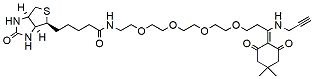
Dde Biotin-PEG4-alkyne is useful for introducing a biotin moiety to azide-containing molecules using Cu(I)-catalyzed Click Chemistry. The hydrophilic spacer arm provides better solubility to the labeled molecules in aqueous media. Dde protecting group allows efficient release of captured biotinylated molecules from streptavidin under mild conditions with hydrazine. Reagent grade, for research purpose. Please contact us for GMP-grade inquiries.
Detail
Dde Biotin-PEG4-alkyne is useful for introducing a biotin moiety to azide-containing molecules using Cu(I)-catalyzed Click Chemistry. The hydrophilic spacer arm provides better solubility to the labeled molecules in aqueous media. Dde protecting group allows efficient release of captured biotinylated molecules from streptavidin under mild conditions with hydrazine. Reagent grade, for research purpose. Please contact us for GMP-grade inquiries.
Other Products
Checkit Go Volumetric Verification Kit Products
Product Info
Document
Product Info
Checkit Go enables you to easily measure the volumes dispensed by a robot or multi-channel pipette, in under 10 seconds. These models measure up to 8 channels at a time and are offered in volume ranges covering 2μL to 50μL.
Please choose the model that matches your volume range:
Model
Volume Range
5 μL Volumetric Verification Kit
2-5 μL
10 μL Volumetric Verification Kit
4-10 μL
20 μL Volumetric Verification Kit
8-20 μL
50 μL Volumetric Verification Kit
20-50 μL
Document
Checkit Go enables you to easily measure the volumes dispensed by a robot or multi-channel pipette, in under 10 seconds. These models measure up to 8 channels at a time and are offered in volume ranges covering 2μL to 50μL.
Please choose the model that matches your volume range:
Propargyl-PEG14-alcohol is a propargyl linker which enables Click Chemistry with azide compounds to yield stable triazole linkage. The PEG spacer enhances the hydrophilicity of the molecule in aqueous media. Reagent grade, for research purpose. Please contact us for GMP-grade inquiries.
Document
Propargyl-PEG14-alcohol is a propargyl linker which enables Click Chemistry with azide compounds to yield stable triazole linkage. The PEG spacer enhances the hydrophilicity of the molecule in aqueous media. Reagent grade, for research purpose. Please contact us for GMP-grade inquiries.
Bis-propargyl-PEG9 is crosslinking reagent containing two propargyl groups. These functional groups enable the formation of triazole linkages with azide-bearing compounds with the presence of copper catalyst. The hydrophilicity of the molecule is improved because of the PEG chain. Reagent grade, for research purpose. Please contact us for GMP-grade inquiries.
Document
Bis-propargyl-PEG9 is crosslinking reagent containing two propargyl groups. These functional groups enable the formation of triazole linkages with azide-bearing compounds with the presence of copper catalyst. The hydrophilicity of the molecule is improved because of the PEG chain. Reagent grade, for research purpose. Please contact us for GMP-grade inquiries.