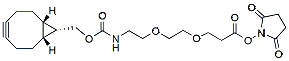
endo-BCN-PEG2-NHS ester is aclick chemistry crosslinker containing an NHS ester group. The NHS ester can be used to label the primary amines (-NH2) of proteins, amine-modified oligonucleotides, and other amine-containing molecules. The BCN group is reactive with azide-tagged biomolecules. Reagent grade, for research purpose. Please contact us for GMP-grade inquiries.
Detail
endo-BCN-PEG2-NHS ester is aclick chemistry crosslinker containing an NHS ester group. The NHS ester can be used to label the primary amines (-NH2) of proteins, amine-modified oligonucleotides, and other amine-containing molecules. The BCN group is reactive with azide-tagged biomolecules. Reagent grade, for research purpose. Please contact us for GMP-grade inquiries.
Other Products
50 bp DNA Ladder
Product Info
Document
Product Info
Overview
Ready-to-use
Quantitative
Highly Stable
Precise
10 discrete bands from 50 bp to 500 bp
Higher intensity reference band at 250 bp
The 50 bp DNA Ladder is prepared to ensure quality and batch-to-batch consistency. This Ladder contains ten discrete fragments ranging from 50 bp to 500 bp with a higher intensity reference band at 250 bp. This Ladder is ideal for quick sizing of PCR products
Contents 1mL of premixed DNA ladder (0.5µg/10µL) in loading buffer (10mM EDTA, 10% glycerol, 0.015% bromophenol blue, and 0.17% SDS).
Ladder Properties: • Ten discrete bands, ranging from 50 bp to 500 bp • Higher intensity band at 250 bp for easy reference
Fragment
Size (bp)
Mass (ng)
1
500
79
2
450
67
3
400
59
4
350
55
5
300
49
6
250
76
7
200
33
8
150
22
9
100
31
10
50
29
Recommended Use:
Mix thoroughly. For best results, load 10µL of DNA ladder per well. For precise mass determination with a densitometer, stain gel after electrophoresis using 0.5µg/mL ethidium bromide for 30-40 minutes. The table above shows the size and mass for each band based on 10µL ladder per well.
Storage:
Stable at room temperature. For longer term storage, -20°C is recommended.
This ladder was standardized using 10µL of DNA per lane on a 0.8 cm thick, 13 x 15 cm, 1.0% agarose gel run in TAE buffer.
Nerve Growth Factor Receptor (NGFR), also known as p75, P-75NTR or CD271, is a neurotrophin receptor belonging to the tumor necrosis factor receptor family. NGFR is expressed mainly in Schwann cells and neurons, as well as a number of other non-neuronal cell types, and functions during central and peripheral nervous system development to regulate neuronal growth, migration, differentiation, and cell death. Nerve Growth Factor Receptor is also expressed in melanocytes, melanomas, neuroblastomas, pheochromocytomas, neurofibromas, neurotized nevi (type C melanocytes), and other neural crest cell or tumor derivatives. It has been suggested that NGFR may act as a tumor suppressor indicated in prostate and urothelial cancer, and Anti-Nerve Growth Factor Receptor (NGFR) is often used in adjunct with S100, to aid in the diagnosis of desmoplastic and neurotrophic malignant melanomas. Anti-NGFR is also useful as an aid in the diagnosis of breast malignancy, as the antibody labels the myoepithelial cells of breast ducts and intralobular fibroblasts of breast ducts.
DBCO-C6-NHS ester is an amine-reactive compound, which can be used to modify an amine-containing molecule in organic media. This reagent isn’t soluble in aqueous media. The extended 6-carbon atom spacer arm improves solubility in commonly used organic solvents including dichloromethane, chloroform, THF, and ethyl acetate and it also improves derivatization efficiency and stability of conjugates. DBCO is commonly used for copper-free Click Chemistry reactions. Reagent grade, for research purpose. Please contact us for GMP-grade inquiries.
Document
DBCO-C6-NHS ester is an amine-reactive compound, which can be used to modify an amine-containing molecule in organic media. This reagent isn’t soluble in aqueous media. The extended 6-carbon atom spacer arm improves solubility in commonly used organic solvents including dichloromethane, chloroform, THF, and ethyl acetate and it also improves derivatization efficiency and stability of conjugates. DBCO is commonly used for copper-free Click Chemistry reactions. Reagent grade, for research purpose. Please contact us for GMP-grade inquiries.