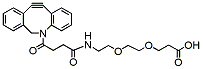
DBCO-PEG2-acid is an analog of DBCO-Acid with PEG linker and a DBCO group. The DBCO groups is commonly used for copper-free Click Chemistry reactions due to its strain promoted high energy. The hydrophilic PEG chain allows for increased water solubility. The terminal carboxylic acid can react with primary amine groups in the presence of activators (e.g. EDC, or HATU) to form a stable amide bond. Reagent grade, for research purpose. Please contact us for GMP-grade inquiries.
Detail
DBCO-PEG2-acid is an analog of DBCO-Acid with PEG linker and a DBCO group. The DBCO groups is commonly used for copper-free Click Chemistry reactions due to its strain promoted high energy. The hydrophilic PEG chain allows for increased water solubility. The terminal carboxylic acid can react with primary amine groups in the presence of activators (e.g. EDC, or HATU) to form a stable amide bond. Reagent grade, for research purpose. Please contact us for GMP-grade inquiries.
Other Products
Norovirus (NoV) TaqMan RT-PCR Detection Kits
Product Info
Document
Product Info
Overview
Detection kits for NoV
CE-IVD marked version available for in vitro diagnostic use
Available in TaqMan format for analysis
Norovirus is a single-stranded, non-enveloped RNA virus belonging to the Caliciviridae family. Norovirus is considered the major causative agent of non-bacterial gastroenteritis in the world. The main channel of transmittance is via contaminated food or water, as well as human-to-human contact. Most Noroviruses infecting humans belong to genogroup I and II (particularly genotype 4). Norovirus is very stable in the environment and is resistant to some surface disinfectants such as alcohols and detergents. Moreover, it is very difficult to culture Norovirus in vitro, making its identification by standard microbiological assays challenging.
NoV TaqMan RT-PCR Kit, 100 reactions
Ready to use format, including Master Mix for the target and PCR control to monitor for PCR inhibition and validate the quality
Specific Primer and Probe mix for the pathogen/virus/viroid of interest
Primer and Probe mix
Positive and negative control to confirm the integrity of the kit reagents
NoV TaqMan RT-PCR Probe/Primer Set and Controls, 100 reactions
Specific Primer/Probe mix and Positive Control for the pathogen/virus/viroid of interest
Nuclease-free water
Can be used together with Norgen’s RT-PCR Master Mix (#28113) or customer supplied master mix
Storage Conditions and Product Stability All kit components can be stored for 1 year after the date of production without showing any reduction in performance.
All kit components should be stored at -20°C upon arrival. Repeated thawing and freezing (> 2 x) of the Master Mix and Positive Control should be avoided, as this may affect the performance of the assay. If the reagents are to be used only intermittently, they should be frozen in aliquots.
This Kit is designed to purify genomic DNA and total RNA simultaneously from a single biological sample. Lysate is first passed through a DNA spin column to selectively isolate DNA and then through an RNA column to selectively isolate RNA. Pure DNA and RNA are purified from the entire sample, in contrast to other procedures where either the biological sample or the purified total nucleic acids is divided into two before being processed separately. The kit is compatible with small amounts of a wide range of animal cells and tissues.
Details
Specifications
Features
Specifications
Main Functions
Co-isolation DNA and RNA(not include miRNA) from a single sample (cells, soft tissue, plant sample)
Applications
RT-PCR, cDNA synthesis, PCR andsecond-generation sequencing, etc.
Purification method
Mini spin column
Purification technology
Silica technology
Process method
Manual (centrifugation or vacuum)
Sample type
Soft tissue samples (viscera, excluding skin andmuscle), cultured cells and common plant tissues
Sample amount
Soft Tissue: < 30mg, Cell: <1 x 10⁷, Plant: <100mg
Yield
DNA: 1 – 20 μg, RNA: 3 – 100 μg
Principle
The Kits are designed to purify both genomic DNA and total RNA from the same cellor tissue sample. Samples are first lysed and homogenized. The lysate is passed through a DNA Mini column and bind DNA. Ethanol is added to the flow-through and the sample is applied to an RNA column. DNA/RNA binds to the membrane and contaminants are washed away. High-quality RNA is eluted in as little as 30µl water using the Kit. High-quality DNA is eluted in as little as 50µl water using the Kit.
Advantages
High quality – high purity total RNA / DNA can be directly used in a variety of downstream applications
Fast – column method can complete the extraction of several samples in 30 minutes
Safe – no phenol chloroform extraction required
Simultaneous extraction- simultaneously isolate DNA and RNA from one sample
Kit Contents
Contents
R511102
R511103
Purification Times
50 Preps
250 Preps
HiPure DNA Mini Columns
50
250
HiPure RNA Mini Columns
50
250
2ml Collection Tubes
100
2 x 250
Buffer RLC
50 ml
200 ml
Buffer DW1
30 ml
150 ml
Buffer RW1
30 ml
150 ml
Buffer RW2*
20 ml
2 x 50 ml
RNase Free Water
10 ml
30 ml
Buffer AE
10 ml
50 ml
Storage and Stability
HiPure DNA/RNA Kit can be stored dry at room temperature (15–25°C) and are stable for at least 18 months under these conditions.
Document
This Kit is designed to purify genomic DNA and total RNA simultaneously from a single biological sample. Lysate is first passed through a DNA spin column to selectively isolate DNA and then through an RNA column to selectively isolate RNA. Pure DNA and RNA are purified from the entire sample, in contrast to other procedures where either the biological sample or the purified total nucleic acids is divided into two before being processed separately. The kit is compatible with small amounts of a wide range of animal cells and tissues.
Amp-Future RNA Isothermal Amplification Kit,Stable & Easy To Operate At ≤-20℃
Product Detail
Kit Storage and term of Validity
Storage term: stored at ≤-20℃,keep away from light, avoid heavy weight and repeated freezing and thawing.
Term of Validity: 14 months
Isothermal nucleic acid Principle Summary
This kit is based on a rapid nucleic acid amplification technology at room temperature and constant temperature:at room temperature and constant temperature(generally 39℃~42℃),reverse transcriptaseuses specific primers and template RNA tosynthesize cDNA strands,and binds the auxiliary protein and single strand with the help of the protein, the recombinase and the primer form a complex; perform a homology search and bind the target homology domain, at this time a D-loop region is formed at the homology positionand strand exchange begins; accompanied by the recombinase from the complex upon dissociation,the polymerase also bindsto the 3′ end of the primer,initiating chainextension.It is suitable for laboratory-level RNA amplification and RNA amplification for other detection purposes.
Isothermal nucleic acid Product Features
1/ High sensitivity and specificity, short reaction time.
2/ The reagent form is freeze-dried, stable and easy to operate.
3/ The reaction can be operated by metal bath and water bath pot without purchasing expensive PCR apparatus.
Technical Parameters:
Parameters
Details
Product Name
RNA Isothermal Amplification Kit Basic
Manufacturer
Amp-future
Storage Temperature
-20°C
Kit Components
Enzymes, Buffers ,Reagents
Packaging
48 Tests/box
Detection Limit
500-1000copies/µL
Shipping
ICE
Test Time
5-20mins
Isothermal nucleic acid Applications
Suitable for RNA isothermal rapid amplification kit(Basic type)
Primer: Require pair of nucleotide primers with the length of 25-35 bp.
RNA basic kit reaction temperature is 39 to 42℃ and time is 5-20 minutes.
Notes
1/ Please avoid nucleic acid contamination and set blank control during reaction due to the high sensitivity of the kit.
2/ Please take out the required quantity of MIRA reaction units for the experiment, and put the rest under storage conditions when performing the experiment.