
DBCO-amine TFA salt is a simple building block containing a DBCO moiety and an amine group. Amine is very reactive with NHS ester. DBCO is commonly used for copper-free Click Chemistry reactions.


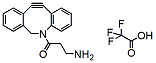
DBCO-amine TFA salt is a simple building block containing a DBCO moiety and an amine group. Amine is very reactive with NHS ester. DBCO is commonly used for copper-free Click Chemistry reactions.

Aminooxy-PEG4-propargyl is a aldehyde reactive crosslinker. The aminooxy group reacts with an aldehyde or ketone group to form a stable oxime linkage. The propargyl group is reactive with azide-bearing compounds or biomolecules via copper catalyzed azide-alkyne Click Chemistry to yield a stable triazole linkage. Reagent grade, for research purpose. Please contact us for GMP-grade inquiries. Aminooxy compounds are very reactive and sensitive; they cannot be stored for long term. Immediate use (within 1 week) is highly recommended.

Aminooxy-PEG4-propargyl is a aldehyde reactive crosslinker. The aminooxy group reacts with an aldehyde or ketone group to form a stable oxime linkage. The propargyl group is reactive with azide-bearing compounds or biomolecules via copper catalyzed azide-alkyne Click Chemistry to yield a stable triazole linkage. Reagent grade, for research purpose. Please contact us for GMP-grade inquiries. Aminooxy compounds are very reactive and sensitive; they cannot be stored for long term. Immediate use (within 1 week) is highly recommended.

The JC virus (JCV) is a type of human polyomavirus and belongs to the family Papovaviridae. JCV is a double-stranded DNA virus, and is genetically similar to BK virus and SV40. The virus is very common in the general population and it is believed that most people acquire JCV in childhood or adolescence. Typically the infection is subclinical and no of consequence in children with healthy immune systems. The initial site of infection may be the tonsils or the gastrointestinal tract, and the virus then remains latent in the gastrointestinal tract. JCV can also infect the tubular epithelial cells in the kidneys, where it continues to reproduce, shedding virus particles in the urine. Also, JCV can cross the blood-brain barrier into the central nervous system. JCV is known to cause the usually fatal progressive multifocal leukoencephalopathy (PML) by destroying oligodendrocytes in the brain in immunodeficient or immunosuppressed individuals. However, it has not been established whether PML is the result of a primary infection with JCV in a person with impaired immunity or whether it follows reactivation of latent virus. JC virus is also the primary cause of nephropathy (kidney disease) in people who have received a kidney transplant and are on immunosuppressive therapy.
JCV TaqMan PCR Kit, 100 reactions
JCV TaqMan PCR Probe/Primer Set and Controls, 100 reactions
Figure 1 / 3

Click for expanded view
Storage Conditions and Product Stability
All kit components can be stored for 2 years after the date of production without showing any reduction in performance.
All kit components should be stored at -20°C upon arrival. Repeated thawing and freezing (> 2 x) of the Master Mix and Positive Control should be avoided, as this may affect the performance of the assay. If the reagents are to be used only intermittently, they should be frozen in aliquots.
| Component | Cat. TM37250 (100 preps) | Cat. TM37210 (100 preps) |
|---|---|---|
| MDx TaqMan 2X PCR Master Mix | 2 x 700 μL | – |
| JCV Primer & Probe Mix | 280 μL | 280 μL |
| JCV Positive Control | 150 μL | 150 μL |
| Nuclease-Free Water (Negative Control) | 1.25 mL | 1.25 mL |
| Product Insert | 1 | 1 |
