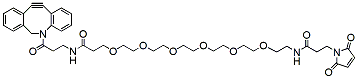
DBCO-PEG8-Maleimide is a PEG linker containing a DBCO moiety and a terminal primary maleimide group. The maleimide group will react with a thiol group to form a covalent bond, enabling the connection of biomolecule with a thiol. DBCO is commonly used for copper-free Click Chemistry reactions. Reagent grade, for research purpose. Please contact us for GMP-grade inquiries.
Detail
DBCO-PEG6-Maleimide is a PEG linker containing a DBCO moiety and a terminal primary maleimide group. The maleimide group will react with a thiol group to form a covalent bond, enabling the connection of biomolecule with a thiol. DBCO is commonly used for copper-free Click Chemistry reactions. Reagent grade, for research purpose. Please contact us for GMP-grade inquiries.
Other Products
Candida albicans TaqMan PCR Detection Kits
Product Info
Document
Product Info
Overview
Detection kits for Candida albicans
CE-IVD marked version available for in vitro diagnostic use
Available in TaqMan format for analysis
Candida albicans is an opportunistic yeast and is the most common fungal pathogen found in the human body. C. albicans can be detected in the gastrointestinal tract, mouth, and vagina of approximately half of healthy adults. It is typically a commensal organism and makes up part of the natural human microflora; however it can overgrow and become pathogenic as a result of various conditions. For example, individuals who have taken recent courses of antibiotics, have a weakened immune system or have diabetes have an increased risk of developing a Candida albicans infection. When an overgrowth occurs, this can lead to common infections such as urinary tract infections, genital yeast infections, oral thrush, and mucocutaneous candidiasis. In the more severe cases, when Candida albicans enters the bloodstream or organs, it can lead to loss of sight, blood and bone infections, endocarditis, meningitis or inflammation of the intraabdominal lining.
Storage Conditions and Product Stability All kit components can be stored for 2 years after the date of production without showing any reduction in performance.
All kit components should be stored at -20°C upon arrival.
This kit is used for extracting total viral nucleic acid from non-cell/low cell content biological samples such as body fluid, serum, plasma, urine, immersion solution, tissue homogenate supernatant, culture supernatant, etc., the extracted products can be used for clinical in vitro detection.
Details
Specifications
Features
Specifications
Main Functions
Extract viral RNA/DNA from non-cell/low cell content biological samples
Applications
RT-PCR,PCR,NGS
Products
Viral total nucleic acid
Purification method
Mini spin column
Purification technology
Silica technology
Process method
Manual (centrifugation or vacuum)
Sample type
Cell-free body fluid such as plasma, serum, soaking solution and tissue homogenate supernatant
Sample amount
200μl
Yield
2-10μg
Elution volume
≥30μl
Time per run
≤30 minutes
Liquid carrying volume per column
800μl
Binding yield of column
100μg
Principle
This product is based on silica gel purification. The sample is lysed and digested with lysate and protease, DNA / RNA is released into the lysate. Transfer to an adsorption plate and filter column. DNA/RNA is adsorbed on the membrane, while protein is not adsorbed and is removed with filtration. After washing proteins and other impurities, DNA / RNA was finally eluted with low-salt buffer (10 Mm Tris, pH 8.0).
Advantages
Fast – several samples can be extracted in 20 minutes by column method
High quality – high purity total RNA can be directly used in various sensitive downstream applications
Safe – no phenol chloroform extraction required
Sensitive – DNA/RNA can be recovered at the level of PG
High yield – carrier RNA contained in the product maximize the recovery of trace nucleic acid
Kit Contents
Contents
IVD4173
Purification Times
100 Preps
HiPure Viral Mini Column
100
2ml Collection Tubes
200
PK/Carrier RNA
50 mg
Protease Dissolve Buffer
5 ml
Buffer AL
30 ml
Buffer MW1*
44 ml
Buffer MW2*
50 ml
RNase Free Water
15 ml
Storage and Stability
Proteinase K should be stored at 2–8°C upon arrival. However, short-term storage (Proteinase K up to 8 weeks) at room temperature (15–25°C) does not affect their performance. The remaining kit components can be stored at room temperature (15–25°C) and are stable for 18 months under these conditions.
Experiment Data
Document
This kit is used for extracting total viral nucleic acid from non-cell/low cell content biological samples such as body fluid, serum, plasma, urine, immersion solution, tissue homogenate supernatant, culture supernatant, etc., the extracted products can be used for clinical in vitro detection.
Nineteen discrete fragments ranging from 100 bp to 10000 bp
Higher intensity reference bands at 500 bp, 1000 bp and 5000 bp
The Norgen HighRangerPlus 100 bp DNA Ladder is prepared to ensure quality and batch-to-batch consistency. Our HighRangerPlus contains nineteen discrete fragments ranging from 100 bp to 10000 bp with higher intensity reference bands at 500 bp, 1000 bp and 5000 bp. This Ladder is ideal for size determination of digested DNA.
Contents: 1mL of premixed DNA ladder (0.5µg/10µL) in loading buffer (10mM EDTA, 10% glycerol, 0.015% bromophenol blue, and 0.17% SDS).
HighRanger Plus 100 bp DNA Ladder (Cat# 12000) – 100 loads
Ladder Properties:
Nineteen discrete fragments ranging from 100 bp to 10000 bp
Higher intensity bands at 500 bp, 1000 bp and 5000 bp for easy reference
Fragment
Size (bp)
Mass (ng)
1
10000
42
2
8000
33
3
6000
25
4
5000
42
5
4000
35
6
3000
27
7
2500
22
8
2000
18
9
1500
13
10
1000
40
11
900
28
12
800
25
13
700
34
14
600
19
15
500
44
16
400
13
17
300
18
18
200
13
19
100
10
Recommended Use: Mix thoroughly. For best results, load 10µL of DNA ladder per well. For precise mass determination with a densitometer, stain gel after electrophoresis using 0.5µg/mL ethidium bromide for 30-40 minutes. The table above shows the size and mass for each band based on 10µL ladder per well.
Storage: This kit is stable for 2 years after the date of shipment.
This ladder was standardized using 10µL of DNA per lane on a 0.8 cm thick, 13 x 15 cm, 1.0% agarose gel run in TAE buffer.