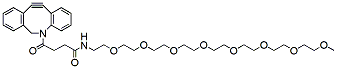
m-PEG12-DBCO is a long chain click chemistry PEG reagents. The DBCO group can react with azides via a copper-free Click Chemistry reaction to form a stable triazole. This reagent can be applied to situations when copper is a concern for DBCO-activated PEGylation. Reagent grade, for research purpose. Please contact us for GMP-grade inquiries.
Detail
m-PEG12-DBCO is a long chain click chemistry PEG reagents. The DBCO group can react with azides via a copper-free Click Chemistry reaction to form a stable triazole. This reagent can be applied to situations when copper is a concern for DBCO-activated PEGylation. Reagent grade, for research purpose. Please contact us for GMP-grade inquiries.
Other Products
IVD3101 MagPure DNA Micro Kit
Product Info
Document
Product Info
Introduction
This product is suitable for rapid extraction of DNA from tissue, cells, blood, saliva, swabs, blood spots, semen and other clinical samples. DNA can be used directly for PCR, quantitative PCR, Southern Blot, test of virus DNA and so on.
Details
Specifications
Features
Specifications
Main Functions
Isolation total DNA from 1-100ul blood, FFPE, tissue and other samples
Applications
Second generation sequencing, PCR, real timePCR, etc.
Purification method
Monodisperse magnetic beads
Purification technology
Magnetic beads technology
Process method
Manual or automatic
Sample type
Anticoagulant blood, concentrated blood, buffy coat, lymphocytes and cultured cells
Sample amount
Body fluid : 10 – 200μl, Tissue : ≤10mg
Yield
10ng – 15μg
Elution volume
80 -100μl
Time per run
Principle
This product is based on the purification method of high binding magnetic particles. The sample is lysed and digested under the action of lysate and Protease. DNA is released into the lysate. After adding magnetic particles and binding solution, DNA will be adsorbed on the surface of magnetic particles, and impurities such as proteins will be removed without adsorption. The adsorbed particles were washed with washing solution to remove proteins and impurities, washed with ethanol to remove salts, and finally DNA was eluted by Elution Buffer.
Advantages
High binding force – suitable for handling DNA rich samples, such as whole blood, buffy coat, concentrated blood, etc.
High purity – carboxyl magnetic beads with weak surface adsorption, getting higher purity
General – can be used for various clinical samples
Kit Contents
Contents
IVD3101
Purification Times
200
MagBind Particles
4.5 ml
Proteinase K
90 mg
Protease Dissolve Buffer
10 ml
Buffer ATL
60 ml
Buffer AL
60 ml
Buffer BD*
20 ml
Buffer BXW1*
110 ml
Elution Buffer
30 ml
Storage and Stability
Proteinase K, MagBind Particles should be stored at 2–8°C upon arrival. However, short-termstorage (up to 18 weeks) at room temperature (15–25°C) does not affect their performance. The remainingkit components can be stored dry at room temperature (15–25°C) and are stable for at least 18 months under these conditions.
Document
This product is suitable for rapid extraction of DNA from tissue, cells, blood, saliva, swabs, blood spots, semen and other clinical samples. DNA can be used directly for PCR, quantitative PCR, Southern Blot, test of virus DNA and so on.
Sulfo DBCO-PEG4-Maleimide is a water-soluble click chemistry reagent with a maleimide group and a DBCO moiety. The hydrophilic PEG spacer arm improves solubility in aqueous buffers. Maleimide group specifically and efficiently reacts with thiols to form stable thioether bonds. The low mass weight will add minimal spacer to modified molecules and will enable simple and efficient incorporation of DBCO moiety onto cysteine-containing peptides or other thiol-containing biomolecules. DBCO is commonly used for copper-free Click Chemistry reactions. Reagent grade, for research purpose. Please contact us for GMP-grade inquiries.
Document
Sulfo DBCO-PEG4-Maleimide is a water-soluble click chemistry reagent with a maleimide group and a DBCO moiety. The hydrophilic PEG spacer arm improves solubility in aqueous buffers. Maleimide group specifically and efficiently reacts with thiols to form stable thioether bonds. The low mass weight will add minimal spacer to modified molecules and will enable simple and efficient incorporation of DBCO moiety onto cysteine-containing peptides or other thiol-containing biomolecules. DBCO is commonly used for copper-free Click Chemistry reactions. Reagent grade, for research purpose. Please contact us for GMP-grade inquiries.
DBCO-C2-PEG4-amine is a PEG linker which contains DBCO and amine moieties. The DBCO group is commonly used in copper-free Click Chemistry reactions. The amine group is reactive with carboxylic acids, activated NHS esters, carbonyls (ketone, aldehyde) etc. The hydrophilic PEG spacer increases solubility in aqueous media. Reagent grade, for research purpose. Please contact us for GMP-grade inquiries.
Document
DBCO-C2-PEG4-amine is a PEG linker which contains DBCO and amine moieties. The DBCO group is commonly used in copper-free Click Chemistry reactions. The amine group is reactive with carboxylic acids, activated NHS esters, carbonyls (ketone, aldehyde) etc. The hydrophilic PEG spacer increases solubility in aqueous media. Reagent grade, for research purpose. Please contact us for GMP-grade inquiries.