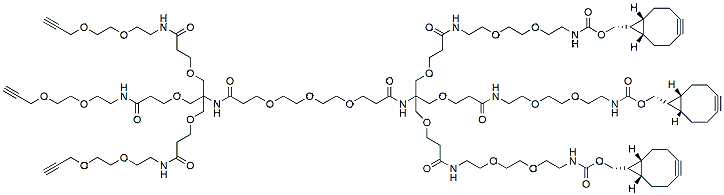
PEG3-(Amino-Tri-(Propargyl-PEG2-ethoxymethyl)-methane)-(Amino-Tri-(endo-BCN-PEG2-ethoxymethyl)-methane) is reactive with azide-bearing compounds or biomolecules via copper catalyzed azide-alkyne Click Chemistry to yield a stable triazole linkage. The DBCO groups are commonly used for copper-free Click Chemistry reactions due to their strain promoted high energy. The hydrophilic PEG chain allows for increased water solubility.
Detail
PEG3-(Amino-Tri-(Propargyl-PEG2-ethoxymethyl)-methane)-(Amino-Tri-(endo-BCN-PEG2-ethoxymethyl)-methane) is reactive with azide-bearing compounds or biomolecules via copper catalyzed azide-alkyne Click Chemistry to yield a stable triazole linkage. The DBCO groups are commonly used for copper-free Click Chemistry reactions due to their strain promoted high energy. The hydrophilic PEG chain allows for increased water solubility.
Other Products
16S V3-V4 Library Preparation Kit for Illumina
Product Info
Document
Product Info
Overview
Protocol optimized for DNA isolated from a diversity of samples including stool, soil, water, saliva, plant, urine, skin, and more
Simple and quick workflow: library could be prepared in less than 5 hours
Component of Norgen’s metagenomics workflow
A single NGS run can be prepared with up to 384 unique dual-index libraries
The 16S V3-V4 Library Preparation Kit for Illumina consists of the reagents and components required for library preparation of the 16S V3-V4 amplicon libraries to be used for next-generation sequencing on Illumina platforms. All molecular reagents including primers, enzyme mixes, indexes, and buffers are provided. Instructions for PCR clean up with the AMPure XP Magnetic Beads (supplied by customer) are also included for rapid purification of nucleic acid products generated at two steps of the workflow. The library prep workflow could be used for purified DNA inputs from different sources including stool, soil, water, saliva, plant, urine, skin swab, vaginal swab, cheek swab, nasal swab, plasma/serum, tongue swab, gum swab, and others.
The 16S V3-V4 Library Preparation Kit for Illumina has a streamlined procedure that reduces the handling time such that the library prep procedure can be completed in approximately 4 hours (see diagram below). Input DNA is first subjected to targeted PCR to amplify the V3-V4 region of the DNA encoding 16S rRNA. The post-PCR reaction is then cleaned up using AMPure XP beads. Dual index primers are then added using a limited-cycle PCR. The indexed amplicons flanked by 5′ and 3′ barcoded adaptors are then cleaned using AMPure XP beads. The libraries are then ready for quantification, pooling and sequencing.
Details
Minimum amount of starting material:
2.5 µL of DNA (5 ng/µL)
Time to complete library preparation:
4 hours
Storage Conditions and Product Stability Norgen’s 16S V3-V4 Library Prep Kit for Illumina is shipped as one kit box (for the 24 prep kit) or two sub-component kits (for the 96 prep kit). All kits should be stored at -20°C upon arrival.
All kit components should remain stable for at least 1 year when stored at the specified storage conditions.
Dietary fiber can generally be described as the carbohydrate content of food that is not digested in the human small intestine. It passes into the large intestine where it is partially or fully fermented. These characteristics of dietary fiber are associated with its numerous well documented health benefits.
Dietary Fiber is a mixture of complex organic substances, including hydrophilic compounds, such as soluble and insoluble polysaccharides and non-digestable oligosaccharides, as well as a range of non-swellable, more or less hydrophobic, compounds such as cutins, suberins and lignins. The procedures for the determination and analysis of total dietary fiber as outlined in our assay protocol are based on the methods of Lee et al.1 and Prosky et al.2,3 (AOAC 991.43, AOAC 985.29, AACC 32-07.01 and AACC 32-05.01). However, the enzymes in the Megazyme Total Dietary Fiber Kit can also be used in other dietary fiber analytical methods such as AACC Method 32-21.01 and AACC Method 32-06.01.
1. Association of Official Analytical Chemists. (1985). Official Methods of Analysis, 14th ed., 1st suppl. Secs. 43, A14-43, A20, p.399. 2. Association of Official Analytical Chemists. (1986). Changes in methods. J. Assoc. Off. Anal. Chem., 69, 370. 3. Association of Official Analytical Chemists. (1987). Changes in methods. J. Assoc. Off. Anal. Chem., 70, 393.
See General Referee Reports: Journal of AOAC INTERNATIONAL, Vol. 81, No. 1, 1998.
Two separate methods are described in the associated assay protocol:
METHOD 1: DETERMINATION OF TOTAL, SOLUBLE AND INSOLUBLE DIETARY FIBER Based on AOAC Method 991.43 “Total, Soluble, and Insoluble Dietary Fiber in Foods” (First Action 1991) and AACC Method 32-07.01 “Determination of Soluble, Insoluble, and Total Dietary Fiber in Foods and Food Products” (Final Approval 10-16-91).
METHOD 2: DETERMINATION OF TOTAL DIETARY FIBER Based on AACC method 32-05.01 and AOAC Method 985.29.
Note that a letter of endorsement from the original method developer, Dr. Leon Prosky, is included in the Documents Tab.
Usages: For cultivating, enumerating and preserving nonfastidious bacteria.
Principle: Peptone and beef extract powder to provide nitrogen, vitamins, amino acids and carbon; agar as medium coagulant.
Formulation(per liter): Peptone: 5g Beef extract :3g Agar :15g Final pH 6.8 ± 0.2
How to use: 1. Suspend 23g of product, adding 1L of distilled or deionized water, heated to boiling stirring until completely dissolved, dispensing into flask, autoclave at 121 ℃ for 15min, set aside. 2.Diluted and treated samples.
Quality control:
Item
The name and number of strain
Growth
Colony Color
1
Escherichia coli ATCC25922
Good
Dark red
2
Aerogenes CMCC (B) 45103
Good
red
3
Staphylococcus aureus ATCC6538
Suppressed
—
Storage: Keep container tightly closed, store in a cool, dry place, away from bright light. Storage period of 3 years.