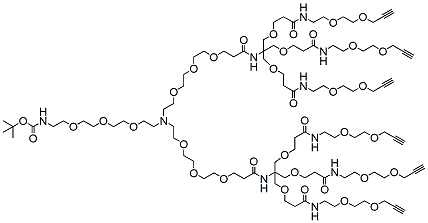
N-(Boc-PEG3)-N-bis-(PEG3-Amino-Tri-(Propargyl-PEG2-ethoxymethyl)-methane) is a crosslinker consisting of six propargyl groups and a t-Boc protected aminooxy group. The propargyl groups can form triazole linkage with azide-bearing compounds or biomolecules via copper catalyzed Click Chemistry. The protected amine can be deprotected under acidic conditions. The hydrophilic PEG spacer increases solubility in aqueous media. Reagent grade, for research use only.
Detail
N-(Boc-PEG3)-N-bis-(PEG3-Amino-Tri-(Propargyl-PEG2-ethoxymethyl)-methane) is a crosslinker consisting of six propargyl groups and a t-Boc protected aminooxy group. The propargyl groups can form triazole linkage with azide-bearing compounds or biomolecules via copper catalyzed Click Chemistry. The protected amine can be deprotected under acidic conditions. The hydrophilic PEG spacer increases solubility in aqueous media. Reagent grade, for research use only.
Other Products
16S V1-V3 Library Preparation Kit for Illumina
Product Info
Document
Product Info
Overview
Protocol optimized for DNA isolated from a diversity of samples including stool, soil, water, saliva, plant, urine, skin, and more
Simple and quick workflow: library could be prepared in less than 5 hours
Component of Norgen’s metagenomics workflow
A single NGS run can be prepared with up to 384 unique dual-index libraries
The 16S V1-V3 Library Preparation Kit for Illumina consists of the reagents and components required for library preparation of the 16S V1-V3 amplicon libraries to be used for next-generation sequencing on Illumina platforms. All molecular reagents including primers, enzyme mixes, indexes, and buffers are provided. Instructions for PCR clean up with the AMPure XP Magnetic Beads (supplied by customer) are also included for rapid purification of nucleic acid products generated at two steps of the workflow. The library prep workflow could be used for purified DNA inputs from different sources including stool, soil, water, saliva, plant, urine, skin swab, vaginal swab, cheek swab, nasal swab, plasma/serum, tongue swab, gum swab, and others.
The 16S V1-V3 Library Preparation Kit for Illumina has a streamlined procedure that reduces the handling time such that the library prep procedure can be completed in approximately 4 hours (see diagram below). Input DNA is first subjected to targeted PCR to amplify the V1-V3 region of the DNA encoding 16S rRNA. The post-PCR reaction is then cleaned up using AMPure XP beads. Dual index primers are then added using a limited-cycle PCR. The indexed amplicons flanked by 5′ and 3′ barcoded adaptors are then cleaned using AMPure XP beads. The libraries are then ready for quantification, pooling and sequencing.
Storage Conditions and Product Stability Norgen’s 16S V1-V3 Library Prep Kit for Illumina is shipped as one kit box (for the 24 prep kit) or two sub-component kits (for the 96 prep kit). All kits should be stored at -20°C upon arrival.
All kit components should remain stable for at least 1 year when stored at the specified storage conditions.
The MagPure Plasmid purification system uses the paramagnetic bead technology for high-throughput preparation of high-copy or low-copy plasmid DNA from E. coli cells. This kit also can be used with fosmid and BAC vector-based constructs. The system uses alkaline lysis followed by a MagPure purification to differentially bind plasmid DNA to paramagnetic beads. While the DNA is bound to the beads, contaminants can be rinsed away using a simple washing procedure. Because MagPure uses magnetic separation technology, the protocol does not require vacuum filtration. This makes kit extremely amenable to automation. Plasmid DNA purified with this system is most commonly used in Sanger Sequencing and PCR amplification.
Details
Specifications
Features
Specifications
Main Functions
Isolation up to 20µg plasmid DNA from 1-3ml bacterial culture
Applications
Enzyme digestion, sequencing, PCR and labeling, etc.
Purification technology
Magnetic beads technology
Process method
Manual or automatic
Sample type
Conventional plasmid, plasmid≤30KB
Sample amount
1-3ml
Elution volume
≥50μl
Principle
This product is based on the purification method of high binding magnetic particles. The sample is lysed and digested under the action of lysate and Lysozyme. DNA is released into the lysate. After adding magnetic particles and binding solution, DNA will be adsorbed on the surface of magnetic particles, and impurities such as proteins will be removed without adsorption.The adsorbed particles were washed with washing solution to remove proteins and impurities, washed with ethanol to remove salts, and finally DNA was eluted by Elution Buffer.
Advantages
1. Suitable for extracting plasmids from 1-5ml or <3ml YT medium. 2. The same amount of buffer 1, 2, and 3 avoids errors caused by adjusting the pipette, making it convenient to use in conjunction with automated workstations. 3. Containing buffer 1 for washing, reducing the problem of false high production. 4. The purified plasmid can be directly used for sequencing, enzyme digestion, PCR, and other applications.
Kit Contents
Contents
P181102
P181103
P181104
Purification Times
100 Preps
500 Preps
5000 Preps
RNase A
10 mg
50 mg
2 x 250 mg
Buffer P1
30 ml
150 ml
2 x 750 ml
Buffer P2
30 ml
150 ml
2 x 750 ml
Buffer N3
30 ml
150 ml
2 x 750 ml
Buffer PW1
35 ml
180 ml
2 x 900 ml
MagPure Particle NB*
2.2 ml
11 ml
2 x 60 ml
Storage and Stability
RNase A and MagPure Particle NB should be stored at 2-8°C upon arrival. However, short-term storage (up to 24 weeks) at room temperature (15-25°C) does not affect its performance. The remaining kit components can be stored dry at room temperature (15-25°C) and are stable for at least 18 months under these conditions. After addition of RNase A, Buffer P1 is stable for 6 months when stored at 2-8°C.
Experiment Data
Document
The MagPure Plasmid purification system uses the paramagnetic bead technology for high-throughput preparation of high-copy or low-copy plasmid DNA from E. coli cells. This kit also can be used with fosmid and BAC vector-based constructs. The system uses alkaline lysis followed by a MagPure purification to differentially bind plasmid DNA to paramagnetic beads. While the DNA is bound to the beads, contaminants can be rinsed away using a simple washing procedure. Because MagPure uses magnetic separation technology, the protocol does not require vacuum filtration. This makes kit extremely amenable to automation. Plasmid DNA purified with this system is most commonly used in Sanger Sequencing and PCR amplification.