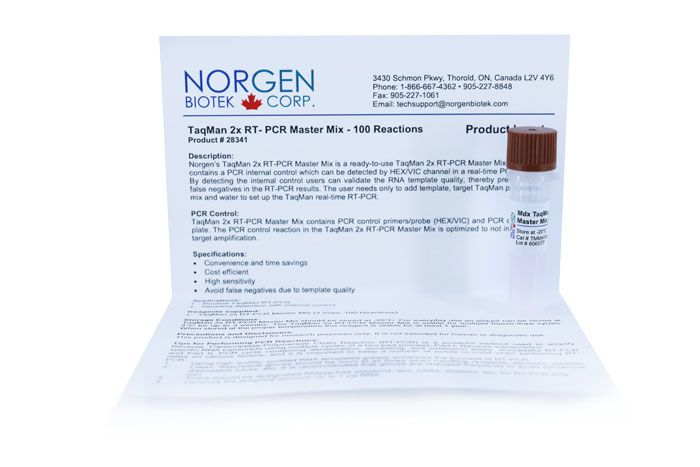
Norgen’s TaqMan 2x PCR Master Mix is a ready-to-use TaqMan 2x PCR Master Mix solution that contains a PCR internal control which can be detected by HEX/VIC channel in a real-time PCR machine. By detecting the internal control users can validate the DNA template quality, thereby preventing any false negatives in the PCR results. The user needs only to add template, target TaqMan primer/probe mix and water to set up the TaqMan real-time PCR.
PCR Control: TaqMan 2x PCR Master Mix contains PCR control primers/probe (HEX/VIC) and PCR control template. The PCR control reaction in the TaqMan 2x PCR Master Mix is optimized to not interfere with target amplification. The fluorescence of the target probe should not be HEX/VIC.
Details
Reagents Supplied – Cat # 28341
TaqMan 2x RT-PCR Master Mix (3 Vials, 100 Reactions) – Sufficient reagent for 100 x 20 µL reactions
Storage Conditions and Product Stability Norgen’s TaqMan 2x PCR and 2x RT-PCR Master Mixes should be stored at -20ºC. For everyday use an aliquot can be stored at 4ºC for up to three months. The Master Mix is stable for multiple freeze-thaw cycles. When stored at the proper temperature this reagent is stable for at least 1 year.
Other Products
D3113 HiPure Tissue&Blood DNA Midi Kit
Product Info
Document
Product Info
Introduction
Blood samples contain rich DNA, including mitochondrial DNA, genomic DNA, circulating DNA (mostly released into blood after tumor cell apoptosis) in white blood cells, as well as parasitic viral or microbial DNA. These DNA are important parameters in clinical testing or diagnosis, which are also valuable materials for medical research. There are three main issues with extracting DNA from blood samples:
1. The sample is highly infectious, posing great harm to operators and the environment.
2. The source of DNA is complex and aportion of the nucleic acid, such as viral DNA or free DNA, may be lost during the operation, leading to downstream detection failure;
3. Blood sample contains a large amount of impurities and inhibitory factors.
Currently there are many methods available for extracting DNA from whole blood samples, such as phenol chloroform extraction, salting out method, etc. However, these methods require pre-treatment of blood sample, which removes red blood cells and isolate white blood cells in the first step. Due to the requirement that it cannot inactivate or kill pathogens during the process of removing red blood cells, the waste liquid (red blood cell lysate) and consumables may be contaminated by pathogens and become infectious, posing a danger to the entire laboratory environment and operators. In addition, during the process of removing red blood cells, useful nucleic acid information such as viruses, microorganisms, or circulating DNA is also lost, leading to experiment or detection failures.
The HiPure Blood DNA Kits series provided by Magen Company uses silica gel column purification technology, which can directly lyse whole blood samples without the need for white blood cell separation. Whole blood samples are directly mixed with lysates and proteases, resulting in the inactivation of pathogens, greatly reducing the infectivity, environmental pollution, and the chance of operators being infected. Due to the direct lysis and digestion of samples, except lymphocyte DNA, other circulating DNA as well as DNA from viruses and microorganisms, can also be recovered.
This product provides fast and easy methods for purification of total DNA for reliable PCR and Southern Blotting. Total DNA (e.g., genomic, viral, mitochondrial) can be purified from tissue and culture cells.
Details
Specifications
Features
Specifications
Main Functions
Isolation total DNA from 2ml blood and 200mg tissue using Midi column
Applications
PCR, southern bolt and virus detection, etc
Purification method
Midi spin column
Purification technology
Silica technology
Process method
Manual (centrifugation or vacuum)
Sample type
Tissue, cell, blood, saliva, swab, blood spot, semen and other clinical samples
Sample amount
0.2-2 ml
Elution volume
≥300μl
Time per run
≤80 minutes
Liquid carrying volume per column
4ml
Binding yield of column
1mg
Principles
This product is based on silica column purification. The sample is lysed and digested with lysate and protease, DNA is released into the lysate. Transfer to an adsorption column. Nucleic acid is adsorbed on the membrane, while protein is not adsorbed and is removed with filtration. After washing proteins and other impurities, Nucleic acid was finally eluted with low-salt buffer (10mm Tris, pH9.0, 0.5mm EDTA).
Advantages
High quality DNA – meet a variety of downstream applications, including PCR, qPCR, enzyme digestion, hybridization, etc.
Fast – without separation of leukocytes, organic extraction or ethanol precipitation
Simple – all nucleic acids can be obtained by direct digestion
Wide applicability – handle a variety of liquid samples
Kit Contents
Contents
D311302
D311303
Purification Times
20
100
HiPure gDNA Midi Columns
20
100
15ml Collection Tubes
40
200
Buffer ATL
50 ml
250 ml
Buffer AL
50 ml
250 ml
Buffer GW1*
22 ml
110 ml
Buffer GW2*
12 ml
50 ml
RNase A
20 mg
90 mg
Proteinase K
100 mg
440 mg
Protease Dissolve Buffer
10 ml
30 ml
Buffer AE
20 ml
120 ml
Storage and Stability
Proteinase K, RNase A should be stored at 2-8°C upon arrival. However, short-term storage (up to 12 weeks) at room temperature (15-25°C) does not affect their performance. The remaining kit components can be stored at room temperature (15-25°C) and are stable for at least 18 months under these conditions.
Blood samples contain rich DNA, including mitochondrial DNA, genomic DNA, circulating DNA (mostly released into blood after tumor cell apoptosis) in white blood cells, as well as parasitic viral or microbial DNA. These DNA are important parameters in clinical testing or diagnosis, which are also valuable materials for medical research. There are three main issues with extracting DNA from blood samples:
This product provides a reliable solution for DNA isolation from yeast samples. Total DNA can be purified from yeast (<5x 10⁷) without phenol or chloroform. The whole extraction can be finished within 60 minutes. Purified DNA can be directly used for PCR, Southern blot, ect.
Details
Specifications
Features
Specifications
Main Functions
Isolation total DNA from yeast cultures
Applications
PCR, southern blot and enzyme digestion, etc.
Purification method
Mini spin column
Purification technology
Silica technology
Process method
Manual (centrifugation or vacuum)
Sample type
Yeast culture
Sample amount
Bacterial culture: 1-1.5 ml
Elution volume
≥30μl
Time per run
≤60 minutes
Liquid carrying volume per column
800μl
Binding yield of column
100μg
Principle
This product is based on silica Column purification. The sample is lysed and digested with lysate and protease, DNA is released into the lysate. Transfer to an adsorption column. Nucleic acid is adsorbed on the membrane, while protein is not adsorbed and is removed with filtration. After washing proteins and other impurities, Nucleic acid was finally eluted with low-salt buffer (10mm Tris,pH9.0, 0.5mm EDTA).
Advantages
Fast – several samples can be extracted in 40 minutes (after digestion)
High purity – purified DNA can be directly used in various downstream applications
Good repeatability – silica technology can obtain ideal results every time
High recovery – DNA can be recovered at the level of PG
Sufficient components – lysozyme, protease K, RNase A and glass beads
Kit Contents
Contents
D314702
D314703
Purification Times
50 Preps
250 Preps
Hipure DNA Mini Columns I
50
250
2ml Collection Tubes
50
250
Glass Beads (0.4~0.6mm)
20 g
90 g
Buffer SE
30 ml
150 ml
Lyticase
1.8 ml
5 x 1.8 ml
Buffer ATL
30 ml
150 ml
ReagentDX
500 μl
1500 μl
Buffer DL
30 ml
150 ml
Buffer GW1*
13 ml
66 ml
Buffer GW2*
20 ml
2 x 50 ml
Proteinase K
12 mg
60 mg
Protease Dissolve Buffer
1.8 ml
5 ml
Buffer AE
15 ml
30 ml
Storage and Stability
Proteinase K should be stored at 2–8°C upon arrival. However, short-term storage (up to 12 weeks) at room temperature (15–25°C) does not affect their performance. The remaining kit components can be stored dry at room temperature (15–25°C) and are stable for at least 18 months under these conditions. Buffer ATL may precipitate at low temperature. Dissolve it by 37℃ water bath.
Document
This product provides a reliable solution for DNA isolation from yeast samples. Total DNA can be purified from yeast (
NGS Low Input DNA Library Prep Kit (illumina and MGI Platforms)
Product Info
Document
Product Info
The NGS Low Input DNA Library Prep Kit (illumina and MGI Platforms) was developed for construction of high quality NGS libraries with low input DNA amount from 1 ng to 400 ng. The kit allows scientist to study samples with limited DNA such as tumor samples, patient samples, and other specially collected samples (FACS sorting etc.). The kit has high library conversion efficiency with as little as 1 ng DNA input. The fast and simple 1.5-hour protocol makes libraries with even coverage and low GC-bias based our unique chemistry for DNA end-polishing and ligation.
The kit needs double strand DNA fragments (blunt and/or sticky) as input DNA for NGS library preparation, and is compatible with DNA fragments generated from both enzymatic approach (for example, BioDynami DNA fragmentation enzymes, Cat.# 40061 and Cat.# 40062) and mechanical approaches such as sonication and nebulization etc.
NGS Low Input DNA Library Prep Kit Workflow
Three index types are available for the NGS Low Input DNA Library Prep Kit of illumina platform:
Non-index (Cat.# 30022): Libraries do not have index.
Index (Cat.# 30024): Each of our index primers contains a unique barcode sequence with 6 bases that can be used to identify the low input DNA libraries. Library multiplexing up to 48 samples is possible. Index information can be downloaded here.
Unique dual index (Cat.# 30025): Library multiplexing up to 96 low input DNA libraries is possible with unique dual indexes with our Four-Base Difference Index System. The system allows us to make indexes for the libraries that have at least 4 bases different from each other in the 8-base barcode length. Our unique dual index primers can reduce sequencing errors such as de-multiplexing errors, amplification errors, mis-assignment of reads, index cross-contamination, and also index hopping. The kit includes 96 pre-mixed unique pairs of index primers. Index information can be downloaded here.
Indexes are available for the MGI platform kits (Cat.# 34024).
Kit advantages:
Fast protocol
The hands-on time is only 10 minutes
The total protocol time is around 1.5 hours
Simple procedure
Ready-to-use master mix makes it simple for reaction setup
Less reaction components
Less magnetic beads required for cleanup steps: Save the cost more than 50%
Low input DNA amount: Starts from 1 ng of DNA
Comparison of library conversion efficiency under the same NGS library preparation condition. Input DNA amounts are 1 ng and 10 ng, respectively. DNA was mechanical sheared with Covaris before library prep. BioDynami kit: NGS Low Input DNA Library Prep Kit (Cat. #30022).
Comparison of library yield under the same NGS library prep condition. Input DNA amounts are 1 ng, 10 ng, and 100 ng. DNA was mechanical sheared with Covaris before library prep. BioDynami kit (Cat. #30022). PCR cycle numbers were indicated.
Document
The NGS Low Input DNA Library Prep Kit (illumina and MGI Platforms) was developed for construction of high quality NGS libraries with low input DNA amount from 1 ng to 400 ng. The kit allows scientist to study samples with limited DNA such as tumor samples, patient samples, and other specially collected samples (FACS sorting etc.). The kit has high library conversion efficiency with as little as 1 ng DNA input. The fast and simple 1.5-hour protocol makes libraries with even coverage and low GC-bias based our unique chemistry for DNA end-polishing and ligation.