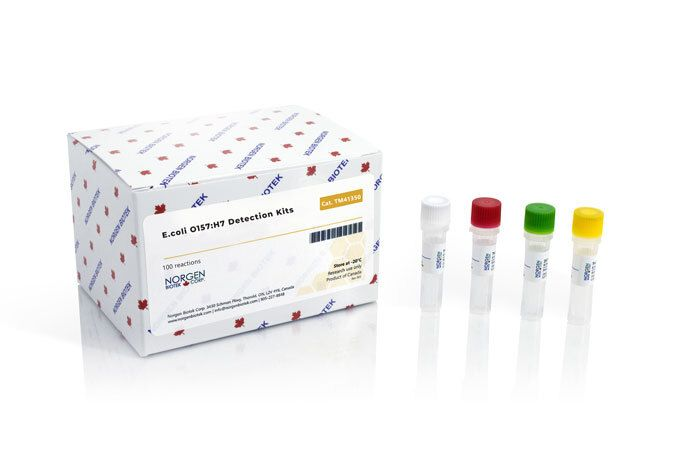
E. coli O157:H7 is a rod-shaped, gram negative bacterium. It is an enterohemorrhagic strain of the common E. coli bacterium and infection by the O157:H7 strain is commonly associated with hemorrhagic colitis. E. coli O157:H7 is recognized by its somatic (cell wall) antigen (O157) and its flagella antigen (H7). In addition, E. coli O157:H7 is known to produce Shiga-like toxins, which cause severe symptoms. While most patients can recover from the infection, up to 15% of the patients may develop hemolytic uremic syndrome, a type of kidney failure that could be fatal. Infection of E. coli O157:H7 usually results from consumption of poorly prepared food including undercooked meat (particularly ground beef), untreated water or raw unpasteurized milk.
E.coli O157:H7 TaqMan PCR Kit, 100 reactions
Ready to use format, including Master Mix for the target and PCR control to monitor for PCR inhibition and validate the quality
Specific Primer and Probe mix for the pathogen/virus/viroid of interest
Primer and Probe mix
Positive and negative control to confirm the integrity of the kit reagents
E.coli O157:H7 TaqMan PCR Probe/Primer Set and Controls, 100 reactions
Specific Primer/Probe mix and Positive Control for the pathogen/virus/viroid of interest
Nuclease-free water
Can be used together with Norgen’s PCR Master Mix (#28007) or customer supplied master mix
For research use only and NOT intended for in vitro diagnostics.
Storage Conditions and Product Stability All kit components can be stored for 2 years after the date of production without showing any reduction in performance.
All kit components should be stored at -20°C upon arrival.
The Her2/Neu (c-erbB-2) proto-oncogene is a transmembrane receptor tyrosine kinase that is clinically indicated in a number of carcinomas. Overexpression of the c-erbB-2 protein has been associated with ductal breast cancer, as well as pulmonary and gastric adenocarcinomas. A correlation between Her2 and p53 has also been documented, as overexpression of both proteins has been associated with early invasion and metastasis in bladder cancer.
Long Term Stable Nucleic Acid Extraction Reagent For RNA
Product Info
Document
Product Info
Product Description
Long-Term Stable Nucleic Acid Reagent For RNA Extraction
Product Description:
Amp-future Bio’s Nucleic Acid Extraction Reagent is a RNA extraction kit that provides the highest quality nucleic acid extraction. The RNA extraction kit is an automated nucleic acid extractor which allows for quick and easy RNA isolation. The reagent is in liquid form and has a shelf life of 12 months, making it a reliable and durable product. With the Nucleic Acid Extraction Reagent, Amp-future Bio provides the accuracy and reliability of a professionally designed RNA extraction kit.
Features:
Product Name: RNA Nucleic Acid Extraction Reagent
Brand: Amp-future Bio
Form: Liquid
Shelf Life: 12 Months
Application: RNA Extract
Keywords: RNA Extraction Kit
Technical Parameters:
Property
Value
Form
Liquid
Product Name
RNA Nucleic Acid Extraction Reagent
Application
RNA Extraction
Brand
Amp-future Bio
Shelf Life
12 Months
Composition
5ml*4 tubes
Applications:
Amp-future Bio’s Nucleic Acid Reagent is an advanced automated nucleic acid extraction solution designed to efficiently extract RNA from biological samples while maintaining quality and accuracy. It is made in China and has a 12-month shelf life. It comes in a liquid form and is suitable for use in automated nucleic acid extractors, allowing for automatic and highly efficient extraction of nucleic acid from various sample types. The reagent is also designed to be easy to use, making it an ideal solution for laboratories that require fast and reliable results. This reagent is a great choice for any research or clinical laboratory that needs efficient and accurate nucleic acid extraction.
Support and Services:
Technical Support and Services for Nucleic Acid Reagent We provide technical support and services for Nucleic Acid Reagents. Our experts are available to help you identify the right reagents for your application, answer any questions, and provide assistance on the use and optimization of these reagents. Our experts are also available to provide advice on troubleshooting and protocol optimization. We offer a range of services to make ordering and stocking of reagents easy and convenient.
We provide:
Expert advice on the selection of the right reagents for your application
Free samples for evaluation
Bulk and custom orders
Technical support and troubleshooting assistance
Secure and reliable online ordering
Fast and convenient shipping options
Please contact us for more information about our technical support and services for nucleic acid reagents.
The series of DNA Size Selection Kits (Magnetic Beads) were developed for DNA size selection using magnetic beads. A total of 11 kits are available, with different selection ranges spanning from 50 bp to over 10 kb. The kits provide a simple and quick approach for the enrichment of a specific range of DNA fragments. The kit workflow allows double-sided or single-sided size selection for specific size cutoffs.
Gel images of different ranges of size selection. Sheared human genomic DNA was used as input.
.
DNA size selection is a selective capture of DNA fragments of a specific range of size for next-generation sequencing (NGS) library preparations, PCR, ChIP assay, DNA ligations, endonuclease digestions, adapter removal, and other genomics and molecular biology applications. DNA size selection is preferred after NGS library prep in most of the cases. The NGS library preparation is related to the quality of the sequencing data. Precise NGS library size selection can increase sequencing efficiency, improve data quality, and reduce costs.
There are two types of sequencing technologies: short-read sequencing and long-read sequencing. Short-read sequencing uses DNA libraries that contain small insert DNA fragments of similar sizes, usually several hundred base pairs. The sequencing efficiency can be improved if the DNA size selection is in the right range. Cat.# 20104S and 20104L are the best kits for NGS library size selection of illumina paired-end 100 (PE100) sequencing with 100-200 bp library inserts; Cat.# 20105S and 20105L are the best kits for NGS library size selection of illumina paired-end 150 (PE150) sequencing with 150-300 bp library inserts; and Cat.# 20106S and 20106L are the best kits for NGS library size selection of illumina paired-end 300 (PE300) sequencing with 300-600 bp library inserts.
Long-read sequencing uses a large DNA fragment as input and makes very long reads. Usually, library size selection is preferred to remove smaller fragments. Cat.# 20110S and 20110L are the best kits for long-read sequencing size selection with DNA sizes >5 kb, and Cat.# 20111S and 20111L are the best kits for long-read sequencing size selection with DNA sizes >10 kb.
The magnetic beads technology uses paramagnetic particles, also known as SPRI (Solid Phase Reversible Immobilization) beads, to bind DNA reversibly and selectively. DNA fragments can be size-selected and purified by changing the properties of the magnetic beads or SPRI beads. The magnetic beads can easily separate the beads-binding DNA from the contaminants and unwanted components in the samples. The samples after DNA size selection are free of contaminants such as buffer components, enzymes, proteins, salts, dNTPs, primers, and adapters. Our proprietary magnetic beads reagents improve yield, selectivity, and reproducibility.
Specific DNA fragments at a certain length range can be purified simply using magnetic separation with different beads components, avoiding tedious and time-consuming gel extraction and column-based purification. The magnetic beads method is popular for common DNA size selection, including library size selection. The first beads-binding step, referred to as the right-side clean-up, removes large DNA fragments. The large DNA fragments are bound to the beads and are discarded. The desired DNA fragments in the supernatant are transferred to a new well, and new beads are added to the supernatant for the second beads-binding, referred to as the left-side clean-up. The double-size selected DNA fragments are eluted after ethanol rinsing.
DNA size selection with dual clean-ups.
.
A single clean-up is needed for DNA size selection with large fragments. In this case, only the large DNA fragments are bound to the beads. The selected larger DNA fragments are eluted after ethanol rinsing.
DNA size selection with single clean-up for >5 kb and >10 kb DNA.
.
Features of DNA size selection and library size selection
High specificity and high recovery of size selection
11 selection ranges are available, including 5 ranges for NGS library size selection
50-100 bp
100-200 bp
200-500 bp
250-350 bp: ideal for illumina PE100 sequencing
300-450 bp: ideal for illumina PE150 sequencing
450-750 bp: ideal for illumina PE300 sequencing
500-1000 bp
1-3 kb
1-5 kb
>5 kb: ideal for long-read sequencing
>10 kb: ideal for long-read sequencing
Fast and simple
20-min protocol
No gel purification required
No columns required
No centrifugation required
Efficient removal of contaminants and unwanted components