CE-IVD marked version available for in vitro diagnostic use
Available in TaqMan format for analysis
Bacillus cereus is a rod-shaped, gram-positive bacterium. Some strains of B. cereus cause foodpoisoning and other diseases such as keratitis. B. cereus grows at a wide range of temperature, from 4°C to 37°C. In fact, many foodborne illnesses caused by B. cereus are a consequence of improperly cooked or improperly stored food, including dairy products and meats. The majority of food poisoning by B. cereus could be divided into two types of symptoms – the emetic type and the diarrheal type, both of which are caused by the enterotoxin produced by the bacteria.
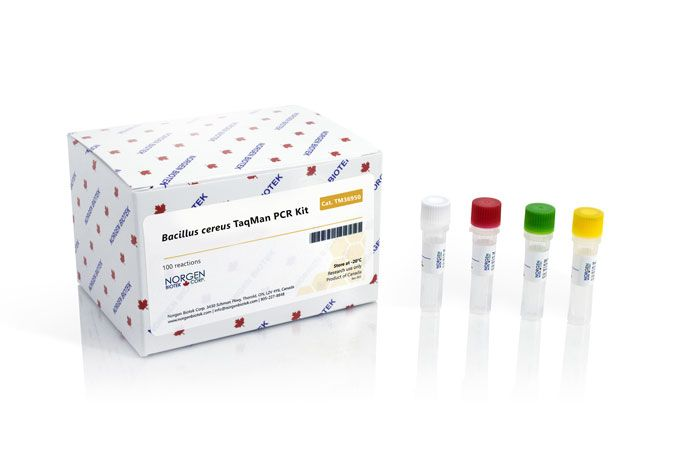
Bacillus cereus TaqMan PCR Kit, 100 reactions
Ready to use format, including Master Mix for the target and PCR control to monitor for PCR inhibition and validate the quality
Specific Primer and Probe mix for the pathogen/virus/viroid of interest
Primer and Probe mix
Positive and negative control to confirm the integrity of the kit reagents
Bacillus cereus TaqMan PCR Probe/Primer Set and Controls, 100 reactions
Specific Primer/Probe mix and Positive Control for the pathogen/virus/viroid of interest
Nuclease-free water
Can be used together with Norgen’s PCR Master Mix (#28007) or customer supplied master mix
Storage Conditions and Product Stability All kit components can be stored for 2 years after the date of production without showing any reduction in performance.
All kit components should be stored at -20°C upon arrival. Repeated thawing and freezing (> 2 x) of the Master Mix and Positive Control should be avoided, as this may affect the performance of the assay. If the reagents are to be used only intermittently, they should be frozen in aliquots.
Component
Cat. TM36950 (100 preps)
Cat. TM36910 (100 preps)
MDx TaqMan 2X PCR Master Mix
2 x 700 μL
–
Bacillus cereus Primer & Probe Mix
280 μL
280 μL
Bacillus cereus Positive Control
150 μL
150 μL
Nuclease-Free Water (Negative Control)
1.25 mL
1.25 mL
Product Insert
1
1
Other Products
DNA Isothermal Rapid Amplification Kit Fluorescent Type
Product Info
Document
Product Info
Product Details
Kit Size:
48 Reactions
Product Name:
DNA Isothermal Rapid Amplification Kit Fluorescent Type
Kit Type:
DNA
Reaction Volume:
50 μL
Storage Temperature:
-20℃
Application:
Nucleic Acid Amplification
Type:
Fluorescent Type
Reaction Time:
20mins
High Light:
20mins home test kit
,
DNA home test kit
,
48 Reactions home dna test kit
Payment & Shipping Terms
Minimum Order Quantity
48T
Price
3.8$/T
Packaging Details
16T/bag,48T/box
Delivery Time
6days
Payment Terms
T/T,Paypal
Supply Ability
100000T/Month
Product Description
DNA Isothermal Rapid Amplification Kit(Fluorescent Type)Guide Manual
Buffer system mainly for stabilizing protein/enzyme and performance
B buffer
0.15ml
1 Tube
Mainly activated systems such as magnesium ions
Positive control template
0.1ml
1 Tube
Mainly the positive plasmid template is used to test the effectiveness of the kit
Positive control primer mix
0.06ml
1 Tube
Mainly the primer combination of the positive control template
Reagent Guide Manua
16T/bags,48T/Box
3 bags
Reagent technology of protein/enzyme system: freeze-dried powder, freeze-dried microspheres
Principle overview
This kit is based on a room temperature and constant temperature nucleic acid rapid amplification technology: at room temperature and constant temperature, the recombinase and primer form the protein/single-stranded nucleotide complex Rec/ssDNA, with the help of auxiliary proteins and single-stranded binding protein SSB , invade the double-stranded DNA template; form a D-loop region at the invasion site, and start scanning the DNA double-strands; after finding the target region complementary to the primer, the Rec/ssDNA complex disintegrates, and the polymerase also binds to The 3′ end of the primer initiates chain extension. This kit relies on the action of exonuclease at 39 ºC, adding specific molecular probes designed based on the template, and using fluorescence monitoring equipment to achieve real-time monitoring of the amplification process of the target fragment.
Primer design
It is recommended to use primers with a length of 30-35 bp. Primers that are too short will affect amplification speed and detection sensitivity; primers are designed to avoid the formation of secondary structures that affect amplification; the amplicon length is recommended to be 150-300 bp, usually no more than 500 bp.
Fluorescent probe design
The probe sequence does not overlap with the specific primer recognition site, is 46-52 nt in length, and the sequence avoids palindromic sequences, internal secondary structures, and continuous repeated bases. The probe has four modification sites: the middle position ≥ 35 nt from the 5′ end is labeled with a dSpacer (tetrahydrofuran, THF) as the recognition site for exonuclease; the upstream of the THF site is labeled with a fluorescent group, and the downstream Label a quenching group, the distance between the two groups is 2-4 nt; THF is ≥15 nt from the 3′ end, and the 3′ end is labeled with a modifying group, such as an amine group, a phosphate group or a C3-Spacer.
Product features and advantages:
This kit has the advantages of high sensitivity, strong specificity,and short reaction time (only 20 minutes), and the reaction groups are in dry powder state, which is easy to operate and easy to store.
It can be applied to various brands of fluorescence quantitative PCR instruments, constant temperature fluorescence amplification instruments and other fluorescence detection equipment.
Document
This kit is based on a room temperature and constant temperature nucleic acid rapid amplification technology: at room temperature and constant temperature, the recombinase and primer form the protein/single-stranded nucleotide complex Rec/ssDNA, with the help of auxiliary proteins and single-stranded binding protein SSB , invade the double-stranded DNA template; form a D-loop region at the invasion site, and start scanning the DNA double-strands; after finding the target region complementary to the primer, the Rec/ssDNA complex disintegrates, and the polymerase also binds to The 3′ end of the primer initiates chain extension. This kit relies on the action of exonuclease at 39 ºC, adding specific molecular probes designed based on the template, and using fluorescence monitoring equipment to achieve real-time monitoring of the amplification process of the target fragment.
Extraction RNA Nucleic Acid Reagent With 12 Months Shelf Life
Product Info
Document
Product Info
Product Description
Nucleic Acid Extraction Reagent – RNA Extraction Kit with 12 Months Shelf Life
Product Description:
Amp-future Bio’s Nucleic Acid Extraction Reagent is a RNA extraction kit that provides the highest quality nucleic acid extraction. The RNA extraction kit is an automated nucleic acid extractor which allows for quick and easy RNA isolation. The reagent is in liquid form and has a shelf life of 12 months, making it a reliable and durable product. With the Nucleic Acid Extraction Reagent, Amp-future Bio provides the accuracy and reliability of a professionally designed RNA extraction kit.
Features:
Product Name: RNA Nucleic Acid Extraction Reagent
Brand: Amp-future Bio
Form: Liquid
Shelf Life: 12 Months
Application: RNA Extract
Keywords: RNA Extraction Kit
Technical Parameters:
Property
Value
Form
Liquid
Product Name
RNA Nucleic Acid Extraction Reagent
Application
RNA Extraction
Brand
Amp-future Bio
Shelf Life
12 Months
Composition
5ml*4 tubes
Applications:
Amp-future Bio’s Nucleic Acid Reagent is an advanced automated nucleic acid extraction solution designed to efficiently extract RNA from biological samples while maintaining quality and accuracy. It is made in China and has a 12-month shelf life. It comes in a liquid form and is suitable for use in automated nucleic acid extractors, allowing for automatic and highly efficient extraction of nucleic acid from various sample types. The reagent is also designed to be easy to use, making it an ideal solution for laboratories that require fast and reliable results. This reagent is a great choice for any research or clinical laboratory that needs efficient and accurate nucleic acid extraction.
Support and Services:
Technical Support and Services for Nucleic Acid Reagent We provide technical support and services for Nucleic Acid Reagents. Our experts are available to help you identify the right reagents for your application, answer any questions, and provide assistance on the use and optimization of these reagents. Our experts are also available to provide advice on troubleshooting and protocol optimization. We offer a range of services to make ordering and stocking of reagents easy and convenient.
We provide:
Expert advice on the selection of the right reagents for your application
Free samples for evaluation
Bulk and custom orders
Technical support and troubleshooting assistance
Secure and reliable online ordering
Fast and convenient shipping options
Please contact us for more information about our technical support and services for nucleic acid reagents.
Document
Amp-future Bio’s Nucleic Acid Extraction Reagent is a RNA extraction kit that provides the highest quality nucleic acid extraction. The RNA extraction kit is an automated nucleic acid extractor which allows for quick and easy RNA isolation. The reagent is in liquid form and has a shelf life of 12 months, making it a reliable and durable product. With the Nucleic Acid Extraction Reagent, Amp-future Bio provides the accuracy and reliability of a professionally designed RNA extraction kit.
Short term stability: 2-8oC, Long term stability: See individual component labels
Stability:
> 2 years under recommended storage conditions
Analyte:
Ammonia, Nitrogen, YAN
Assay Format:
Spectrophotometer, Microplate, Auto-analyser
Detection Method:
Absorbance
Wavelength (nm):
340
Signal Response:
Decrease
Linear Range:
0.2 to 7 µg of ammonia per assay
Limit of Detection:
0.07 mg/L
Reaction Time (min):
~ 5 min
Application examples:
Grape juice, wine, fruit juices, soft drinks, dairy products (e.g. milk), dietetic food, soy sauce, eggs and egg products, cheese, meat, processed meat, seafood, bakery products (and baking agents), fertilisers, pharmaceuticals, tobacco, cosmetics, water, Kjeldahl analysis, paper (and cardboard), water and other materials (e.g. biological cultures, samples, etc.).
Method recognition:
Methods based on this principle have been accepted by MEBAK
Ammonia Assay Kit, for the rapid measurement and analysis of ammonia in all samples, including grape juice and wine (and other foods/beverages).
Note for Content: The number of manual tests per kit can be doubled if all volumes are halved. This can be readily accommodated using the MegaQuantTM Wave Spectrophotometer (D-MQWAVE).