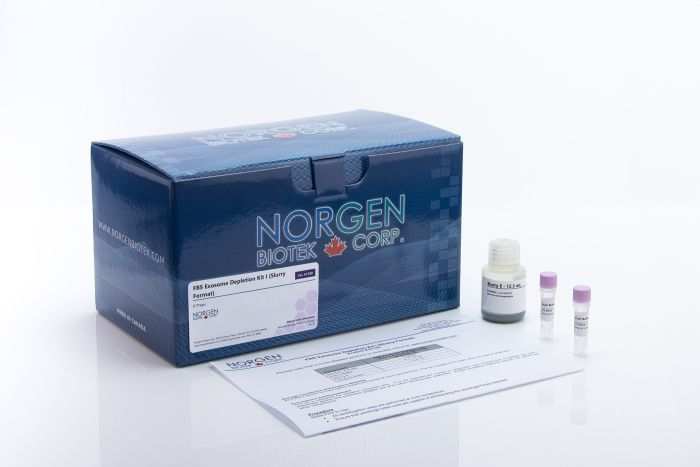
Efficient depletion of bovine exosomes from Fetal Bovine Serum
Deplete exosome-sized vesicles from versatile FBS volumes
No protease treatment required
No time-consuming ultracentrifugation
No precipitation reagents required
No overnight incubation required
Exosome depletion confirmed by reduction of bovine miRNAs below detectable levels
The depleted FBS provides the same cellular growth rates as the standard FBS
Purification is based on Norgen’s proprietary Silicon Carbide resin matrix
Norgen’s FBS Exosome Depletion Kits provides a quick and easy protocol for the depletion of bovine exosomes from FBS prior to using it as a growth supplement in your culture medium. The FBS recovered from the depletion process is exosome-depleted and does not contain any quantifiable bovine miRNAs. Moreover, the exosome-depleted FBS will support the growth of your cells of interest similar to the non-depleted FBS. Norgen’s kits allow for the processing of different FBS volumes. The depletion is based on Norgen’s proprietary resin. These kits provide a clear advantage over other available kits in that they do not require ultracentrifugation, any special instrumentation, precipitation reagents or any protease treatments. More importantly, the depletion process is an inexpensive method for exosome depletion from FBS, as compared to the expensive current ready-to-use exosome-depleted media available on the market.
Background
Most culture medium used for the growth and propagation of cells in culture require the addition of fetal bovine serum (FBS) as a growth supplement to media. FBS is obtained from bovine (cow) serum, and therefore contains large quantities of bovine exosome vesicles. These exosomes may interfere with some types of studies, or may lead to unreliable results when studying the exosomes shed from your cells of interest in normal culture conditions. Therefore, the use of exosome-depleted FBS is highly recommended for many types of studies.
Up to 140 mL (FBS Exosome Depletion Kit I (Slurry Format) Up to 280 mL (FBS Exosome Depletion Kit II (Slurry Format)
Depletion
Deplete exosome-sized vesicle
Bovine miRNA
No detectable bovine miRNA
Time to Complete 6 Purifications
40 minutes
Storage Conditions and Product Stability All buffers should be kept tightly sealed and stored at room temperature. This kit is stable for 2 years after the date of shipment.
Component
Cat. 61100 (6 preps)
Cat. 61400 (12 preps)
Cat. 61200 (6 preps)
Cat. 61300 (12 preps)
ExoC Buffer
2 x 1.5 mL
8 mL
2 x 1.5 mL
8 mL
Slurry E
12.5 mL
2 x 12.5 mL
–
–
Maxi Spin Column
–
–
6
12
Product Insert
1
1
1
1
Other Products
Bacterial Genomic DNA Isolation Kit
Product Info
Document
Product Info
Overview
Isolate genomic DNA from all types of bacteria (both Gram-positive and Gram-negative)
Rapid and convenient spin column protocol
96-well format available for high throughput
High yield, high quality DNA for sensitive downstream applications including sequencing, PCR, qPCR and more
This kit is designed for the rapid spin column preparation of genomic DNA from 2 x 10⁹ viable bacterial cells (between 0.5 and 1.0 mL of culture). This kit can be used for both Gram-negative and Gram-positive bacteria including Escherichia coli and Bacillus cereus. Purified genomic DNA is of an excellent quality and yield, and is fully compatible with restriction enzyme digestions, sequencing, PCR, qPCR and more. Also available in 96-well format for high throughput applications.
* Yield will vary depending on the type of sample processed
Storage Conditions and Product Stability All solutions should be kept tightly sealed and stored at room temperature. This kit is stable for 1 year after the date of shipment. The kit contains a ready-to-use Proteinase K, which is dissolved in a specially prepared storage buffer. The buffered Proteinase K is stable for up to 1 year after the date of shipment when stored at room temperature.
Short term stability: 2-8oC, Long term stability: See individual component labels
Stability:
> 2 years under recommended storage conditions
Analyte:
Glucose Oxidase
Assay Format:
Spectrophotometer, Microplate, Auto-analyser
Detection Method:
Absorbance
Wavelength (nm):
510
Signal Response:
Increase
Linear Range:
0.01 to 0.08 U/mL of glucose oxidase per assay
Limit of Detection:
10 U/L
Reaction Time (min):
~ 20 min
Application examples:
Enzyme preparations, and other materials (e.g. biological cultures, samples, etc.).
Method recognition:
Novel method
The Glucose Oxidase assay kit is a simple procedure for the rapid and reliable measurement and analysis of glucose oxidase activity in industrial enzyme preparations and bread improver mixtures.
All reagents stable for > 12 months after preparation
Simple format
Mega-Calc™ software tool is available from our website for hassle-free raw data processing
Standard included
Suitable for manual, microplate and auto-analyser forma
Document
The Glucose Oxidase assay kit is a simple procedure for the rapid and reliable measurement and analysis of glucose oxidase activity in industrial enzyme preparations and bread improver mixtures.
Magnetic bead nucleic acid purification technology uses nano or micron superparamagnetic material as the matrix, generally black ferric oxide or yellowish brown ferricoxide as the magnetic material. The surface of bead is coated with appropriate functional groups, which can adsorb nucleic acid. Magnetic beads commonly used for nucleic acids, containing carboxyl groups, hydroxyl groups, or silicon groups. Silicon-based magnetic beads are the most common, and its principle of adsorbing nucleic acid is consistent with the classical glass milk purification technology or glass fiber filter membrane purification method. Magpure particle is a kind of polydisperse fast speed silica magnetic beads. The core is ferricoxide, accounting for 50%, and the surface coating is silica, accounting for 50%. The product can be used for plasmid extraction, gel DNA recovery, product purification, genomic DNA and RNA extraction, and viral nucleic acid extraction.
Details
Specifications
Features
Specifications
Concentration
100 mg/ml
Appearance
Suspension of black particles
Surface functional group
Si-OH, Silanol
Dispersibility
Polydisperse Amorphous
Particle size
1.5-5 μm
Preservation conditions
Room Temperature, valid for up to 2 years.It is recommended to store in 2-8°C to prevent microbial growth.
Magnetic response speed
15-30 seconds
Settling velocity
>5 minutes
High salt mediated binding
>2M guanidine isothiocyanate, DNA recovery up to 80%
Alcohol mediated binding
2M guanidine hydrochloride / isopropanol (30%), and the recovery of DNA / RNA was as high as 85%
PEG8000 mediated binding
The recovery of DNA/RNA was up to 85%
DNase/RNase
Not detected
DNA residue
<1 ppm
Recommended application
Plasmid extraction, gel DNA recovery, genomic DNA extraction and RNA extraction.
Principle
Highsalt mediated binding: in the solution containing 2-4M guanidine isothiocyanate, Magpure particles can selectively recover DNA molecules, and impurities such as protein polysaccharides are not adsorbed.
Alcohol mediated binding: in the solution containing guanidine salt and alcohol (>25%), Magpure particles can selectively recover DNA/RNA molecules, and proteins and other impurities are not adsorbed.
After biological samples are treated with digestive solution or lysis Buffer, DNA/RNA is released from cells, organelles and protein complexes (ribosomes and nucleosomes) into reagents. After Magpure particles and binding solution are added, DNA/RNA is adsorbed to the surface of Magpure particles to form DNA/RNA bead complex. Under the action of the magnetic field, the magnetic beads are separated and collected, and the impurities such as protein are removed with the waste liquid. After two or three steps of further cleaning, the DNA/RNA magnetic bead complex is resuspended in sterilized water or TE buffer, and the DNA/RNA falls off from the surface of the magnetic beads, so as to achieve the purpose of purification.
gDNA/RNA Isolation from Blood, Tissue, Plant, Swab, Spots, Stool, Soil and etc.Viral DNA/RNA IsolationAgarose Gel DNA Purification
DNA/RNA Isolation from low nucleic acid content samplesPlasmid IsolationDNA/RNA Clean Up
Circulating DNA IsolationViral Nucleic acid IsolationgDNA Isolation FFPE DNA/RNA Isolation
Plasmid extractiongel DNA recoverygenomicDNA/RNA extraction viral nucleic acid extractionCirculating DNA extraction
DNA/RNA Clean Up and concentrationDNA/RNA Isolation from low nucleic acid content samplesResearch immuno assays
The MagPure magnetic-particle technology combines the speed and efficiency of silica-based DNA purification with the convenient handling of magnetic particles. DNA binds to the silica surface of the magnetic particles in the presence of a chaotropic salt. DNA bound to the particles is then efficiently washed, considerably improving the purity of DNA. High-quality DNA is eluted. The automated purification procedure completely removes enzymes, nucleotides, and other contaminants and inhibitors. Purified DNA is suitable for direct use in downstream applications, such as sequencing and microarray analysis.
Document
Magnetic bead nucleic acid purification technology uses nano or micron superparamagnetic material as the matrix, generally black ferric oxide or yellowish brown ferricoxide as the magnetic material. The surface of bead is coated with appropriate functional groups, which can adsorb nucleic acid. Magnetic beads commonly used for nucleic acids, containing carboxyl groups, hydroxyl groups, or silicon groups. Silicon-based magnetic beads are the most common, and its principle of adsorbing nucleic acid is consistent with the classical glass milk purification technology or glass fiber filter membrane purification method. Magpure particle is a kind of polydisperse fast speed silica magnetic beads. The core is ferricoxide, accounting for 50%, and the surface coating is silica, accounting for 50%. The product can be used for plasmid extraction, gel DNA recovery, product purification, genomic DNA and RNA extraction, and viral nucleic acid extraction.