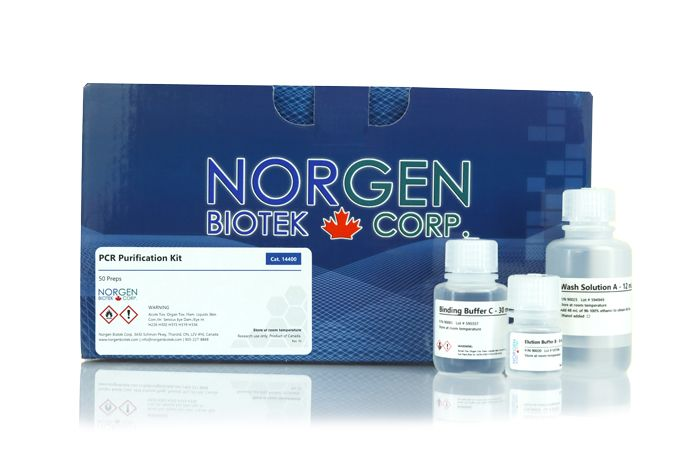
Purify amplified DNA ranging from 100 bp -15,000 bp in size
Fast and efficient spin column format
Available in a 50 prep size and a 250 prep size
Also available in 96 well format
This kit enables the rapid purification of amplified DNA products from PCR mixes. It is able to effectively remove PCR by-products including primers, dimers, enzymes, unincorporated nucleotides and mineral oil from the desired PCR product. The purified PCR products are fully compatible with restriction enzyme digestion, ligation into vectors, labeling, sequencing and more. This kit can also be used as an alternative to organic extraction and ethanol precipitation to clean up various enzymatic reactions.
The kit is also available in a 96-well format for high-throughput PCR purification. Purification with the 96-well plate can be performed using either a vacuum manifold or centrifugation.
Storage Conditions and Product Stability All solutions should be kept tightly sealed and stored at room temperature. This kit is stable for 1 year after the date of shipment.
Gel images of different ranges of library size selection. Sheared human genomic DNA was used as input.
.
Library size selection is an enrichment of a specific range of library sizes for NGS library preparations. The NGS library preparation is related to the quality of the sequencing data. Precise NGS library size selection can increase sequencing efficiency, improve data quality, and reduce costs.
There are two types of sequencing technologies: short-read sequencing and long-read sequencing. Short-read sequencing uses DNA libraries that contain small insert DNA fragments of similar sizes, usually several hundred base pairs. The sequencing efficiency can be improved if the DNA size selection is in the right range. Cat.# 20104S and 20104L are the best kits for NGS library size selection of illumina paired-end 100 (PE100) sequencing with 100-200 bp library inserts; Cat.# 20105S and 20105L are the best kits for NGS library size selection of illumina paired-end 150 (PE150) sequencing with 150-300 bp library inserts; and Cat.# 20106S and 20106L are the best kits for NGS library size selection of illumina paired-end 300 (PE300) sequencing with 300-600 bp library inserts.
Long-read sequencing uses a large DNA fragment as input and makes very long reads. Usually, library size selection is preferred to remove smaller fragments. Cat.# 20110S and 20110L are the best kits for long-read sequencing size selection with DNA sizes >5 kb, and Cat.# 20111S and 20111L are the best kits for long-read sequencing size selection with DNA sizes >10 kb.
The magnetic beads, or SPRI (Solid Phase Reversible Immobilization) beads, is well used for the purification of DNA due to their reversible DNA binding. The NGS library can be size-selected by the magnetic beads or SPRI beads. The properties of the magnetic beads can be changed for a specific range of DNA binding. The contaminants and other unwanted components in the libraries can also be removed during size selection.
Specific ranges of NGS libraries can be selected using magnetic beads with different buffer compositions. The first DNA-beads binding step, also called the right-side clean-up, removes large NGS library fragments. The large NGS library fragments that bind to the beads are discarded with the beads pellet. The desired NGS library fragments in the supernatant are transferred to a new well, and new beads are added to the supernatant for the second beads-DNA binding, also called the left-side clean-up. After the rinsing step, the NGS library fragments with the dual selection are eluted in water or an appropriate buffer. The magnetic beads method has great advantages over time-consuming column purification and tedious gel-based purification.
NGS library size selection with dual clean-ups.
.
Library size selection for long-read sequencing only requires a single clean-up. In this case, only the large library fragments are bound to the beads, while other small library fragments are discarded with the supernatant. The selected larger library fragments are eluted in water or an appropriate buffer after the rinsing step.
NGS library size selection with single clean-up for >5 kb and >10 kb libraries.
The BK virus is a member of the polyomavirus family. BK viral infections are typically asymptomatic in healthy individuals, however very mild symptoms may appear including mild respiratory infections and fever. Once an individual has been infected the virus disseminates to the kidneys and the urinary tract where it remains for the lifetime of the individual. Infections with BK virus in immunocompromised or immunosupressed patients are much more severe and may involve renal dysfunction. In fact, in kidney transplant patients the immunosupressive drugs required for the transplant may allow the virus to replicate within the graft, resulting in a disease called BK virus nephropathy (BKVN). It is thought that 1-10% of renal transplant patients progress to BK virus nephropathy (BKVN) and up to 80% of these patients are reported to have lost their grafts. The onset of nephritis can occur as early as several days post-transplant to as late as 5 years. The mode of transmission of the virus is not clear, however it has been suggested that BKV may be transmitted through respiratory fluids or urine, since infected individuals periodically excrete virus in the urine. This virus can be diagnosed by BKV blood & urine testing, in addition to carrying out a biopsy in the kidneys. PCR techniques are now widely used to identify the virus.
BKV TaqMan PCR Kit, 100 reactions
Ready to use format, including Master Mix for the target and PCR control to monitor for PCR inhibition and validate the quality
Specific Primer and Probe mix for the pathogen/virus/viroid of interest
Primer and Probe mix
Positive and negative control to confirm the integrity of the kit reagents
BKV TaqMan PCR Probe/Primer Set and Controls, 100 reactions
Specific Primer/Probe mix and Positive Control for the pathogen/virus/viroid of interest
Nuclease-free water
Can be used together with Norgen’s PCR Master Mix (#28007) or customer supplied master mix
For research use only and NOT intended for in vitro diagnostics.
Storage Conditions and Product Stability All kit components can be stored for 2 years after the date of production without showing any reduction in performance.
All kit components should be stored at -20°C upon arrival.