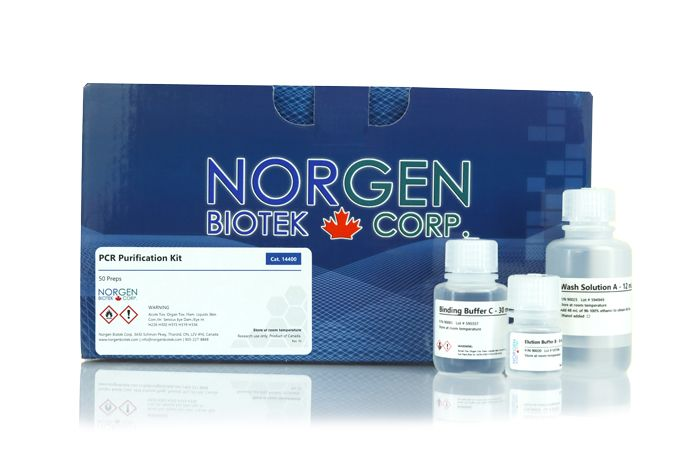
Purify amplified DNA ranging from 100 bp -15,000 bp in size
Fast and efficient spin column format
Available in a 50 prep size and a 250 prep size
Also available in 96 well format
This kit enables the rapid purification of amplified DNA products from PCR mixes. It is able to effectively remove PCR by-products including primers, dimers, enzymes, unincorporated nucleotides and mineral oil from the desired PCR product. The purified PCR products are fully compatible with restriction enzyme digestion, ligation into vectors, labeling, sequencing and more. This kit can also be used as an alternative to organic extraction and ethanol precipitation to clean up various enzymatic reactions.
The kit is also available in a 96-well format for high-throughput PCR purification. Purification with the 96-well plate can be performed using either a vacuum manifold or centrifugation.
Storage Conditions and Product Stability All solutions should be kept tightly sealed and stored at room temperature. This kit is stable for 1 year after the date of shipment.
Component
Cat. 14400 (50 preps)
Cat. 45700 (250 preps)
Cat. 24800 (192 preps)
Binding Buffer C
30 mL
5 x 30 mL
3 x 30 mL
Wash Solution A
12 mL
2 x 20 mL
2 x 38 mL
Elution Buffer B
8 mL
2 x 30 mL
2 x 15 mL
Spin Columns
50
250
–
Collection Tubes
50
250
–
96-Well Plate
–
–
2
Adhesive Tape
–
–
4
96-Well Collection Plate
–
–
2
Elution Tubes (1.7 mL)
50
250
–
96-Well Elution Plate
–
–
2
Product Insert
1
1
2
Other Products
DNA Isothermal Rapid Amplification Kit (Colloidal Gold Test Strip Type)
Product Info
Document
Product Info
Product Details
Application:
DNA Nucleic Acid
Format:
NFO Kit
Kit Components:
Reagents,Buffer,Enzymes
Manufacturer:
Amp-future Bio
Product Name:
DNA Isothermal Rapid Amplification Kit (Colloidal Gold Test Strip Type)
Reaction Time:
5-20mins
Reaction Volume:
50μL
Sensitivity:
500-1000copies/ml
Shelf Life:
14 Months
Specificity:
High
Storage Conditions:
-20℃
Suitability:
Universal
High Light:
Isothermal DNA Amplification Kit
,
DNA Amplification Kit NFO
,
20mins nucleic acid amplification
Payment & Shipping Terms
Minimum Order Quantity
48T
Price
USD$3.8/T
Packaging Details
16T/Bag,48T/Box
Delivery Time
6 working days
Payment Terms
T/T, MoneyGram
Supply Ability
100000T/Month
Product Description
DNA Isothermal Rapid Amplification Kit (Colloidal Gold Test Strip Type)
【Principle Overview】
This kit is based on a rapid nucleic acid amplification technology at room temperature and constant temperature: at room temperature and constant temperature (generally 39℃~42℃), with the help of auxiliary proteins and single-strand binding proteins, the recombinase and primers form a complex; Source search and combine the target homology domain, at this time, a D-loop region is formed at the homology position and strand exchange begins; along with the dissociation of the recombinase from the complex, the polymerase also binds to the 3′ end of the primer and begins chain extension. Relying on the action of nfo enzyme, adding specific molecular probes designed according to the template, and using colloidal gold technology (sandwich method) can detect the final result.
【Primer design】
It is recommended to use primers with a length of 30-35 bp.Too short primers will affect the amplification speed and detection sensitivity;the 5′ end of the reverse primer is labeled with a modification group (commonly used biotin).
Primers are designed to avoid the formation of secondary structures that affect amplification; the length of the amplicon is recommended to be 150-500bp.
【Colloidal gold probe design】
In the middle of the forward and reverse primer,design a sequence of 46-52nt in length that is complementary to the target fragment; modify an antigen marker (typical FAM) at the 5′ end;mark a dSpacer (tetrahydrofuran, THF) in the middle of the 5′ end and the 3′ end ), as the recognition site of nfo;the 3′ end is labeled with a modification group, such as amine group, phosphate group or C3-Spacer, etc.
【Features】
This kit has the advantages of high sensitivity, strong specificity,and short reaction time (only 15 minutes),and the reaction components are in dry powder state,which is easy to operate and easy to store.
This reagent has low equipment requirement,and the reaction operation can be carried out in metal baths, water baths, etc.,and there is no need to purchase expensive exclusive equipment such as PCR amplifiers.
Composition
Content
A buffer
1.6mL×1Tube
B buffer
150μL×1Tube
Positive control template-II
100μL×1Tube
Positive control probe and primer mix-II
70μL×1Tube
Reagent
48 T
Guide Manual
1 Copy
【Kit storage】
1. Storage conditions: storage temperature ≤ -20℃constant temperature environment, keep away from light and avoid heavy pressure;
2. Product validity period: 14 months;
3. See the outer packaging for the production date.
Document
This kit is based on a rapid nucleic acid amplification technology at room temperature and constant temperature: at room temperature and constant temperature (generally 39℃~42℃), with the help of auxiliary proteins and single-strand binding proteins, the recombinase and primers form a complex; Source search and combine the target homology domain, at this time, a D-loop region is formed at the homology position and strand exchange begins; along with the dissociation of the recombinase from the complex, the polymerase also binds to the 3′ end of the primer and begins chain extension. Relying on the action of nfo enzyme, adding specific molecular probes designed according to the template, and using colloidal gold technology (sandwich method) can detect the final result.
DDL5 Low Speed 5000RPM Swing out rotor 4x800ml Refrigerated Centrifuge Adapters for 5/7/10/15/50ml tubes.
DDL5 Refrigerated Centrifuge Application:
DDL5 Refrigerated centrifuge widely used in the field of blood bank station, pharmaceutical factory and laboratory, can hold 500ml triple, 400ml triple and 250ml triple blood bags.
DDL5 Refrigerated Centrifuge Features:
1. Brushless frequency motor which in great torque, free maintenance, no powder pollution, quick in speed up and down.
2. Digital display which indicates the program, speed, time, RCF and temperature.
3. Micro computer control, there are 10 kinds of program and 10 kinds of acceleration/deceleration for your choice.
4. There are 6 kinds of rotors for your choice.
5. Electric lid lock, compact design, super speed and imbalance protection.
6. The centrifuge body is made of high-quality steel, safe and reliable.