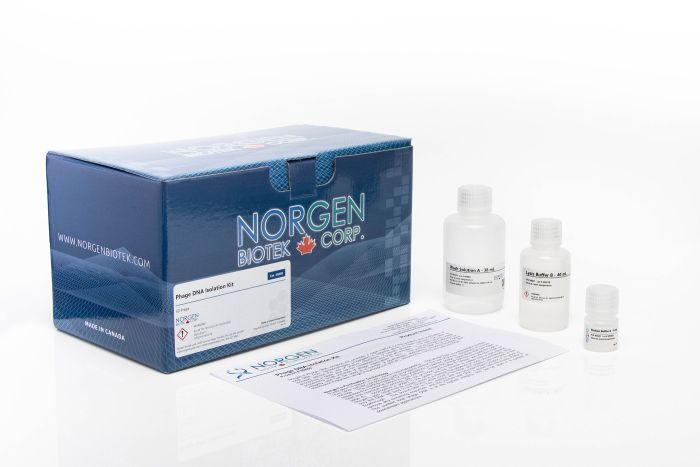
Isolate high quality DNA from a broad variety of phage strains
High yields of total DNA
Fast and easy processing using a rapid spin-column format
No phenol or chloroform extractions or cesium chloride banding required
High yields of DNA recovered3-15 µg DNA from 106-1010 pfu/ mL of enriched phages
This kit provides a rapid spin column method for the purification of total DNA from a broad spectrum of bacteriophages propagated in bacteria grown in liquid cultures. The DNA is isolated without the use of phenol, chloroform or cesium chloride banding procedures. The spin-column based procedure is rapid and can be completed in less than 45 minutes. The kit is highly efficient for processing small volumes of phage supernatant (500 µL – 1 mL) and with the optional DNase and Proteinase K treatments phage DNA yields are maximized while host DNA contamination is minimized. Purified total phage DNA is of the highest integrity, and can be used in a number of downstream applications including PCR, qPCR, Restriction Fragment Length Polymorphism (RFLP), sequencing, cloning, Southern Blot and more.
3-15 µg DNA from 106-1010 pfu/mL of enriched phages
Time to Complete 10 Purifications
45 minutes
* Average yields will vary depending upon a number conditions used and developmental stage.
Storage Conditions and Product Stability All solutions should be kept tightly sealed and stored at room temperature. This kit is stable for 1 year after the date of shipment.
Component
Cat. 46800 (50 preps)
Cat. 46850 (100 preps)
Lysis Buffer B
40 mL
2 x 40 mL
Wash Solution A
38 mL
2 x 38 mL
Elution Buffer B
8 mL
2 x 8 mL
Spin Columns
50
100
Collection Tubes
50
100
Elution Tubes (1.7 mL)
50
100
Product Insert
1
1
Other Products
C13110 HiPure DNA Mini Column II
Product Info
Document
Product Info
Introduction
Magen’s HiPure columns are prepared by high quality glass fiber filter membrane as raw materials through membrane cutting, membrane release, ring release, ring pressing, gland, weighing and other processes. HiPure nucleic acid adsorption columns have the characteristics of long-term stability and high binding capacity. Experiments show that the highest binding capacity and binding efficiency of HiPure nucleic acid adsorption columns are basically unchanged when stored at room temperature for 4 years.
The series of nucleic acid columns produced by Magen Biotech are based on carefully selected imported glass fiber membranes (GF/B, GF/D, GF/F). Columns production processes such as polypropylene injection molding materials, injection molding process, and downstream membrane packing and compression rings are strictly controlled. This is to ensure that the column has extremely high adsorption capacity and long-term stability. Compared with conventional products on the market, Magen’s columns are with varieties, and binding rate will not change when stored at room temperature for 4 years.
Details
Specifications
Features
Specifications
Recommended application
Plasmid Mini Preparation,gDNA/ RNA Extraction, DNA/RNA Clean Up
Preservation conditions
Room temperature
Stability
Up to 4 years
Filter membrane
High quality glass fiber filter GF/B, 4 layers
Membrane aperture
1.0μm
Maximum binding yield of plasmid
35 μg
Maximum yield of alcohol mediated Binding
200 μg
Single liquid carrying capacity of column
800 μl
Minimum elution volume
50 μl
Withstand centrifugal force
16,000 x g
Centrifuge
Small high speed centrifuge (2ml)
Adsorption Mechanism
Based on the negatively charged DNA skeleton, it has a high affinity for positively charged glass fibers. In high salt and ethanol solutions, DNA/RNA binds to glass fiber and interacts with hydrophilic matrix on silica through hydrogen bond. DNA/RNA is tightly bound. All pollutants can be removed by washing solution. At high salt concentration, nucleic acids selectively bind to silicagel membrane, while other pollutants, mainly proteins, are removed by membrane washing.
Ordering information
CAT.No.
Product Name
Package
C13110
HiPure DNA Mini Column II (4 x GF/B)with 2ml Collection Tubes
1000/Bag
Purchase Guide
Item No.
Product Name
Membrane type/number of layers
Collection tubes
Plasmid DNA binding capacity (Physical adsorption)
Note: GF/B pore size is for 1.0μM glass fiber membrane; GF/F pore size is for 0.7μm glass fiber membrane.
Document
Magen’s HiPure columns are prepared by high quality glass fiber filter membrane as raw materials through membrane cutting, membrane release, ring release, ring pressing, gland, weighing and other processes. HiPure nucleic acid adsorption columns have the characteristics of long-term stability and high binding capacity. Experiments show that the highest binding capacity and binding efficiency of HiPure nucleic acid adsorption columns are basically unchanged when stored at room temperature for 4 years.
141.6 mL of prepared reagent (e.g. 456 assays of 0.31 mL)
Content:
141.6 mL of prepared reagent (e.g. 456 assays of 0.31 mL)
Shipping Temperature:
Ambient
Storage Temperature:
Short term stability: 2-8oC, Long term stability: See individual component labels
Stability:
> 2 years under recommended storage conditions
Analyte:
Acetic Acid
Assay Format:
Auto-analyser
Detection Method:
Absorbance
Wavelength (nm):
340
Signal Response:
Increase
Linear Range:
up to 30 μg/mL of acetic acid per assay
Limit of Detection:
10 mg/L (recommended assay format)
Reaction Time (min):
~ 15 min
Application examples:
Wine, beer, fruit and fruit juices, soft drinks, vinegar, vegetables, pickles, dairy products (e.g. cheese), meat, fish, bread, bakery products (and baking agents), ketchup, soy sauce, mayonnaise, dressings, paper (and cardboard), tea, pharmaceuticals (e.g. infusion solutions), feed and other materials (e.g. biological cultures, samples, etc.).
Method recognition:
Methods based on this principle have been accepted by EN, ISO, ICUMSA, IFU and MEBAK
The Acetic Acid analyser format test kit is suitable for the specific measurement and analysis of acetic acid (acetate) in beverages and food products.
See more of our acetic acid and organic acid test kits.
Advantages
No wasted ACS solution (stable suspension supplied)
PVP incorporated to prevent tannin inhibition
Very stable reagent when prepared for auto-analyser applications (> 3 days at 4oC)
Linear calibration up to 30 μg/mL of acetic acid in final reaction solution
Validated by the University of Wine, Suze la Rousse, France
Very competitive price (cost per mL of reagent)
All reagents stable for > 2 years after preparation
Document
The Acetic Acid analyser format test kit is suitable for the specific measurement and analysis of acetic acid (acetate) in beverages and food products.
Isolate all sizes of circulating and exosomal RNA, including microRNA
Versatile plasma/serum input ranges
No phenol extractions
No carrier RNA
Bind and elute all RNA irrespective of size or GC content, without bias
Concentrate circulating RNA and exosomal RNA into a flexible elution volume
High quality, purified RNA is suitable for a variety of downstream applications, including Small RNA Sequencing. Find out more information on Norgen’s NGS services
Compatible with Streck Cell-Free RNA BCT® Tubes
Purification is based on spin column chromatography that uses Norgen’s proprietary resin separation matrix
These kits provide a fast, reliable and convenient method to purify and concentrate high quality, high purity and inhibitor-free cell-free circulating and exosomal RNA using a convenient spin column method. These kits can purify RNA from fresh or frozen serum or plasma samples prepared from blood collected on either EDTA or Citrate. Plasma samples prepared from blood collected on heparin should not be used, as heparin can significantly interfere with many downstream applications such as RT-PCR. The purified plasma/serum RNA is fully compatible with all downstream applications including PCR, qPCR, methylation-sensitive reverse transcription qPCR, reverse transcription PCR, Northern blotting, RNase protection and primer extension, expression array assays, and NGS.
Background
Plasma/Serum cell-free circulating RNA or exosomal RNA has the potential to provide biomarkers for certain cancers and disease states. Exosomes are 40 – 150 nm membrane vesicles, which are secreted by most cell types. Exosomes can be found in saliva, blood, urine, amniotic fluid and malignant ascitic fluids, among other biological fluids. Evidence has been accumulating recently that these vesicles act as cellular messengers, conveying information to distant cells and tissues within the body. These exosomes may play a functional role in mediating adaptive immune responses to infectious agents and tumours, tissue repair, neural communication and transfer of pathogenic proteins. For this reason exosomal RNAs may serve as biomarkers for various diseases including cancer. As the RNA molecules encapsulated within exosomes are protected from degradation by RNAses they can be efficiently recovered from biological fluids, such as plasma or serum.
Plasma/Serum RNA Purification Mini Kit
This kit can purify RNA from fresh or frozen serum or plasma samples prepared from blood collected on either EDTA or Citrate, from volumes ranging from 50 µL to 200 µL. The purified plasma/serum RNA is eluted in a flexible final volume of 10 µL to 25 µL.
Plasma/Serum RNA Purification Midi Kit
This utilizes a two column method, and can purify RNA from fresh or frozen serum or plasma samples prepared from blood collected on either EDTA or Citrate, from volumes ranging from 250 µL to 1.5 mL. The first column will handle the large volume input of bodily fluids that is followed by a concentration on a mini column for a final elution of 50 µL to 100 µL.
Plasma/Serum RNA Purification Maxi Kit
This kit can purify RNA from fresh or frozen serum or plasma samples prepared from blood collected on either EDTA or Citrate, from volumes ranging from 2 mL to 5 mL. The first column will handle the large volume input of bodily fluids that is followed by a concentration on a mini column for a final elution of 50 µL to 100 µL.
*This kit is suitable for the isolation of RNA from fresh or frozen serum or plasma prepared from blood collected on either EDTA or Citrate. Plasma samples prepared from blood collected on heparin should not be used as heparin can significantly interfere with many downstream applications such as RT-PCR.
**Please check page 7 for Average Plasma/Serum Yields and Common RNA Quantification Methods.
Storage Conditions and Product Stability
All solutions should be kept tightly sealed and stored at room temperature. This kit is stable for 2 years after the date of shipment. It is recommended to warm Lysis Buffer A for 20 minutes at 60°C if any salt precipitation is observed.