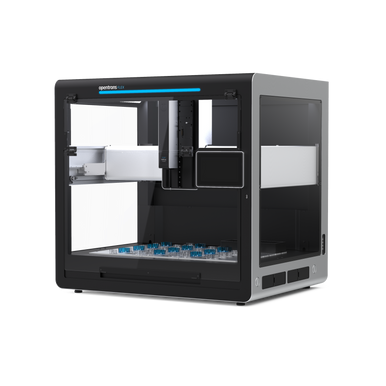
Flex Prep offers an affordable entry point into automation, combining easy-to-install hardware with an intuitive walk-up-and-operate interface
Flex Prep empowers users to start with semi-automated, routine pipetting and seamlessly scale up to full automation as their needs grow. Compatible with additional Opentrons Flex Pipettes and Modules for scaling up to full automation.
Prices listed here are valid in the US and select other territories. Please get in touch with your local team for pricing for your territory.
Detail
Flex Prep offers an affordable entry point into automation, combining easy-to-install hardware with an intuitive walk-up-and-operate interface
Flex Prep empowers users to start with semi-automated, routine pipetting and seamlessly scale up to full automation as their needs grow. Compatible with additional Opentrons Flex Pipettes and Modules for scaling up to full automation.
Prices listed here are valid in the US and select other territories. Please get in touch with your local team for pricing for your territory.
Other Products
D3141 HiPure Stool DNA Kit
Product Info
Document
Product Info
Introduction
With the development of molecular biology, stool, a new non-invasive sample, has been widely used in the research of animal molecular genetics, population ecology, behavioral ecology and some intestinal disease diagnosis. Stool samples includes gut microbial DNA, food residue sample DNA, and alimentary tract exfoliated cell DNA.
The primary problem encountered when using stool sample for molecular biology research is the low content of exfoliated cells in the digestive tract and a certain degree of degradation of genetic material in stool. Another issue in molecular scatology research based on PCR is the presence of a large number of inhibitors in stool that can affect Taq enzyme activity, leading to downstream detection inactivation. These inhibitors include polysaccharides, plant polysaccharides, bile acids, bile salts, bile pigments, digestive juices, mucus, etc. Therefore, selecting appropriate extraction methods to obtain high-quality DNA is the key to successful downstream detection of stool DNA.
At present, the pretreatment methods used in the laboratory, such as phenol/chloroform extraction, cetyltrimethyl bromide (CTAB) lysis, and guanidine isothiocyanate lysis, lack universality in different species, and the success rate of extracting DNA for PCR amplification is also very low. The HiPure Stool DNA Kit provided by Magen Company has opened up a new approach for DNA extraction from stool samples with good universality, high cost-effectiveness, high yield and purification. The reagent kit adopts a unique solution system and inhibitory factor adsorbent, which can efficiently remove various impurities in stool samples. The purified DNA can be directly used for PCR, quantitative PCR and other applications.
This product allows rapid and reliable isolation of high-quality genomic DNA from various stool samples. Up to 100 mg soil samples can be processed in 60 minute. The system combines the reversible nucleic acid binding properties of HiPure matrix with the speed and versatility of spin column technology to eliminate PCR inhibiting compounds such as humic acid from soil samples. Purified DNA is suitable for PCR, restriction digestion, and next-generation sequencing. There are no organic extractions thus reducing plastic waste and hands-on time to allow multiple samples to be processed in parallel.
Details
Specifications
Features
Specifications
Main Functions
Isolation total DNA from 50-100mg stool samples
Applications
PCR, Southern Blot, enzyme digestion and NGS, etc.
Purification method
Mini spin column
Purification technology
Silica technology
Process method
Manual (centrifugation or vacuum)
Sample type
Stool
Sample amount
50-100mg
Yield
3-15μg
Elution volume
≥30μl
Time per run
≤60 minutes
Liquid carrying volume per column
750μl
Binding yield of column
100μg
Principle
Stool sample is homogenized and then treated in a specially formulated buffer containing detergent to lyse bacteria, yeast, and fungal samples. Humic acid, proteins, polysaccharides, and other contaminants are removed using our proprietary Absorber Solution. Binding conditions are then adjusted and the sample is applied to a DNA Mini Column. Two rapid wash steps remove trace contaminants and pure DNA is eluted in low ionic strength buffer. Purified DNA can be directly used in downstream applications without the need for further purification.
Advantages
High purity – unique adsorbent can completely remove inhibitory factors
High concentration – maximum extraction of total DNA from stool samples
High recovery – DNA can be recovered at the level of PG
Good repeatability – silica technology can obtain ideal results every time
Kit Contents
Contents
D314102
D314103
Purification Times
50 Preps
250 Preps
HiPure DNA Mini Columns II
50
250
2ml Collection Tubes
50
250
2ml Bead Tubes
50
250
Proteinase K
24 mg
120 mg
Protease Dissolve Buffer
1.8 ml
10 ml
Buffer SPL
40 ml
200 ml
Buffer PCI
40 ml
200 ml
Buffer AL
20 ml
80 ml
Buffer GW1
22 ml
88 ml
Buffer GW2
20 ml
2 x 50 ml
Buffer AE
15 ml
30 ml
Storage and Stability
Proteinase K and Buffer PCI should be stored at 2-8°C upon arrival. However, short-term storage (up to 12 weeks) at room temperature (15-25°C) does not affect their performance. The remaining kit components can be stored at room temperature (15-25°C) and are stable for at least 18 months under these conditions. The entire kit can be stored at 2–8°C, but in this case buffers should be redissolved before use. Make sure that all buffers are at room temperature when used.
Document
With the development of molecular biology, stool, a new non-invasive sample, has been widely used in the research of animal molecular genetics, population ecology, behavioral ecology and some intestinal disease diagnosis. Stool samples includes gut microbial DNA, food residue sample DNA, and alimentary tract exfoliated cell DNA.
The primary problem encountered when using stool sample for molecular biology research is the low content of exfoliated cells in the digestive tract and a certain degree of degradation of genetic material in stool. Another issue in molecular scatology research based on PCR is the presence of a large number of inhibitors in stool that can affect Taq enzyme activity, leading to downstream detection inactivation. These inhibitors include polysaccharides, plant polysaccharides, bile acids, bile salts, bile pigments, digestive juices, mucus, etc. Therefore, selecting appropriate extraction methods to obtain high-quality DNA is the key to successful downstream detection of stool DNA.
At present, the pretreatment methods used in the laboratory, such as phenol/chloroform extraction, cetyltrimethyl bromide (CTAB) lysis, and guanidine isothiocyanate lysis, lack universality in different species, and the success rate of extracting DNA for PCR amplification is also very low. The HiPure Stool DNA Kit provided by Magen Company has opened up a new approach for DNA extraction from stool samples with good universality, high cost-effectiveness, high yield and purification. The reagent kit adopts a unique solution system and inhibitory factor adsorbent, which can efficiently remove various impurities in stool samples. The purified DNA can be directly used for PCR, quantitative PCR and other applications.
This product allows rapid and reliable isolation of high-quality genomic DNA from various stool samples. Up to 100 mg soil samples can be processed in 60 minute. The system combines the reversible nucleic acid binding properties of HiPure matrix with the speed and versatility of spin column technology to eliminate PCR inhibiting compounds such as humic acid from soil samples. Purified DNA is suitable for PCR, restriction digestion, and next-generation sequencing. There are no organic extractions thus reducing plastic waste and hands-on time to allow multiple samples to be processed in parallel.
Nucleic acid testing (NAT) is the method of choice for detection and quantification of a wide range of micro organisms. Primerdesign manufactures and supplies high quality quantitative real-time PCR kits for the detection and simultaneous quantification of numerous significant pathogens . A copy number standard curve is provided for quantification and an the internal extraction template (DNA or RNA), controls for the quality of the nucleic acid extraction and eliminates false negative results.
The kit is designed with the broadest possible detection profile to ensure that all clinically relevant strains and subtypes are detected. Target sequences are selected by working with data from key opinion leaders in the field. Multiple sequence alignments and unprecedented real-time PCR expertise in design and validation ensure the best possible kit.
Details of the target and priming specificity are included in the individual handbooks above.
Packaged, optimised and ready to use. Expect Better Data.
Document
Exceptional value for money Rapid detection of all clinically relevant subtypes Positive copy number standard curve for quantification Highly specific detection profile High priming efficiency Broad dynamic detection range (>6 logs) Sensitive to < 100 copies of target
Accurate controls to confirm findings
Short term stability: 2-8oC, Long term stability: See individual component labels
Stability:
> 2 years under recommended storage conditions
Analyte:
Glucuronoyl Esterase
Assay Format:
Spectrophotometer, Auto-analyser
Detection Method:
Absorbance
Wavelength (nm):
400
Signal Response:
Increase
Reproducibility (%):
~ 3%
Total Assay Time:
10 min
Application examples:
Fermentation broths, industrial enzyme preparations and biofuels research.
Method recognition:
Novel method
The Glucuronoyl Esterase Assay Kit provides a simple robust method for the measurement of glucuronoyl esterase. The assay kit employs a novel colourimetric reagent, termed GEUX3 that is highly specific for glucuronoyl esterase.