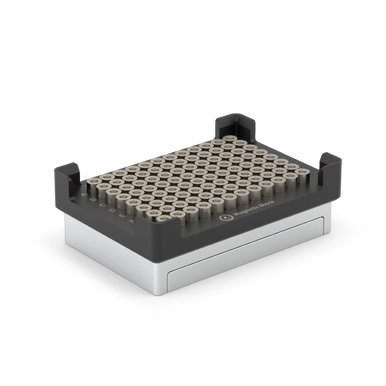
Opentrons Flex Magnetic Block (GEN 1) is a 96-well magnetic well plate holder containing static ring magnets, specifically designed for use with the Flex Robot. Use it with the Flex Gripper and skirted 96-well PCR or deep-well plates to facilitate quick and efficient separation using magnetic beads. This module is not compatible with the OT-2.
Detail
Opentrons Flex Magnetic Block (GEN 1) is a 96-well magnetic well plate holder containing static ring magnets, specifically designed for use with the Flex Robot. Use it with the Flex Gripper and skirted 96-well PCR or deep-well plates to facilitate quick and efficient separation using magnetic beads. This module is not compatible with the OT-2.
Other Products
[NS1001] FluoroVue™ Nucleic Acid Gel Stain (10,000X), 500 μl x 5
Product Info
Document
Product Info
Description
FluoroVue™ Nucleic Acid Gel Stain (10,000X) is specially designed for in-gel use and is a safer replacement for conventional Ethidium bromide (EtBr), which poses a significant health and safety hazard to its users. It is a fluorescent stain which offers highly sensitive detection of double-stranded or single-stranded DNA and RNA in a convenient manner. FluoroVue™ Nucleic Acid Gel Stain offers high sensitivity that is several times greater than EtBr.
FluoroVue™ Nucleic Acid Gel Stain is compatible with both conventional UV gel-illumination systems as well as harmless long wavelength blue light illumination systems, like B-BOX™. When bound to nucleic acids, FluoroVue™ Nucleic Acid Gel Stain has a fluorescent excitation maximum of 250 and 482 nm, and an emission maximum of 509 nm. Therefore, it can replace EtBr without the need of changing existing lab imaging systems.
Features:
Excellent for in-gel staining
Sensitivity: 0.14 ng (DNA) or 1 ng (total RNA)
A safer alternative to EtBr
Compatibility: suitable to blue or UV light
Increased cloning efficiency (blue light)
Storage
Protected from light 4°C for 12 months -20°C for 24 months
Document
FluoroVue™ Nucleic Acid Gel Stain (10,000X) is specially designed for in-gel use and is a safer replacement for conventional Ethidium bromide (EtBr), which poses a significant health and safety hazard to its users. It is a fluorescent stain which offers highly sensitive detection of double-stranded or single-stranded DNA and RNA in a convenient manner. FluoroVue™ Nucleic Acid Gel Stain offers high sensitivity that is several times greater than EtBr.
FluoroVue™ Nucleic Acid Gel Stain is compatible with both conventional UV gel-illumination systems as well as harmless long wavelength blue light illumination systems, like B-BOX™. When bound to nucleic acids, FluoroVue™ Nucleic Acid Gel Stain has a fluorescent excitation maximum of 250 and 482 nm, and an emission maximum of 509 nm. Therefore, it can replace EtBr without the need of changing existing lab imaging systems.
CP0101J Triple Wrapped Irradiated Plate-Nutrient Agar
Product Info
Document
Product Info
Introduction
Usages: For monitoring and detection of surface of equipment and personnel hygiene.
Advantage: 1.This series of products was filling at A level of environment, and final sterilization by Gamma ray irradiation, triple packaging insure sterility and long shelf life. 2.Each dish was marking label product name, batch number, expiration date .Information is available of traceability. 3.Inner additional desiccant, reducing formation of condensation water, while inner additional sterile paper and plastic bags for easier transfer and cultivation. 4.Triple packing dense bags to avoid the penetration of hydrogen peroxide; clean gas was filled as a buffer to reduce broken bags and dish in transit.. 5.This series of products is available to store at (2-25 ℃), shelf life of up to 6 months.
Storage: Store in a cool (2-25 ℃), dry place, away from bright light. Storage period of 6 months.