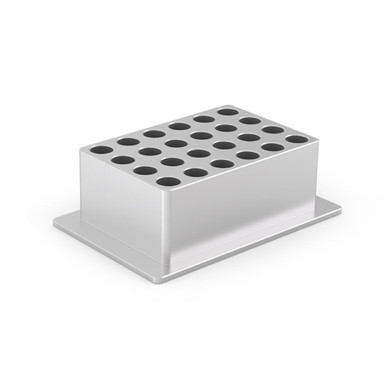
The Opentrons® 3-piece Aluminum Block Set is used with our Temperature Deck. The set comes with a 24-well, 96-well and flat bottom plate format block. These are used to keep your 2mL tubes, 1.5mL tubes, 96-well PCR plates, PCR strips and flat bottom plates at a constant temperature. These blocks holds temperatures between 4°C and 95°C when used with the Opentrons Temperature Module (GEN2).
Detail
The Opentrons® 3-piece Aluminum Block Set is used with our Temperature Deck. The set comes with a 24-well, 96-well and flat bottom plate format block. These are used to keep your 2mL tubes, 1.5mL tubes, 96-well PCR plates, PCR strips and flat bottom plates at a constant temperature. These blocks holds temperatures between 4°C and 95°C when used with the Opentrons Temperature Module (GEN2).
Other Products
Tri(propargyl-NHCO-ethyloxyethyl)amine
Product Info
Document
Product Info
Tri(propargyl-NHCO-ethyloxyethyl)amine is a crosslinker that can react with azide compounds or biomolecules via copper catalyzed Click Chemistry to form a stable triazole linkage. Reagent grade, for research purpose. Please contact us for GMP-grade inquiries.
Document
Tri(propargyl-NHCO-ethyloxyethyl)amine is a crosslinker that can react with azide compounds or biomolecules via copper catalyzed Click Chemistry to form a stable triazole linkage. Reagent grade, for research purpose. Please contact us for GMP-grade inquiries.
Organophosphate compounds (OP) account for the largest class of rural and urban poisons in the world that are used to kill pests but can also be toxic to humans. OPs cause toxicity by means of blocking the acetylcholinesterase enzyme (AchE). The AChE-directed OPs react with a serine residue that is located at the catalytic site found within the AChE gorge. The OP targeted enzyme is no longer able to hydrolyze ACh, resulting in the buildup of ACh in the nerve synapse. This effect causes excessive excitation of the nerves, producing uncoordinated movements, tremors, paralysis and death. Both synthetic and natural(Guanitoxin) organophosphates are dangerous to humans — exposure can lead to visual, coordination, muscular, and neurological deficiencies, and in some cases even to death. In turn, exposure to OP is a significant public health concern which would significantly benefit from an improved detection platform.
Attogene’s Organophosphate detection kit is in designed specifically to detect Organophosphate in liquid samples. For solid samples a simple sample preparation method is performed. The ability to detect Organophosphate is performed is simple and sensitive. The reaction uses a chromophore that can be detected by eye. In the presence of Organophosphate, the rate of chromophore production is reduced in a concentration dependent fashion. The higher the concentration of Organophosphate the less color is produced.
Document
Attogene’s Organophosphate detection kit is in designed specifically to detect Organophosphate in liquid samples.