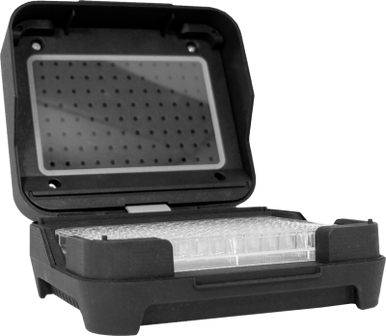
Cerillo’s Stratus Plate Reader is a third party module that can be placed next to or inside the OT-2 or Opentrons Flex for post experimental analysis. The worktable adapter will allow you to utuilize the OT-2 or Opentrons Flex to prepare the samples directly into the plate reader positions on the worktable.
This small portable device is primarily for microbial growth curve analysis. The Stratus is compatible with Cerillo’s Canopy wireless device that allows real time visualization, control, and analytics. This product is compatible with reading 600nm wavelengths.
Detail
Cerillo’s Stratus Plate Reader is a third party module that can be placed next to or inside the OT-2 or Opentrons Flex for post experimental analysis. The worktable adapter will allow you to utuilize the OT-2 or Opentrons Flex to prepare the samples directly into the plate reader positions on the worktable.
This small portable device is primarily for microbial growth curve analysis. The Stratus is compatible with Cerillo’s Canopy wireless device that allows real time visualization, control, and analytics. This product is compatible with reading 600nm wavelengths.
Short term stability: 2-8oC, Long term stability: See individual component labels
Stability:
> 2 years under recommended storage conditions
Analyte:
Ethanol
Assay Format:
Spectrophotometer, Microplate, Auto-analyser
Detection Method:
Absorbance
Wavelength (nm):
340
Signal Response:
Increase
Linear Range:
0.25 to 12 µg of ethanol per assay
Limit of Detection:
0.093 mg/L
Reaction Time (min):
~ 5 min
Application examples:
Wine, beer, cider, alcoholic fruit juices, spirits, liqueurs, low-alcoholic / non-alcoholic beverages, pickles, fruit and fruit juice, chocolate products, vinegar, jam, bread and bakery products, honey, soy sauce, dairy products, cosmetics, pharmaceuticals and other materials (e.g. biological cultures, samples, etc.).
Method recognition:
Methods based on this principle have been accepted by AOAC (AOAC Method 2019.08, First Action), IFU, EBC Method 9.3.1, MEBAK and ASBC Method Beer 4-F
The Ethanol test kit is a simple, reliable and accurate method for the measurement and analysis of ethanol in beverages and foodstuffs.
Note for Content: The number of manual tests per kit can be doubled if all volumes are halved. This can be readily accommodated using the MegaQuantTM Wave Spectrophotometer (D-MQWAVE).
Solid Phase Adsorption Toxin Tracking (SPATT) is a biomimetic in-situ water monitoring tool that falls under an expanding umbrella of passive samplers. It serves to warn researchers of toxin-producing harmful algal bloom (HAB) developments early on. It has been popularized through its affordability, ease of use, and its ability to capture ephemeral events in marine, brackish, and freshwater environments. Its uptake of contaminants has been shown to be more similar than other sampling methods to that of aquatic species like bivalves, mussels, and clams. It provides an average bioavailable fraction of a toxin over deployment time that can be used to determine an overall toxin risk to organisms. The sampling period typically depends on the bioactivity at a site, ranging from 24 hours to 4 weeks in most cases.
A SPATT passively absorbs and desorbs extracellular compounds over its stretch of time at a sampling site; in an organism, a toxin would go through biochemical detoxification processes. Passive samplers have a higher sensitivity for more compounds and provide improved stability and preservation of these compounds within the resin. SPATT devices capture less commonly detected cyanotoxins (e.g. cylindrospermopsin) at lower concentrations than that of a grab sample (collected at one point in time). Grab samples are limited in scope and sensitivity, and underrepresent toxins like microcystin-LR, which is picked up very reliably through SPATT technology.
Uses HP20 that is widely applicable for many toxins.
Used to capture:
Cyanotoxin (e.g. microcystin and cylindrospermopsin)
Saxitoxin & derivatives (GNTXs, C-toxins), and other paralytic shellfish toxins (PSTs)
For plate-based colorimetric enzymatic determination of alkaline phosphatase:
Distributed in almost every tissue of the body, serum alkaline phosphatase (ALP) levels are of interest in the testing for hepatobiliary disorder and bone disease. Most of the ALP in the normal adult serum is from the liver or biliary tract. Normal alkaline phosphatase levels are age-dependent and are elevated during periods of active bone growth. Moderate elevations of ALP (not involving the liver or bone) may be attributed to Hodgkin’s disease, congestive heart failure, and abdominal bacterial infections.
Alkaline phosphatase (ALP) catalyzes the hydrolysis of phosphate esters in an alkaline environment, resulting in the formation of an organic radical and inorganic phosphate. In mammals, this enzyme is found mainly in the liver and bones. Marked increase in serum ALP levels, a disease known as hyperalkalinephosphatasemia, has been associated with malignant biliary obstruction, primary biliary cirrhosis, primary sclerosing cholangitis, hepatic lymphoma, and sarcoidosis.
The kit contains sufficient materials to rapidly test 42 samples in duplicate.
Document
Highly Sensitive, rapid, robust screening kit for sample phosphatase activity.